A dehumidifier can only ever be part of the solution: first investigate the source of the moisture, ventilation and any problems with the glazing, and keep ventilating. If the living room is still too humid afterwards, choose a model based on the floor area and temperature. In a shared space, also consider noise, electricity consumption and how the water is drained.
Who is this advice for?
Residents who want to find the cause of condensation first
You’ve noticed wet windows and want to check whether moisture sources, ventilation or a cold window surface need attention before buying anything. Milieu Centraal and the Consumers' Association point out that damp problems can have several different causes.
Residents with a persistently damp living room
You’ve investigated the causes and want to match the capacity to the measured floor area and temperature. The Consumers' Association stresses that a stated maximum capacity does not automatically reflect what a model will achieve in your room.
Housemates who want to enjoy a peaceful living room
You want to dehumidify the room while others are talking, reading or watching television, so you’re factoring in the noise level during operation. The Consumers' Association notes that dehumidifiers make some noise.
What should you look for when choosing?
Milieu Centraal recommends ventilation to bring fresh air in and remove stale air. The Consumers' Association advises tackling damp at its source and matching capacity to the room and temperature.
| Buying concern |
What should you look for? |
Who is this important for? |
| Tackling the cause |
Check for sources of moisture and assess the ventilation. Also consider whether a cold window surface is contributing to the problem. |
As a consumer, I want to know whether an appliance is the right solution before buying one; around 25% of consumers say finding the cause is their top priority. |
| Capacity for the room |
Measure the floor area and temperature. The Consumers' Association gives 12–16 l/24 h for 20–30 m² and 20–30 l/24 h for 30–45 m² as rules of thumb, not guaranteed output figures. |
For consumers looking to dehumidify a persistently damp living room, capacity is crucial; around 25% put this need first. |
| Noise when sharing the space |
Compare the noise level at the fan setting you actually plan to use; a claim such as ‘quiet’ doesn’t tell you everything about the experience. |
If housemates talk, read or watch television in the living room, audible noise matters; around 20% of consumers put it at the top of their list. |
| Electricity consumption |
Only compare 24-hour measurements if the temperature and humidity are the same, and take the operating mode into account too. |
For consumers who plan to use the appliance regularly, electricity consumption is a major consideration; around 15% put running costs first. |
| Draining the water |
Check the tank capacity and full-tank indicator, and confirm whether the exact model has a continuous-drain connection. |
As a consumer, I don’t want to keep emptying the water tank in a shared living room; around 15% put easy water management first. |
Common buying mistakes
-
Thinking a dehumidifier can replace ventilation or repairs
Sources of moisture, poor ventilation and structural problems may each need a different solution. An appliance won’t remove polluted indoor air or fix a leak.
Investigate the cause first and keep bringing in fresh air. If the problem persists, work on the property itself may also be needed.
If the cause isn’t dealt with, the damp problem may continue and still require work on the property.
-
Assuming the daily capacity figure is a guaranteed output
Actual dehumidification depends on factors such as temperature and humidity. In a cold room, a different type of model may be more suitable too.
Measure the floor area and room temperature, then compare capacities on the same stated or measured basis.
-
Choosing a small Peltier dehumidifier for the whole living room
The Consumers' Association describes Peltier models as having limited capacity and says they’re intended for small spaces, such as a cupboard.
Give the size of the area to be dehumidified more weight than a compact design or a general claim about quiet operation.
-
Confusing tank capacity, daily capacity and drainage
The tank stores water; l/24 h measures the stated dehumidification capacity. These are two different figures.
Check both figures and confirm whether the exact model has a drain connection and whether there’s a suitable route to a drain.
Without a suitable drain, you may need to empty the tank by hand more often.
Brands and models to compare
Auronic
The Compact Series 12L AU1003505 is a 12-litre model to compare for a medium-sized room.
- Auronic lists an adjustable humidity setting, timer and 2-litre tank; the stated capacity is 12 l/day.
- The capacity and noise claims are manufacturer specifications, not independently verified performance figures for your living room. Check the exact version.
Eurom
The DryBest 20 is a 20-litre model to compare for a larger room.
- According to Eurom, this model has a 5-litre tank, a humidistat and the option of continuous drainage.
- The stated capacity and noise level are manufacturer specifications. Don’t assume this is the same model as the separately listed ‘DryBest 20 2026’ without evidence that they are identical.
Meaco
The MeacoDry Arete One 20L is a 20-litre model worth considering if you’re also looking for an included HEPA filter.
- The Dutch product page lists a HEPA H13 filter and an optional version with a pump.
- Consider drying performance and noise in your own situation; claims about quiet operation, energy use and suitable floor area come from the retailer.
Qlima
The D 820 A SMART is a 20-litre model with Wi-Fi control, for anyone who wants to use that feature.
- Qlima lists a 3.8-litre tank, built-in hygrometer, timer and HEPA filter.
- According to Qlima, D 6xx and D 8xx compressor models work best from 18 °C and may temporarily defrost at lower temperatures. So don’t treat 20 l/24 h as guaranteed output in a cool living room.
Dehumidifiers on Joybuy
These models are designed for condensation or compressor dehumidification in living rooms. Compare the stated capacity with the measured room and check how the water is collected or drained.
 No image available
ELECCI 12L/D with drain hose
An option to compare for a room where the stated capacity and drainage method are suitable.
Stated capacity: 12 l/day; tank: 3.8 l; automatic defrost; 24-hour timer; continuous drainage; suitable for 25 m² according to the product name.
View on Joybuy
 No image available
VINO 12L Smart
A 12-litre model to compare for a living room where Wi-Fi control and a timer would be useful.
Stated capacity: 12 l/day; tank: 1.8 l; Wi-Fi control; 24-hour timer; three modes (Auto/Dry/Sleep); suitable for 24 m² according to the product name.
The product name states 32 dB; this isn’t an independent noise measurement.
View on Joybuy
 No image available
VINO 20L Smart
A model with a stated capacity of 20 l/day to compare for a larger living room; check how the specification compares with the conditions in your room.
Tank: 2.5 l; Wi-Fi control; three modes (Auto/Dry/Sleep); suitable for up to 40 m² according to the product name; the product description mentions hose drainage or using the tank.
The product description states 35 dB in sleep mode; this isn’t an independent noise measurement.
View on Joybuy
 No image available
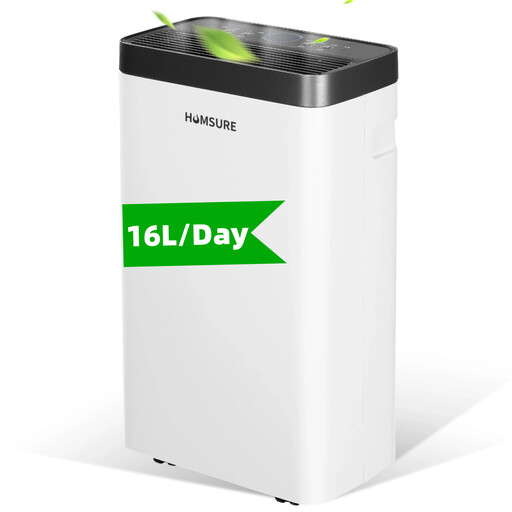
HUMSURE 16L/Day
A model to compare if the stated capacity and recommended room size suit your needs.
Stated capacity: 16 l/day; tank: 1.4 l; 24-hour timer; automatic defrost and shut-off; three modes; suitable for 25 m² according to the product name. The product name also mentions a drain hose.
View on Joybuy
 No image available
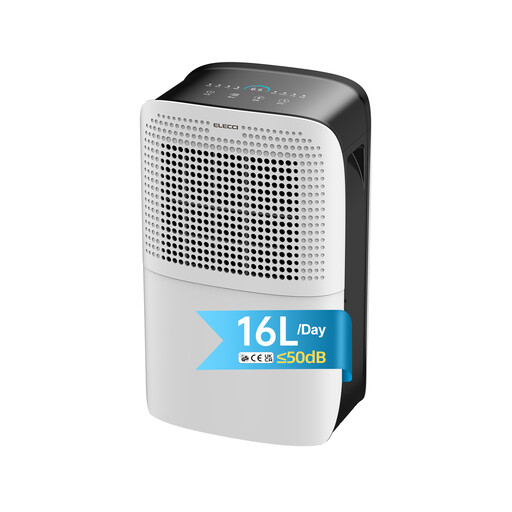
ELECCI 16L/D with drain hose
Compare the stated capacity with the Consumers' Association rule of thumb: it recommends 20–30 l/24 h for 30–45 m², compared with the 16 l/day in the product name.
Tank: 3.1 l; four modes; continuous drainage; automatic defrost; 24-hour timer; suitable for 32 m² according to the product name.
View on Joybuy
Frequently asked questions
Should you stop ventilating when the dehumidifier is on?
No. A dehumidifier doesn’t replace ventilation. Milieu Centraal explains that ventilation brings in fresh air and removes stale indoor air, so keep the air circulating.
How do you choose the right capacity for a living room?
First measure the floor area and temperature. The Consumers' Association gives 12–16 l/24 h as a rule of thumb for 20–30 m² and 20–30 l/24 h for 30–45 m². Actual dehumidification also depends on the conditions.
What should you look for in the water tank and a drain hose?
Empty the tank when it’s full and check the care instructions for the exact model. Before using a drain hose, confirm that the appliance has a connection for one and that there’s a suitable route to a drain at your chosen location.
What can you do if a dehumidifier bought in the Netherlands turns out to be faulty?
According to the Dutch government, the seller must offer a solution. The Netherlands has no fixed statutory warranty period of two years; what you can reasonably expect from a product depends, among other things, on the product and the information provided.
Is a CE marking required for a dehumidifier?
That depends on the rules that apply to the exact appliance. The European Commission states that the Low Voltage Directive covers, among other things, electrical equipment within 50–1000 V AC. A CE marking is the manufacturer's declaration that the appliance complies with applicable rules; it isn’t an independent test result for dehumidification performance.


