
Vandaag of morgen in huis

Kwaliteit gegarandeerd

Welkomstaanbiedingen ontgrendelen: GRATIS bezorging | Tot 80% korting | Gratis 30 dagen JoyPlus-proefperiode
Download de app
Condensation on the windows, a musty smell in the bedroom or laundry that stays damp indoors for days: a dehumidifier can be useful in situations like these. However, not every model is suitable for every room. A compact appliance may work well in a bathroom but lack the capacity for a cellar or open-plan living room.
Be wary of marketing claims, too. A higher number of litres per day does not automatically mean an appliance will work faster in your home. Capacity is often measured in warm, very humid conditions. Dutch homes are usually cooler, with ventilation that varies from room to room.
A model rated at 20 litres per day sounds powerful, but always check the test conditions. The stated capacity may, for example, apply at 30 °C and 80% relative humidity. At 18 °C, the actual output may be lower.
So, consider these points together:
An appliance with a 1,4 or 1,8-litre tank may need emptying regularly, especially in a damp cellar or when drying laundry. A continuous drain with a hose is often more convenient. Check whether the hose is included and whether water can flow to a drain without the hose kinking.
The appliance should switch off automatically when the tank is full. This prevents it from overflowing while you are out.
A quiet dehumidifier still makes some noise from its fan and compressor. A stated noise level of 32 or 35 dB usually applies in sleep mode, while the noise level may be higher in normal mode. For a bedroom dehumidifier, display lights, automatic restart and compressor interruptions are also worth considering.
For a bedroom, bathroom or small flat, a model rated at around 8 to 12 litres per day is often a sensible choice. For a larger living room, cellar or utility room, you could look at models rated at 16 to 20 litres per day. Use the stated room size as a guide, and take open doors, high ceilings and cold external walls into account.
A dehumidifier for large rooms needs more than a high capacity: it also needs to move enough air. A big number on the packaging tells you little without that context.
An adjustable relative humidity setting, for example between 40% and 60%, makes everyday use easier. The appliance can then switch itself on and off automatically when it reaches the set level. A dehumidifier with a timer is useful if you only want to run it during the day or while doing the laundry.
The humidity reading can vary from one spot to another. So, don’t place the appliance right next to a window, radiator or air vent.
Compare the power consumption in watts with how long you expect to use the appliance. An energy-efficient dehumidifier is particularly useful if it runs for many hours each week. However, lower power consumption does not always mean the appliance removes moisture faster.
Many models in this category use R290 as a refrigerant. R290 is flammable, so follow the instructions, keep ventilation openings clear and leave work on the refrigerant circuit to a qualified professional. Only use a dehumidifier indoors, and never place it somewhere it could be directly exposed to splashing water.

Why it suits this household: According to the product description, this model is designed for rooms up to around 25 m². It offers a straightforward combination of automatic humidity control, a timer and a drain.
The included drain hose means you won’t need to empty the tank as often. According to the description, the appliance switches off automatically when the tank is full.
12 l/day under the stated test conditions, 3,8-litre tank, 24-hour timer and laundry-drying mode.
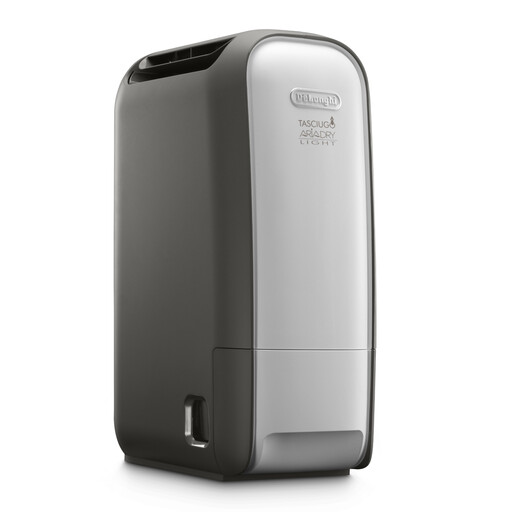
Why it suits this household: Its compact design, touch control panel and laundry-drying function are a good fit for households that value convenience and an established product range.
The product specifications list the tank capacity, noise level and features. This makes it easier to choose a model that suits a bedroom or utility room.
According to the product information: 7,5 l/day, 2,8-litre tank, 34 dB and three fan speeds.

Why it suits this household: According to the product information, this model is designed for rooms up to around 40 m². App control is handy if you want to manage humidity remotely.
The product specifications mention a sleep mode, automatic shut-off when the tank is full and two drainage options. Before buying, check the current noise rating: the description gives 35 dB in sleep mode, while the specifications list 40 dB(A).
20 l/day under the stated conditions, Wi-Fi control, 24-hour scheduling, laundry-drying mode and a 2,5-litre tank.

Why it suits this household: Sleep, laundry-drying and standard modes make this a good fit for households that use their appliance in different rooms, such as a bedroom, bathroom, living room or utility room.
Automatic shut-off when the tank is full and the included drain hose help prevent overflows and reduce the need for frequent manual emptying.
According to the product description: 16 l/day, suitable for around 32 m², 24-hour timer, wheels and a laundry-drying function.
We’ve put together a complete, up-to-date list of products that meet these strict selection criteria and the applicable European safety requirements.
A dehumidifier can help reduce moisture and condensation, but it is no substitute for ventilation, fixing leaks or addressing structural issues. If mould keeps coming back, it’s a good idea to have the cause of the damp investigated.
Yes, as long as the noise level and dimensions are suitable. Ideally, choose a model with sleep mode, a timer and automatic humidity control. Don’t place it right next to the bed, and keep the air vents clear.
It depends on the power consumption and how many hours it runs. A 200-watt appliance running for five hours uses 1 kWh in theory. In practice, this varies because the compressor can switch off automatically. So, compare the wattage, timer and humidity control rather than looking at capacity alone.
A dehumidifier for mould and condensation can reduce the amount of moisture in the air, but it can’t address every underlying cause. Poor ventilation, cold surfaces, leaks and cold bridges need to be dealt with separately. Use the appliance alongside ventilation and heating, not as a replacement for them.
