For a large living room that is usually heated, a compressor dehumidifier is a sensible starting point. In a room that stays cold for long periods, an adsorption dehumidifier may be a better fit, although the Consumentenbond says this type uses more electricity. First, tackle sources of moisture and ventilation issues. Then choose a model based on the room’s size and temperature, the conditions used to state its capacity, its noise level and how you’ll drain the water. A maximum capacity doesn’t guarantee the same performance at home.
Who is this advice for?
Anyone living with persistent damp in a large living room
Once you’ve tackled sources of moisture, you want to know whether a dehumidifier is suitable for your room’s size, temperature and conditions. The Consumentenbond lists room size and temperature as factors to consider when choosing a model.
Anyone looking for a quieter living room
You use the room to chat, watch television or relax, and want to take the noise from the fan and compressor into account. The Consumentenbond notes that dehumidifiers make noise.
Anyone using a dehumidifier every day
If you’ll be using your dehumidifier regularly, you’ll also want to consider its electricity use, automatic controls, tank capacity and whether it supports continuous drainage. The Consumentenbond includes electricity use and ease of use in its tests.
What should you look for when choosing?
Compressor
Suitable for: a living room that is usually heated, where you’ll use the dehumidifier regularly.
Bear in mind: according to the Consumentenbond, this type works best above 15 °C. The compressor and fan are audible, and you’ll need to keep an eye on the tank.
Adsorption
Suitable for: a living room that stays cool or unheated for long periods.
Bear in mind: according to the Consumentenbond, this type uses more electricity than a compressor model.
Peltier
Suitable for: small spaces, such as a cupboard or caravan, according to the Consumentenbond.
Bear in mind: its dehumidifying capacity is limited, so it’s not an obvious choice as the main solution for a large living room.
| What to consider |
What to look for |
Who should pay particular attention? |
| Capacity for your room |
Measure your living room and consider whether it opens onto other rooms. Compare the stated room coverage and litres per 24 hours with the specified temperature and relative humidity. |
I want a dehumidifier that suits the size and dampness of my living room, not just one with an impressive maximum claim. Capacity is the top priority for around 36% of consumers. |
| Noise in the living room |
Compare noise ratings for each setting and check whether there’s a quieter mode. Manufacturer ratings aren’t automatically comparable with one another or with real-world test results. |
I want to be able to chat or relax while the dehumidifier is running. For around 29% of consumers, noise is the main priority when choosing. |
| Electricity use and drainage |
Compare energy use under similar conditions. Also check the tank, the full-tank indicator and whether the model supports continuous drainage. |
If I use it regularly, I want to empty the water less often and know what electricity use to expect under the relevant conditions. Around 21% of consumers put these practical considerations first. |
| Use in a cool room |
Check how warm your living room usually is and confirm the operating temperature of the exact model before choosing a type. |
If my living room stays cool for long periods, I want to know whether the type I’ve chosen is suitable. This is the top priority for around 14% of consumers. |
Common buying mistakes
-
Assuming the maximum litres-per-day rating is what you’ll get at home
The amount of moisture a dehumidifier removes depends in part on the temperature and relative humidity. For example, the De'Longhi DDSX220’s stated 20 l/24 hours is based on 30 °C and 80% relative humidity.
Compare the test conditions with those in your living room and, where possible, use independent measurements taken on a like-for-like basis.
-
Using a dehumidifier instead of ventilation or repairs
Ventilation also removes polluted air. According to Milieu Centraal, recurring mould in several places may point to an underlying building issue.
Check your ventilation and sources of moisture. If mould appears in several places and you’re unsure of the cause, seek professional advice.
-
Looking only at the tank capacity
Tank capacity isn’t the same as dehumidifying performance. Continuous drainage is only useful if the exact model supports it and your set-up is suitable.
Check the tank, full-tank indicator, drainage option and positioning together.
An unsuitable drainage set-up or a tank that needs frequent emptying can cost you time.
Brands to compare
Meaco
The MeacoDry Arete One 20L is a compressor model worth comparing for a larger room.
- Meaco lists a HEPA H13 filter and coverage of up to 100 m², based on a ceiling height of 2.5 m.
- These are product and seller claims, not a guarantee of performance in every living room. Also check whether the version you choose has the optional built-in condensate pump.
De'Longhi
The Tasciugo AriaDry Multi DDSX220 is a compressor model with a humidistat, laundry function and provision for continuous drainage.
- De'Longhi specifies 20 l/24 hours for this model at 30 °C and 80% relative humidity.
- The manufacturer lists 42–47 dB(A) and an input power of 470 W. These model ratings don’t necessarily predict the performance or noise level in your living room.
Pro Breeze
The OmniDry 20L without the app is sold with a laundry mode and an option for continuous drainage.
- The manufacturer lists a 4 l tank.
- Check whether the stated maximum coverage of 30 m² and noise level of 36 dB are suitable for your living room. Also check the exact version: the product page says ‘Without App’, but also includes general references to app control.
Dehumidifiers on Joybuy
These dehumidifiers are worth comparing for a large living room. Always check the stated room coverage and capacity against your own conditions and the specified test conditions.
 No image available
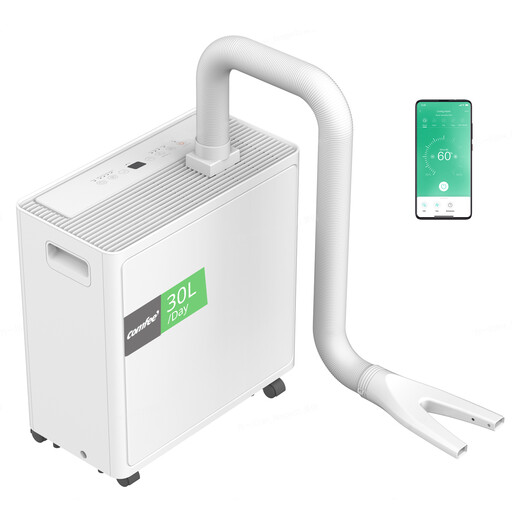
Comfee' MDDA-30DEN7-SD
Compare this model with your large room if the stated coverage matches your living room.
Stated specifications: up to 30 L per day at 30 °C and 80% relative humidity; approximately 73 m²; 3.2 L tank; app control and continuous drainage.
View on Joybuy
 No image available
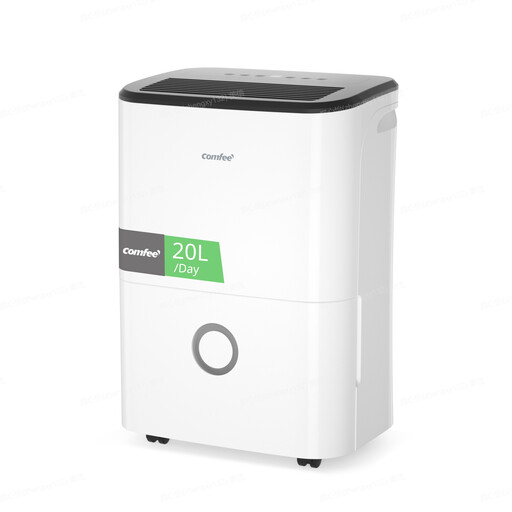
Comfee' MDDF-20DEN7
Compare this model with a living room that falls within its stated coverage range.
Stated specifications: up to 20 L per day; approximately 40 m²; 3 L tank; three modes and continuous drainage.
View on Joybuy
 No image available
VINO 20L Smart Dehumidifier
Before choosing this model, compare its stated coverage with the dimensions of your living room.
Stated specifications: up to 20 L per day at 30 °C and 80% relative humidity; up to 40 m²; 2.5 L tank; Wi-Fi control and three modes.
View on Joybuy
 No image available
CONOPU 16L Dehumidifier
An option to compare if you’re looking for a model with continuous drainage and a timer.
Stated specifications: 16 L per day; 2.5 L tank; continuous drainage and a 24-hour timer.
View on Joybuy
 No image available
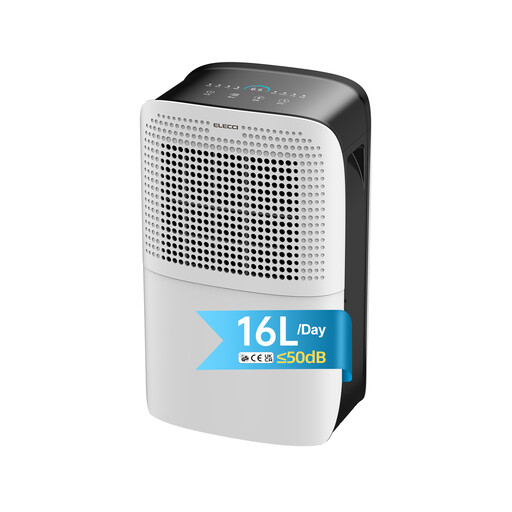
ELECCI 16L/D Dehumidifier
Compare this model with a living room that falls within its stated coverage range.
Stated specifications: 16 L per day; approximately 32 m²; 3.1 L tank; four modes, continuous drainage and a 24-hour timer.
View on Joybuy
Frequently asked questions
When is a dehumidifier useful?
First tackle issues such as poor ventilation, leaks or building problems. According to the Consumentenbond, a dehumidifier may help if relative humidity then remains consistently above 65%. Take measurements over time rather than basing your choice on a single damp spell.
Can I close the ventilation grilles once the dehumidifier is running?
No, a dehumidifier doesn’t replace ventilation in your home. The Dutch government recommends keeping your home adequately ventilated day and night, as ventilation removes polluted air. Also follow the instructions for the space around your dehumidifier.
Where should I put the dehumidifier, and how do I maintain it?
Don’t put the appliance in a corner or behind furniture where air circulation could be restricted. The Consumentenbond recommends cleaning the dust filter about once every two months, or more often with intensive use, and checking the air vents for dirt. Also follow the instructions for your chosen model.
What additional costs and rights should I consider after buying?
As well as electricity use, allow for possible filter replacements and a suitable drainage set-up; costs depend on the model and how you use it. According to the Dutch government, there’s no fixed statutory guarantee period in the Netherlands, but a product must be of satisfactory quality and the seller must offer a solution if a complaint is valid. For online purchases, you’ll usually have a 14-day cooling-off period from delivery, with some exceptions, according to ACM ConsuWijzer.
Does a dehumidifier in the Netherlands need a CE marking?
That depends on which rules apply to the specific product. The European Commission says that harmonised EU rules may require a CE marking for certain product groups; the manufacturer is responsible for meeting the relevant requirements and applying the marking. A CE logo on its own doesn’t prove that the dehumidifying performance has been independently tested.


