
Vandaag of morgen in huis

Kwaliteit gegarandeerd

Welkomstaanbiedingen ontgrendelen: GRATIS bezorging | Tot 80% korting | Gratis 30 dagen JoyPlus-proefperiode
Download de app
Condensation on the windows, a musty smell in the cellar or laundry that takes ages to dry indoors: a dehumidifier for your home can be a practical solution. But it’s not wise to rely on claims such as “powerful”, “quiet” or “suitable for large rooms” alone. The conditions under which capacity is measured, the noise level and how the water is drained matter far more than the marketing copy.
A dehumidifier rated at 12 L, 16 L or 20 L usually refers to the maximum amount of water it can remove per day. This figure is often measured at a high temperature and humidity level, for example 30 °C and 80% relative humidity. In a cooler Dutch bedroom or cellar, the actual output may be lower.
So use capacity as a point of comparison, not as a guaranteed daily output. Also check the recommended floor area and the temperatures at which the appliance can operate.
A 2.5 or 3.8-litre tank may seem generous, but it can still fill up regularly when there’s a lot of moisture in the air. Without an automatic shut-off, there’s also a risk of overflow. So check whether the appliance has a full-tank indicator and automatic shut-off.
For a cellar, utility room or holiday home, a dehumidifier with a drain hose is often more convenient. The condensation drains straight into a waste outlet. The hose must slope downwards all the way; otherwise, water could flow back into the appliance.
A quiet dehumidifier might be rated at 30 to 35 dB in sleep mode, while its noise level is higher on the normal setting. With compressor models, you may also hear the compressor start up or the refrigerant circulating. This doesn’t automatically mean there’s a fault.
So check the noise level for each mode. For a bedroom dehumidifier, sleep mode, dimmable lights and a timer are more useful than a general claim that it runs quietly.
Choose the capacity according to the room, moisture levels and how long you plan to use it:
The stated capacity depends on the test conditions. According to its product information, for example, VINO specifies 12 litres per day for rooms up to 24 m² and 20 litres per day for rooms up to 40 m². Always check the latest product specifications before ordering.
With automatic dehumidification, you set your preferred relative humidity. The sensor then switches the compressor on or off around that target level, so the appliance doesn’t keep running unnecessarily. A dehumidifier with a timer is useful if you only want to run it during the day, while doing the laundry or before bed.
A relative humidity setting of around 40–60% is often considered a practical range, but the right setting depends on the room and the season. A hygrometer in another corner of the room may also show a different reading because of air currents and temperature differences.
An electric compressor dehumidifier uses electricity to condense moisture. So compare the rated power in watts, automatic shut-off and running time. A lower wattage doesn’t automatically mean lower overall costs if the appliance needs to run for longer.
Many models in this selection use R290 as a refrigerant. R290 is flammable. Place the appliance on a stable surface, keep the air inlet and outlet clear, and follow the manufacturer’s safety instructions. Plug a compressor appliance directly into a suitable earthed socket, and don’t use an unsuitable multi-way adaptor or extension lead.

Why it suits this type of buyer: A straightforward model for smaller spaces of up to around 25 m², with dehumidifying, drying and fan modes.
The product information lists a drain hose, automatic shut-off when the tank is full and a 24-hour timer.
12L/day according to the product specifications, a hose for continuous drainage, automatic defrost and a laundry-drying function.

Why it suits this type of buyer: Designed for larger living spaces of up to around 40 m², and for anyone who values app control and remote scheduling.
The quoted 35 dB applies to sleep mode; the product specifications also list 40 dB(A). This makes it easier to compare like for like.
20L/day according to the product page, Wi-Fi control, a 2.5L transparent tank, child lock and two drainage options.
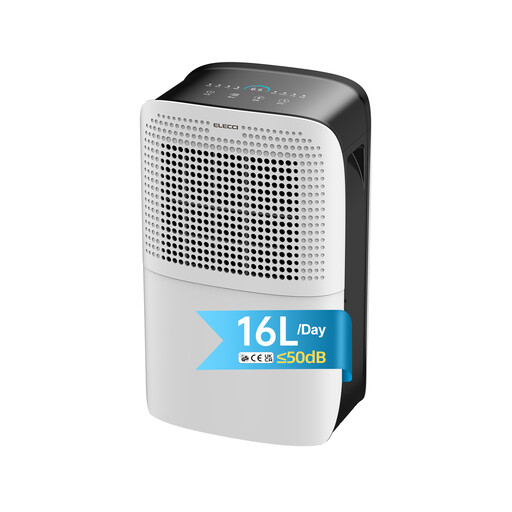
Why it suits this type of buyer: A handy choice for cellars, utility rooms, bathrooms, campervans and other spaces that need long periods of dehumidification.
A hose for continuous drainage means you won’t need to keep emptying the tank. Automatic shut-off is still important if the hose doesn’t slope down correctly.
16L/day under the stated test conditions, a 3.1L water tank, four modes, automatic humidity control and auto-defrost.
We’ve put together a complete, up-to-date list of products that meet these strict selection criteria and the applicable European safety regulations.
A portable air conditioner with a dehumidifying function is worth considering if you also want to cool your home in summer. The Humhold models combine cooling, fan and dehumidifying modes, and come with a window kit and drain hose. If you only need to tackle moisture, a separate electric dehumidifier is usually easier to set up: there’s no need to vent warm air through a window.
When choosing a portable air conditioner, check the noise level, window seal, weight and drainage in dehumidifying mode. An air conditioner’s stated dehumidification capacity isn’t directly comparable with that of a compressor dehumidifier.
Place the appliance upright on a flat, stable surface. Leave enough clear space around it as specified in the manual, don’t block the air inlet or outlet, and only connect a drain hose if it slopes gradually towards a waste outlet. After being transported or tilted, a compressor appliance often needs to stand upright for a while before use.
It depends on the power consumption and how many hours it runs. A 200-watt appliance running for five hours uses 1 kWh in theory. In automatic mode, consumption may be lower because the compressor switches off once the set humidity level is reached. Actual consumption varies according to the room, temperature and moisture levels.
Empty the tank in good time, clean the filter as instructed in the manual, and regularly check the hose and air vents. Switch off the appliance and unplug it before cleaning, moving or carrying out maintenance. A clean filter helps maintain airflow, but it’s no substitute for ventilation or fixing leaks and rising damp in the building.
