What should you consider when choosing?
First, work out whether the damp is confined to the wardrobe or whether the air in your home office also needs attention. Then consider the temperature, noise and any regular tasks involved.
Passive moisture absorber
Suitable when: you mainly need to tackle damp in a closed wardrobe and want a solution that doesn't use electricity.
Trade-off: you'll need to refill it and safely collect or empty the liquid. It won't tackle damp throughout a room.
Electric desiccant dehumidifier
Suitable when: the air in your home office is damp and the room is often cool or unheated.
Trade-off: according to the Dutch Consumers' Association, desiccant dehumidifiers use more electricity than condensation models. Also check the noise level, drainage options and the model's stated operating temperature.
Condensation dehumidifier
Suitable when: the whole room needs dehumidifying and usually stays above 15 °C.
Trade-off: performance falls at lower temperatures. Capacity figures are only comparable when the test conditions are the same.
| What to consider |
What to check before buying |
Who is this important for? |
| Wardrobe or whole room |
Measure the humidity in the room and check whether the wardrobe, wall or surrounding area is damp before choosing a solution. |
If I mainly want to protect the clothes I store, I need to know whether the damp is only in the wardrobe or also in the room. Around 36% of consumers prioritise protecting their clothes. |
| Performance in a cool room |
Measure the usual room temperature, including when the heating is off, and compare it with the operating range of the exact model. |
If my office often stays cool, I want a unit that can be used at that temperature. Around 29% of consumers prioritise suitability for a cool room. |
| Noise and positioning |
Compare the noise information for each setting and check how much clearance the unit needs. |
If I need to make calls or concentrate while dehumidifying, I want to know how noisy the chosen setting is. Around 21% of consumers prioritise being able to work from home without interruption. |
| Electricity, drainage and maintenance |
Check the stated power consumption, tank capacity, option for continuous drainage and maintenance requirements. |
If I use the unit regularly, I want to know in advance how much electricity it uses and how often I'll need to empty the water or maintain its parts. Around 14% of consumers prioritise low running and maintenance demands. |
Joybuy product picks
These product picks are suited to damp in a home office or wardrobe. For each model, check whether it's a room dehumidifier or a moisture absorber, and whether its stated operating conditions suit your space.
 No image available
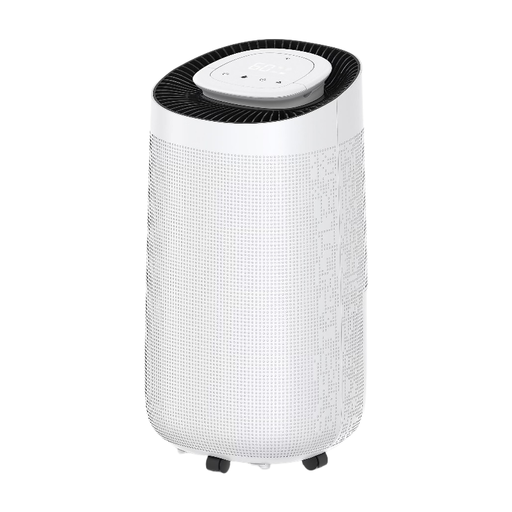
Komodo Humi+ dehumidifier, 16 L/day, 3.2 L tank
For anyone looking to tackle moisture in the room air; the listed features also include a laundry-drying mode.
The product name specifies a capacity of 16 L/day and a 3.2 L water tank.
Joybuy
 No image available
CONOPU 16L dehumidifier, 2.5 L tank
The listed features include dehumidification and a laundry-drying mode; check that these suit the way you plan to use it in your home office.
The product name specifies a 2.5 L tank, continuous drainage and a 24H timer.
Joybuy
 No image available
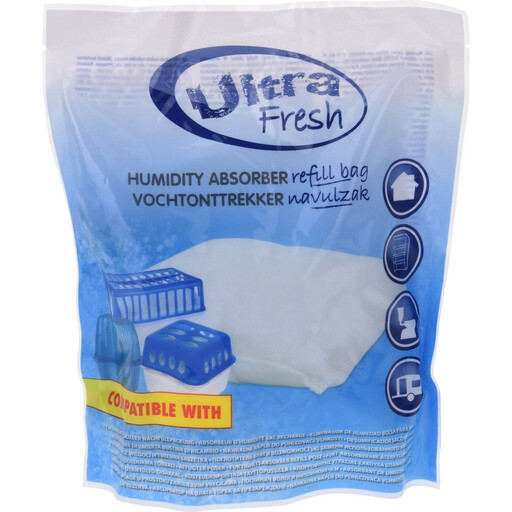
Ultra Fresh Moisture Stopper, 450 g
A moisture absorber to consider if you mainly want to tackle damp in an enclosed space; check the product instructions for the intended location.
The product name specifies a capacity of 450 g.
It needs refilling and the collected liquid needs emptying; spilt liquid can cause stains.
Joybuy
 No image available
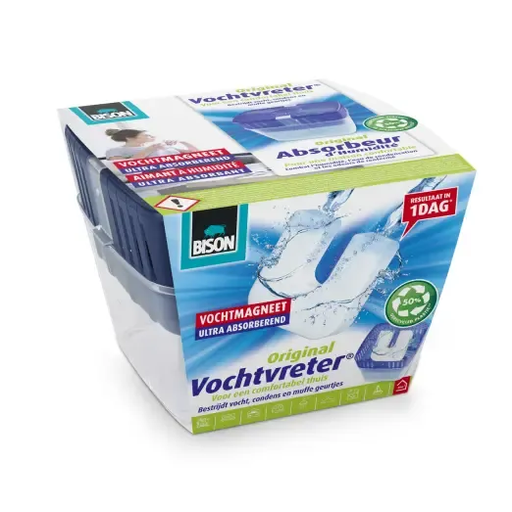
Bison Vochtvreter® Original, 450 g
The product name specifies a 450 g moisture absorber. Check the intended use and placement instructions before using it near clothes.
Joybuy
 No image available
TRULIVA AP10-2012EE dehumidifier, approx. 32 m²
For anyone looking to dehumidify the room air and considering a laundry-drying mode; check that the stated operating temperature suits your office.
The product name specifies a 24H timer and continuous drainage. The product description recommends using it between 5 °C and 35 °C; below 15 °C, frost may form and the compressor may stop.
Joybuy
Frequently asked questions
When won't a dehumidifier be enough to tackle damp around stored clothes?
If there's a leak, structural damp or poor ventilation, you'll also need to address the cause. The Dutch Consumers' Association suggests that a dehumidifier may help if humidity stays consistently above 65% after the causes have been addressed. For mould, the Dutch Municipal Health Service recommends removing it, reducing moisture, ventilating and heating. This is guidance to help you choose, not a legal humidity limit.
Can I put a dehumidifier in a closed wardrobe?
Distinguish between a passive moisture absorber and an electric room dehumidifier. Bison describes its passive Vochtvreter as suitable for places such as wardrobes and specifies that it should be placed on a flat, stable surface. For an electric model, follow its placement and airflow instructions.
What should I know about using a drain hose for long periods?
Check whether the model has a hose connection and whether the water can drain to a suitable outlet. For the DD 208, among other models, Qlima specifies that the hose must slope down properly and must not be kinked or bent; follow the instructions for the model you choose.
Is desiccant or condensation dehumidification better for a cool home office?
According to the Dutch Consumers' Association, desiccant dehumidification works well in cold or unheated rooms, but uses more electricity than condensation dehumidification. In a room that's usually heated, condensation may be worth comparing. Check the stated operating temperature and compare capacity figures only when the test conditions are suitable.
Does an electric dehumidifier need a CE mark?
The Netherlands Food and Consumer Product Safety Authority (NVWA) states that CE marking is mandatory for electrical consumer products. Check the product identity and relevant conformity information for the model on offer; this general requirement doesn't in itself confirm that a specific version complies. The rule doesn't automatically apply to a non-electric moisture absorber.


