First, deal with leaks, the causes of condensation and ventilation problems. If humidity around your clothes remains persistently high afterwards, a dehumidifier may help. For a cold or unheated conservatory, a desiccant dehumidifier is worth considering. A compressor dehumidifier is more suited to a warmer room and, according to the Consumentenbond, uses less electricity than a desiccant model. Also compare capacity under relevant conditions, and choose a tank or drainage option that suits how often you can check on the conservatory.
Who is this relevant to?
Storing clothes in a cold conservatory
If your conservatory is barely heated during the colder months, performance at low temperatures is an important factor when choosing a dehumidifier. The Consumentenbond says desiccant dehumidifiers are suitable for cold or unheated rooms.
Clothes storage with recurring condensation
If you keep seeing moisture around windows or stored items, first investigate the cause. Then consider whether you still need additional humidity control. Milieu Centraal points out that recurring mould can have an underlying cause.
Storage without daily checks
If you can’t empty a collection tank regularly, check when the appliance stops because the tank is full and whether you can connect a suitable drain hose.
Key buying considerations
Desiccant
Choose this option when: the conservatory is often cold or unheated while the appliance is in use, and humidity remains high after you’ve dealt with the cause.
Trade-off: the Consumentenbond says desiccant dehumidifiers work well in cold rooms, but use more electricity than compressor models.
Compressor or refrigerant
Choose this option when: the conservatory is generally warmer while the dehumidifier is running, and you want to compare capacity, humidity control and drainage.
Trade-off: performance drops at lower temperatures. Duux recommends 16–32 °C for the Bora’s best performance, with more frequent defrosting at 5–16 °C.
Small Peltier dehumidifier
Choose this option when: you only need to treat a small, specific area such as a cupboard, and the amount of moisture to remove is limited.
Trade-off: the Consumentenbond describes its capacity as limited, so it may not be suitable for an entire conservatory.
| What to consider |
What to look for when buying |
Who is this important for? |
| Performance on cold days |
Note the lowest operating temperature and check the range for the exact model. Compare capacity under the stated test conditions. |
If my conservatory stays cold in winter, I want to know whether the appliance can work at that temperature. For around 36% of consumers who store clothes in a conservatory, performance on cold days is the top priority. |
| Persistent damp around clothes |
First check for leaks and ventilation issues. Then measure humidity where the clothes are stored and compare the model’s controls and capacity. |
If damp keeps returning around my stored clothes, I want to address the cause and decide whether I still need a dehumidifier. Around 29% of consumers say reducing persistent damp is their top priority. |
| Running without supervision |
Check the tank capacity, whether the appliance stops when the tank is full, and whether a hose can be connected to the exact model. |
If I’m not there regularly to empty the tank, I want to know whether the appliance stops when it’s full and whether drainage is possible. For around 21% of consumers, being able to run the appliance without emptying the tank is the top priority. |
| Energy use and noise |
Compare energy figures on the same basis and check the noise level and which setting it applies to. |
If I also spend time in the conservatory, energy use and noise matter when the appliance is running for long periods. Around 14% of consumers name running costs or noise as their top buying priority. |
Pitfalls to watch out for
-
Assuming the maximum litres per day is what you’ll get in a cold conservatory
Capacity depends on temperature and humidity. A stated maximum under warm, humid conditions doesn’t necessarily tell you how much moisture the appliance will remove from your conservatory.
Check the test conditions and temperature range for the exact model before comparing capacities.
In different conditions, the actual amount of moisture removed may be lower than the stated figure, so the appliance may need to run for longer.
-
Using a dehumidifier instead of dealing with the source of the moisture
An appliance won’t fix a leak or ventilation problem. Recurring mould or damp may point to an underlying cause.
Investigate and deal with the cause first, then decide whether you still need additional dehumidification.
-
Forgetting that a full tank can interrupt operation
Models with a tank may stop when it’s full, so dehumidifying won’t continue until someone empties it.
Check whether the appliance stops when the tank is full and whether you can connect a hose to the model you’ve chosen in your intended location.
Brands to compare
Qlima
Qlima’s range includes the DD 808 desiccant model and the D 612, which is listed with a capacity of 12 l/24 hours and a hygrometer.
- Qlima describes the DD 808 as suitable for colder rooms.
- This claim applies to this model. Compare its energy use, and don’t assume all Qlima models use the same technology.
De’Longhi
The Tasciugo AriaDry DEX210SF is a compact compressor dehumidifier with a stated capacity of 10 l/24 hours at 30 °C and 80% relative humidity, plus an option for continuous drainage.
- The stated capacity and drainage option give you specific features to compare for this model.
- The stated daily capacity is measured in warm, humid conditions and doesn’t guarantee the same performance on cold days in a conservatory.
Duux
According to Duux, the Bora 20/30L Smart range combines compressor dehumidification with a humidistat, a tank and the option of hose drainage.
- Duux gives 16–32 °C as the Bora’s range for best performance.
- Duux says defrosting happens more often at 5–16 °C. Check the specifications for the 20L or 30L version you’re considering.
Meaco
The MeacoDry Arete One 20L is an example for larger rooms. An optional condensate pump is available for this model.
- The manufacturer lists a pump as an option to consider when comparing drainage methods.
- Meaco says moisture removal depends on temperature and humidity, and may be lower than the maximum stated figure. Check whether a pump is included with the version you choose.
Wood’s
Wood’s lists a tank and hose connection for the MDK11, positioning this model for small spaces such as bathrooms.
- A tank and hose connection are useful features to compare with other compact models.
- Its positioning for small spaces doesn’t show that the MDK11 is suitable for an entire, larger or cold conservatory.
Dehumidifiers at Joybuy
These dehumidifiers are options to compare for rooms where clothes are stored. If you’re using one in a conservatory, check its capacity and the conditions under which it’s specified, as well as its humidity control and how it drains water.
 No image available
ELECCI 12L/D dehumidifier
An option to consider if you want to compare adjustable humidity control and continuous drainage. Check that its operating temperature range suits your conservatory.
12 l/day; 3.8 l water tank; rooms up to 25 m²; automatic defrost; 24-hour timer; R290; automatic humidity control and continuous drainage via a hose. When using the tank, the appliance switches off when it’s full.
View at Joybuy
No image available
ELECCI 16L/D dehumidifier
An option to consider if you want to compare adjustable humidity settings and continuous drainage. Check the operating temperature for your conservatory.
16 l/day; 3.1 l water tank; rooms up to 32 m²; four modes; R290; automatic defrost; 24-hour timer; automatic humidity control and continuous drainage via a hose.
View at Joybuy
 No image available
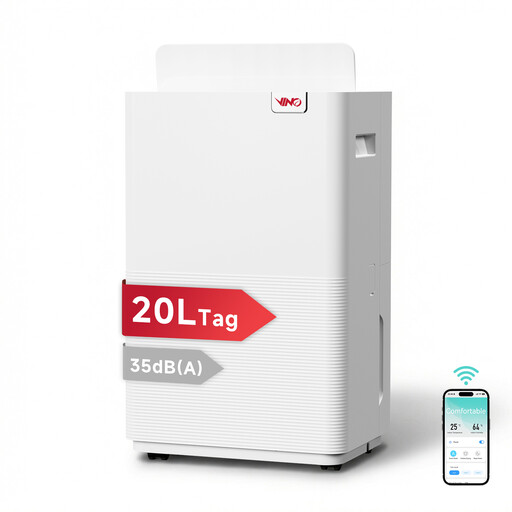
VINO 20L Smart dehumidifier
An option to consider if you want to compare automatic humidity control and drainage via a hose. Also check the stated temperature and capacity conditions.
20 l/24 hours at 30 °C and 80% relative humidity; stated operating temperature 5–32 °C; rooms up to 40 m²; 2.5 l water tank; Wi-Fi control; three modes: Auto, Dry and Sleep; automatic humidity control and continuous drainage via a hose.
View at Joybuy
 No image available
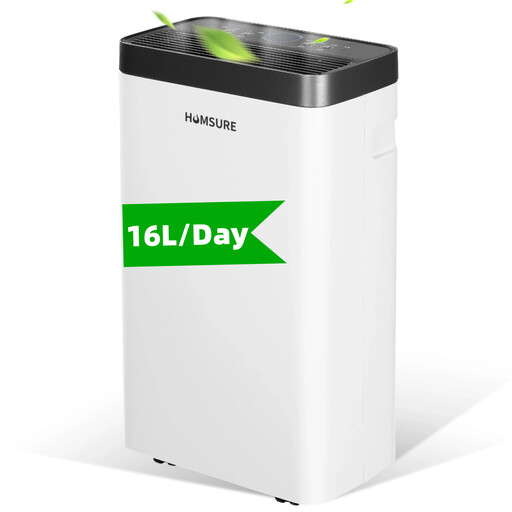
HUMSURE 16L/Day dehumidifier
An option to consider if you want to compare automatic humidity control and drainage via a hose. Check that its operating temperature suits your conservatory.
16 l/day; rooms up to 25 m²; 1.4 l water tank; R290; 24-hour timer; automatic defrost; three modes; automatic humidity control. When using the tank, the appliance switches off when it’s full; continuous drainage requires the hose to be connected.
View at Joybuy
 No image available
Comfee’ MDDO-10DEN7 dehumidifier
An option to consider if you want to compare adjustable humidity settings and a laundry-drying mode. Bear in mind that operation stops when the tank is full.
10 l/day; 2.5 l water tank; rooms up to approximately 40 m³ (16 m²); three modes; 24-hour timer; automatic defrost; child lock; R290. The appliance switches off automatically when the tank is full.
View at Joybuy
Frequently asked questions
Should I ventilate first or buy a dehumidifier straight away?
First check for leaks and ventilation problems. Consider a dehumidifier if humidity remains persistently high afterwards. The Consumentenbond suggests considering a dehumidifier when humidity is above 65%; this is buying advice, not a legal limit. The Dutch Government points out that opening a window from time to time is not an adequate substitute for ventilation.
Where should I put the appliance, and how do I maintain it?
Place the appliance with enough clear space around it for air to circulate, and don’t put it behind furniture. The Consumentenbond recommends cleaning the dust filter regularly, and more often if you use the appliance intensively. Also follow the instructions for the model you choose.
Can a dehumidifier with a tank keep running while I’m away for a while?
It depends on the full-tank shut-off and drainage options on the exact model. Check whether the appliance stops when the tank is full. For continuous operation, compare a suitable hose connection with the drainage available where you plan to place it.
What guarantee and cancellation period apply to online purchases in the Netherlands?
In the Netherlands, statutory guarantees apply, but there is no fixed statutory guarantee period; if a product is faulty, contact the seller. For most online consumer purchases, you have a 14-day cooling-off period from delivery, subject to applicable exceptions and conditions on return costs. The Dutch Government explains statutory guarantees, and Your Europe sets out the European cooling-off period.


