
Vandaag of morgen in huis

Kwaliteit gegarandeerd

Welkomstaanbiedingen ontgrendelen: GRATIS bezorging | Tot 80% korting | Gratis 30 dagen JoyPlus-proefperiode
Download de app
Condensation on windows, a musty smell in the bedroom or washing that stays damp for days: a dehumidifier can help reduce excess moisture in your home. But it’s not wise to judge a model by a big number on the box alone. Its capacity, noise level and water drainage options all affect how well it works in practice.
A model claiming to remove 16 litres a day won’t necessarily manage that in every living room in the UK. Stated capacity is often measured at a relatively high temperature and humidity level, for example 30 °C and 80 or 90% relative humidity. Output may be lower in a cooler room.
So don’t look at litres per day alone. Also consider:
A model that’s too small will need to run for longer. One that’s too large may use more electricity and take up more space.
A compact tank may seem convenient, but it can fill quickly when there’s a lot of moisture. Dehumidifiers generally switch off automatically when the tank is full. This prevents spills, but the appliance will stop removing moisture until you empty the tank.
For a cellar, utility room or home where you want to run the appliance for hours, a dehumidifier with continuous drainage is often more practical. Check that the hose can reach a suitable drain and that the drain point is lower than the appliance.
A compressor, fan and automatic defrosting will always make some noise. So a quiet dehumidifier is a relative term. Check the stated decibel level and whether it applies to sleep mode or normal operation.
For a bedroom, models with a sleep mode and a stated noise level of around 30 to 40 dB are worth considering. Also, don’t place the appliance right next to your bed, and keep the air inlet and outlet clear.
A model that removes around 8 to 12 litres a day may suit a bedroom, home office or small bathroom. For a larger living room, cellar or utility room, 16 to 30 litres a day may be more suitable. These figures still depend on the temperature, insulation, ventilation and source of the moisture.
A bedroom dehumidifier should be compact and relatively quiet. For a bathroom dehumidifier, it’s important to keep the appliance away from splashes. An electric dehumidifier should be placed somewhere dry and stable. Ventilation is still essential: an appliance is no substitute for air vents or mechanical ventilation.
Check:
A larger tank means less frequent emptying, but it also often makes the appliance heavier. Wheels and a handle are useful if you plan to move the model between the bedroom, bathroom and utility room.
A dehumidifier with a timer can be set to run only while you’re drying washing, for example, or at certain times of day. Automatic humidity control switches the appliance on or off around a set level. This can help avoid unnecessarily long running times, but electricity use depends on the power, how long you use it and the conditions in the room.
A laundry-drying function can help when drying washing indoors by removing moisture from the air. Ideally, put the washing in a smaller, enclosed room and make sure there’s enough air circulation. A portable air conditioner with a dehumidifying function is worth considering if you also need to cool the room. If you only need to control moisture, a standalone dehumidifier is usually easier to position.

Why it suits this type of buyer: According to the product information, this model is designed for rooms up to around 25 m² and has a timer, drying mode and hose for continuous drainage.
The 3.8-litre tank and continuous drainage mean less frequent emptying. The appliance switches off automatically when the tank is full.
12 litres a day under the stated test conditions, a 24-hour timer, drying mode and R290 refrigerant.
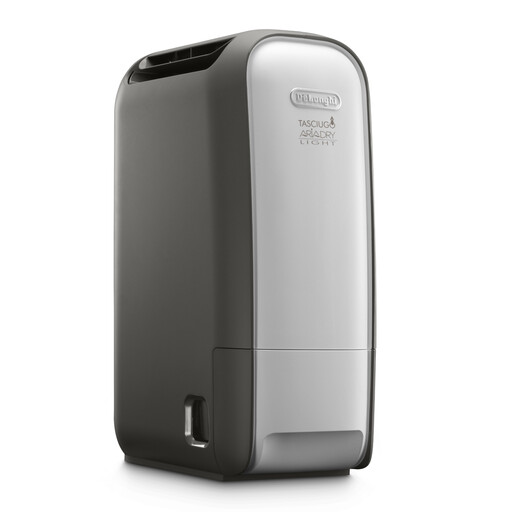
Why it suits this type of buyer: The product specifications list a capacity of 7.5 litres a day, a noise level of 34 dB, three speeds and a 2.8-litre tank. It’s a good fit for anyone who prioritises ease of use and noise level.
The stated noise level of 34 dB gives you a clear point of comparison, rather than relying on a general claim that it runs quietly.
Timer, laundry-drying function, folding handle and an A++ energy rating stated in the product information.
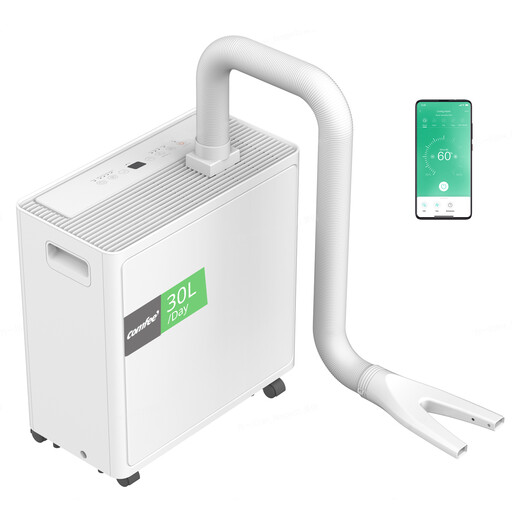
Why it suits this type of buyer: According to the product specifications, this model is designed for larger spaces of up to around 73 m², including cellars, bathrooms and utility rooms where it may need to run for long periods.
The 3.2-litre tank can be replaced by continuous drainage, so you’re less reliant on emptying it by hand during intensive use.
30 litres a day under the stated conditions, Wi-Fi control, four modes, a timer and a washable filter.
A moisture absorber works without electricity and is handy in a wardrobe, caravan, storage area or small, poorly ventilated room. However, its capacity is limited and you’ll need to replace the refills. For a bedroom, cellar or utility room with persistent excess moisture, an electric dehumidifier is usually more practical.
If mould, leaks or heavy condensation persist despite using a dehumidifier, check the ventilation, sealant and insulation, and check for possible water ingress. The appliance tackles moisture in the air, but it won’t automatically address the cause of the problem.
We’ve put together a complete, up-to-date list of products that meet these strict selection criteria and the applicable European safety requirements.
Place the appliance on a flat, stable surface with enough clear space around it. Keep the air inlet and outlet unobstructed, and don’t put an electric model somewhere it could be splashed. Close windows and doors while it’s running if you want to dehumidify one room, but continue to ventilate as normal when needed.
Its lifespan depends on how it’s used, maintained and stored. Clean the filter regularly, empty the tank promptly and keep the appliance upright. After moving or tilting it, follow the waiting time in the manual before plugging it in. A compressor may also have a short start-up delay; that doesn’t automatically mean there’s a fault.
That depends on its power consumption and how many hours it runs. A 200-watt model running for five hours uses 1 kWh in theory. In practice, an appliance with humidity control may switch off once it reaches the set level. So compare the power rating with the features you actually need, and use a timer to avoid unnecessary running time.
