
Vandaag of morgen in huis

Kwaliteit gegarandeerd

Welkomstaanbiedingen ontgrendelen: GRATIS bezorging | Tot 80% korting | Gratis 30 dagen JoyPlus-proefperiode
Download de app
Condensation on windows, a musty smell in the bedroom or laundry that takes ages to dry indoors: a dehumidifier can be a practical solution. But it’s not wise to focus only on the highest litres-per-day figure. Performance also depends on the temperature, humidity, room size and drainage.
As a Joybuy Product Recommendation Officer, I focus on specifications you can verify. That helps you avoid paying for features you won’t use or buying a machine that’s too noisy for your flat.
A model rated at “20L per day” will typically reach that figure under specific conditions, such as a high temperature and relative humidity. In a cool Dutch bedroom, the actual output may be lower.
So use capacity as a point of comparison, not as a guaranteed daily amount. A dehumidifier for large rooms also needs good air circulation, so don’t tuck the appliance between pieces of furniture.
A powerful electric dehumidifier can fill a 1.4 to 3.2-litre tank relatively quickly. Without automatic shut-off, that can be inconvenient. Check whether the model stops when the tank is full and has a clear full-tank indicator.
For a cellar, utility room or holiday home, continuous drainage is often more practical. Water flows through a hose to a drain. The hose needs to sit lower than the appliance and be securely connected.
Noise levels are usually given in dB(A), but testing conditions can vary. According to the product specifications, a quiet dehumidifier rated at around 30 to 36 dB(A) is generally more suitable for a bedroom than a model rated at around 46 to 48 dB(A). A compressor may also make different noises briefly when it starts up.
Don’t automatically choose a 30L dehumidifier for every room. Check the stated floor area or room volume:
The terms 12L dehumidifier, 16L dehumidifier, 20L dehumidifier and 30L dehumidifier usually refer to the maximum moisture-removal capacity under a particular test condition.
A dehumidifier with a hose is handy if you don’t want to empty the tank every day. Check whether the hose is included; some models don’t come with one. A tank with automatic shut-off prevents it from filling further once it’s full.
For a bedroom dehumidifier, useful features include a sleep mode, dimmable lights and a timer. A dehumidifier with a timer can, for example, switch off automatically once your clothes are dry.
Wi-Fi controls are most useful if you want to start the appliance remotely or check the humidity. A Wi-Fi dehumidifier gives you more flexibility, but check in advance that the app is compatible with your phone and network.

Why it suits this profile: According to the product description, this model is designed for rooms up to 25 m² and has a 3.8-litre tank. That makes it a good fit for a bedroom, bathroom or smaller living room where ease of use matters.
The product description lists continuous drainage, automatic shut-off when the tank is full and a 24-hour timer.
12L per day according to the product specifications, a laundry-drying function, automatic defrosting and R290 refrigerant.
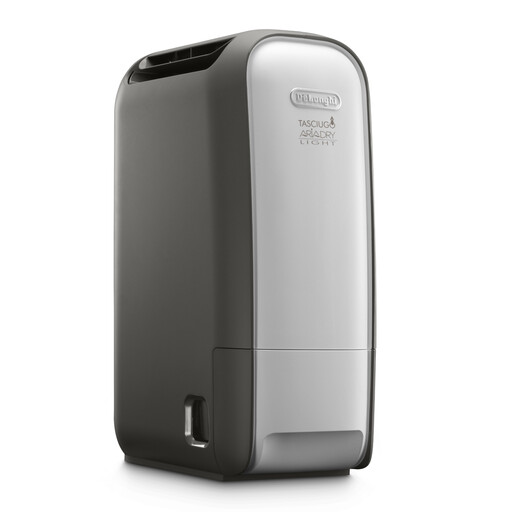
Why it suits this profile: If you value a compact design and low noise levels, this model is worth comparing. The product details list a noise level of 34 dB, a weight of 6.5 kg and a stated room size of up to 34 m².
The specifications list a timer, a 2.8-litre water tank and automatic shut-off when the tank needs emptying.
34 dB according to the product specifications, three fan speeds, a laundry-drying function and a folding handle.
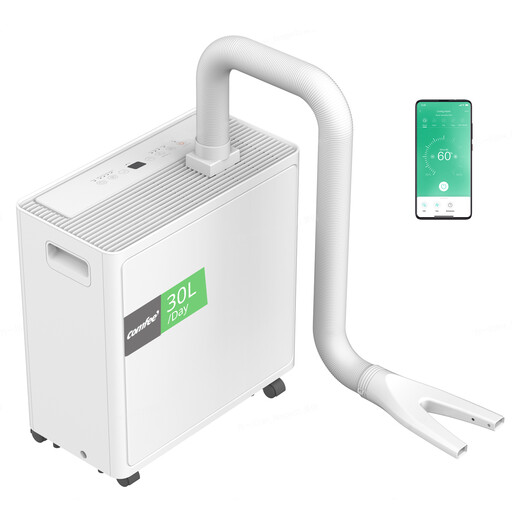
Why it suits this profile: According to the product description, this model is designed for spaces of around 58 to 73 m² and 92.5 to 130 m³. That makes it a good option for larger living areas, cellars, garages or utility rooms with high moisture levels.
The stated room size, continuous drainage and automatic shut-off make it easier to assess whether this model is right for long-term use.
30L per day according to the product specifications, Wi-Fi app control, four modes, a 3.2-litre tank and a noise level of 45.3–47 dB(A).
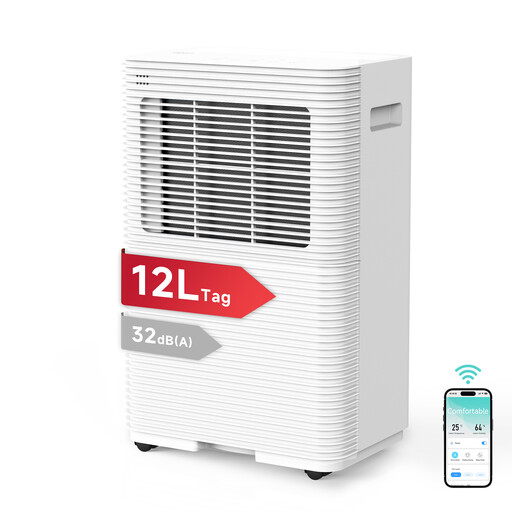
Why it suits this profile: According to the product description, this model is designed for rooms up to 24 m² and offers app control and a sleep mode. That can be useful for flat-dwellers who want to schedule the dehumidifier remotely.
The product details list a sleep mode, timer, automatic shut-off and the option of hose drainage. Do check whether the hose is included.
12L per day, Wi-Fi control, 24-hour scheduling, a laundry-drying function and a stated sleep-mode noise level of 32 dB.
We’ve put together a full, up-to-date list of products that meet these strict selection criteria and current European safety regulations.
You can easily calculate energy use: power in kW × number of hours used × electricity rate. A 200-watt appliance running for four hours uses around 0.8 kWh. The actual cost depends on the programme selected, compressor cycles and your energy tariff.
Yes, as long as the noise level and size are right for the room. Look for a sleep mode, timer and automatic humidity control. Don’t place it right next to the bed if the noise or airflow is disturbing.
Only if the manual says it’s suitable and the appliance won’t be exposed to splashing water. Keep an electric dehumidifier away from the shower and bath, place it on a stable surface, and unplug it before emptying the tank or cleaning the appliance.
Its lifespan depends on use, maintenance, filter cleaning and storage. Keep the appliance upright, clean the filter regularly and only move it once it’s switched off and the tank has been emptied. If it makes an unusual noise, has a damaged cable or is leaking, switch it off and consult the manual or customer service.
