What should you look for when choosing one?
For a heated living room that is usually warmer than 15 °C, you could compare compressor dehumidifiers. If the unit needs to work in a room below 15 °C, the Consumentenbond identifies desiccant dehumidifiers as an option for cold rooms. It also notes that they use more electricity than compressor models, and that this type was not included in the test cited.
| What to consider |
What should you check? |
Who should pay particular attention? |
| Capacity for your living room |
Measure the floor area and note the temperature. Compare l/24 hours only when the stated test conditions are the same. For 30–45 m², the Consumentenbond gives 20–30 l/24 hours as a rule of thumb. |
If my living room is large or open-plan, I want to know which capacity suits the measured space. Around 36% of consumers prioritise capacity for their own room. |
| Ventilation and the source of moisture |
Check the extractor while showering and make sure air is being directed outside before choosing additional dehumidification. |
If the damp mainly increases after showering, I want to check first that the moist air is being properly extracted. Around 29% of consumers prioritise tackling the source of the moisture. |
| Noise and energy use |
Compare noise measurements on the setting you plan to use and energy consumption under similar conditions. A night mode doesn’t automatically tell you how noisy or energy-intensive the other settings are. |
If I’m sitting in the living room while the unit is running, I want to weigh up its noise and energy use. Around 21% of consumers put comfort during use first. |
| Tank and drainage |
Check the tank capacity, the route to a suitable drain and whether the model you’ve chosen needs a hose or pump. |
If I don’t want to empty the tank often, I want to know whether a hose can be connected easily to a drain. Around 14% of consumers prioritise water management. |
Dehumidifiers at Joybuy
These models are included for comparison if damp persists after ventilation and tackling its source. Compare the stated capacity with your measured room size and conditions of use; the stated litres per day don’t guarantee the same output in your living room.
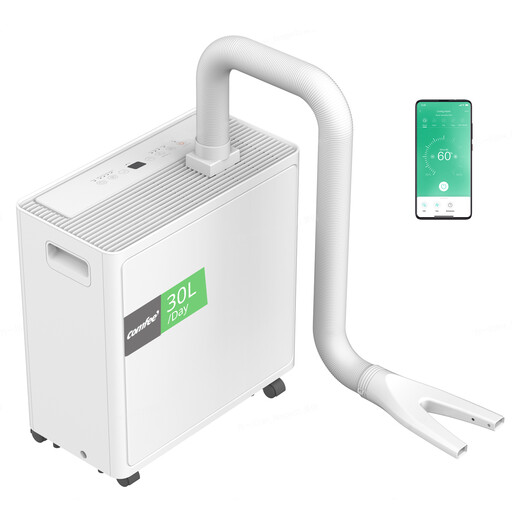 Image unavailable
Comfee' MDDA-30DEN7-SD dehumidifier
Worth comparing if you have a larger measured room and are looking for a higher stated daily capacity.
Stated capacity: 30 l/24 hours at 30 °C and 80% relative humidity. The product details list a 3.2-litre tank, continuous drainage and a room coverage of approximately 58–73 m².
View at Joybuy
 Image unavailable
VINO 20L Smart dehumidifier
This model is worth comparing if the stated coverage of up to 40 m² suits your measured living room.
Stated capacity: 20 l/24 hours at 30 °C and 80% relative humidity. The product name lists a 2.5-litre tank, Wi-Fi control and a sleep mode; continuous hose drainage is listed as an option.
View at Joybuy
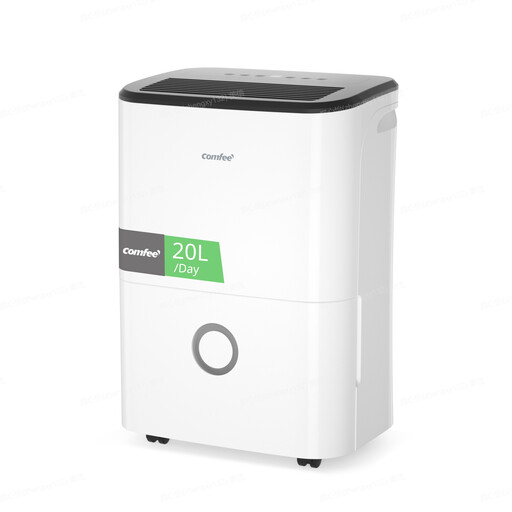 Image unavailable
Comfee' MDDF-20DEN7 dehumidifier
Compare this model with your measured room size if you’re considering a unit with a stated capacity of 20 litres per day.
The product name lists coverage of approximately 40 m² and a 3-litre tank. The product details also mention continuous drainage.
View at Joybuy
 Image unavailable
CONOPU 16L dehumidifier
This model is most worth comparing if the measured room size and level of damp suit a stated capacity of 16 litres per day.
The product details list a 2.5-litre tank, a timer and continuous drainage. For 30–45 m², the Consumentenbond gives 20–30 l/24 hours as a rule of thumb; the stated 16 l/day is below this.
View at Joybuy
 Image unavailable
TRULIVA AP10-2012EE dehumidifier
The product details list coverage of approximately 32 m². Compare this with your measured room size and the amount of moisture you want to tackle.
Stated capacity: 16 l/day. For 30–45 m², the Consumentenbond gives 20–30 l/24 hours as a rule of thumb, so this model is below that range. According to the product description, frost may form below 15 °C and the compressor stops temporarily during automatic defrosting. Continuous drainage is also listed.
View at Joybuy
Frequently asked questions
When is extra dehumidification more useful than ventilation alone?
Ventilate more while showering, and tackle leaks or poor ventilation first. The Consumentenbond says a dehumidifier may help if humidity remains consistently above 65% afterwards; this is buying advice, not a legal threshold.
How do you use and maintain a dehumidifier in the living room?
Don’t place the unit behind furniture, and keep the air inlet clear. The Consumentenbond recommends cleaning the dust filter every two months, or more often if you use the unit intensively. Close windows and doors while the dehumidifier is running, but don’t switch off the home’s essential background ventilation.
How do you compare energy use and warranties?
Compare measured energy use under similar conditions, then work out the running costs using your own usage and electricity tariff. According to ACM ConsuWijzer, the seller must offer an appropriate solution free of charge if a product breaks too soon during normal use. A manufacturer’s warranty doesn’t replace this legal right.
What product safety rules apply to dehumidifiers in the Netherlands?
Electrical equipment must meet the applicable product safety requirements. According to Business.gov.nl, the information service of the Netherlands Enterprise Agency, the manufacturer must assess the applicable requirements, affix the required CE marking and draw up an EU declaration of conformity. If you’re unsure, ask for information specific to the model you’re considering.
Do you have a cooling-off period when buying online?
For a standard online product purchase, you generally have a statutory cooling-off period of up to 14 days after delivery, according to ACM ConsuWijzer. Check the statutory exceptions and the returns process for your specific order.


