
当日/次日达

品质保障

开启新人专享福利: 全场免邮 | 低至 2 折 | 免费试用 30 天 JoyPlus 会员
下载 Joybuy
A deep frying pan with a lid is useful for far more than frying. You can use this type of pan for pasta, curry, sauces, stir-fries, braised meat and one-pan meals. However, not every deep frying pan, sauté pan or large frying pan will suit your hob and cooking style.
Marketing copy can also hide important limitations. For example, a pan may be described as “suitable for all hobs”, while another model may not be suitable for induction. “Ceramic coating” does not automatically mean that a pan is made from solid ceramic, either. So pay attention to the following points before making your choice.
An induction frying pan needs a magnetic base. An aluminium pan without a suitable induction base will not work on induction, even if the pan itself is otherwise robust. Always check the listed heat sources: induction, gas, electric, ceramic, halogen or a combination of these.
A clear example is the 32 cm Tefal Easy Cook & Clean. According to the product information, this deep pan is suitable for gas, electric and ceramic cooking, but not for induction. If you have an induction hob, this model is therefore not suitable.
A non-stick pan generally requires careful use. Metal spatulas, scouring pads and prolonged heating without food can damage the coating. “Dishwasher-safe” also does not mean that using the dishwasher is the best option for a long service life.
Hand washing is recommended for several ceramic models, even when the product information permits dishwasher use. Preferably use low to medium heat, allow the pan to cool before cleaning it and choose wooden, silicone or nylon utensils.
Diameter is not everything. A 28 cm pan with high sides may be more suitable for a family than a low-sided 32 cm pan. Also consider the height, capacity and diameter of the flat base. A wide pan will not always sit properly on a small induction zone, which can result in less even heat distribution.
Cast aluminium is relatively lightweight and conducts heat quickly. Combined with a ceramic coating, it is practical for cooking with little oil and for everyday maintenance. Do check that the base is suitable for induction.
Tri-ply stainless steel consists of several layers. For example, the PURECOOK Tri-Ply 304 pan is described as having a 304 stainless steel construction with an aluminium heat-conducting layer. This material does not have a traditional non-stick coating. Such a pan therefore requires more attention to preheating and using the right amount of fat.
A carbon steel wok does not have a factory-applied non-stick coating. The School of Wok 14 inch/36 cm must be seasoned before first use. A patina then develops through use. This material is well suited to high temperatures and stir-frying, but requires hand washing, immediate drying and light oiling to prevent rust.
A ceramic frying pan is usually a metal pan with a ceramic coating, rather than a pan made entirely from ceramic. Product information from brands including Naturepan and SENSARTE states that they have a ceramic coating and a PFAS-free or PTFE-free composition. Treat this information as the brand’s product specification and check the current packaging or product page for the exact version.
An uncoated pan, such as one made from carbon steel or stainless steel, does not contain a non-stick coating. This may be appealing if you do not want a coating, but the cooking technique and maintenance are different.
A lid helps when simmering, braising and retaining moisture. Check whether the lid is included and whether it can be used in the oven. With some models, the lid must be removed before placing the pan in the oven.
Also pay attention to the handles. A handle that stays cooler on the hob can make the pan more comfortable to use, but always use oven gloves when handling a hot pan. Also check the maximum temperature range and whether the pan is oven-safe.
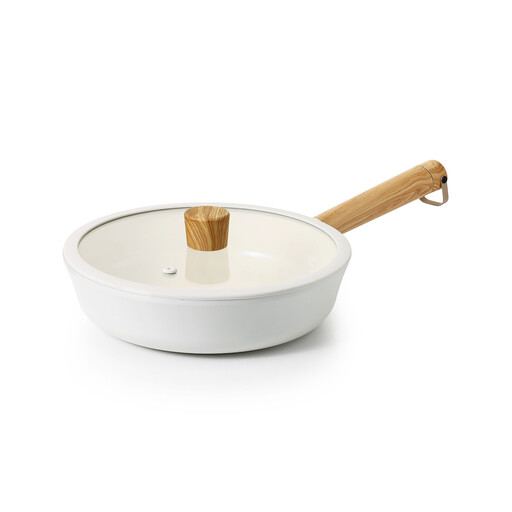
Why it suits this profile: A compact size for everyday portions, with a ceramic coating, lid and compatibility with gas, induction, halogen, ceramic and electric cooking.
The product information explicitly lists the different heat sources and recommends hand washing, avoiding metal utensils and not using abrasive cleaners.
24 cm diameter, lid included, magnetic stainless steel base and, according to the product information, a PTFE- and PFAS-free ceramic coating.
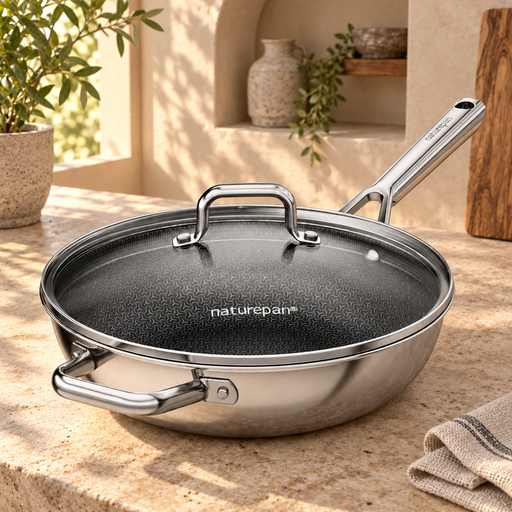
Why it suits this profile: A spacious sauté pan for sauces, stews and one-pan meals, with high sides and a supplied lid.
The specifications state 28 cm, a body height of 7.8 cm, induction compatibility and an oven limit of 230 °C without the lid.
Multi-layer stainless steel body with an aluminium core, hybrid ceramic surface and suitability for induction, gas, electric and ceramic cooking.
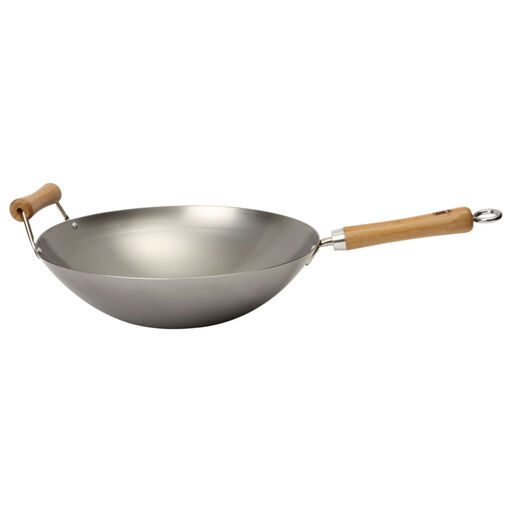
Why it suits this profile: For high-temperature stir-frying and large portions for around four to six people.
It is clearly an uncoated wok, and the product information mentions seasoning, hand washing, immediate drying and oiling to prevent rust.
36 cm diameter, carbon steel, two handles and, according to the product information, suitable for all hobs, including induction.
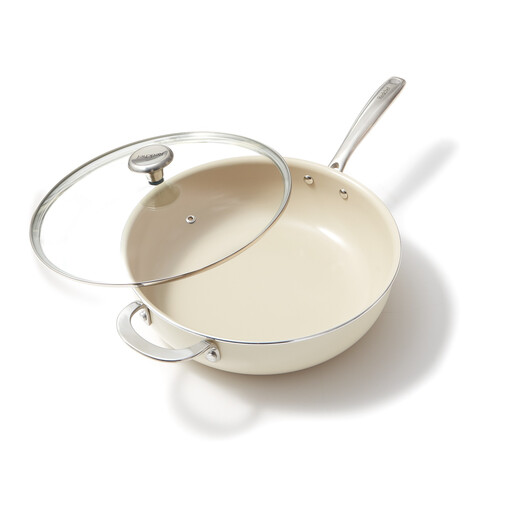
Why it suits this profile: The stated capacity of 5 quarts and the lid make this model suitable for larger portions, simmering and one-pan dishes.
The specifications state that it has an induction base, is compatible with gas and electric cooking, and has a maximum oven temperature of 450 °C.
Cast aluminium, ceramic coating, glass lid and dishwasher-safe construction according to the product information; hand washing is still recommended for the coating.
We have put together a complete, up-to-date list of products that fully meet these strict selection criteria and the applicable European safety regulations.
For one or two people, 24 cm is often practical. A large frying pan measuring 28 cm is more convenient for families, multiple portions and one-pan dishes. A 36 cm wok offers plenty of space, but also requires sufficient hob surface area and storage space.
That depends on the base. Look specifically for “induction-compatible” or “suitable for all hobs” in the product specifications. Also check that the flat base is large enough for your induction zone. A pan intended only for gas, electric and ceramic cooking must not be used on induction.
Its lifespan depends on heat, frequency of use and maintenance. Use low to medium heat, do not heat the pan empty for prolonged periods and avoid metal utensils and abrasive products. Hand washing with a soft sponge can help preserve the coating. If the coating shows cracks, starts to peel or has clear damage, stop using the pan.
