
Vandaag of morgen in huis

Kwaliteit gegarandeerd

Welkomstaanbiedingen ontgrendelen: GRATIS bezorging | Tot 80% korting | Gratis 30 dagen JoyPlus-proefperiode
Download de app
A deep fryer seems simple enough: add oil, set the temperature and start frying. Yet choosing the wrong capacity, struggling with maintenance or finding that the electrical connection isn’t suitable can all lead to a disappointing purchase. A small fryer can quickly feel too cramped for a family, while a large professional deep fryer may take up unnecessary space and use more electricity than you need in a student kitchen.
When comparing models, don’t focus only on discounts, wattage or promises of crispy chips. Check the capacity, heating element, safety features and how easy the appliance is to clean.
A 3-litre deep fryer is usually suitable for small to medium-sized portions. The exact amount of chips or snacks you can fry depends on the basket and the recommended fill level. Adding too much food at once lowers the oil temperature, which can make the results less even.
For one or two people, a capacity of 1.2 to 2 litres may be more practical. Families might want to look at models with a capacity of 3 to 5 litres. An 8-litre deep fryer is mainly intended for larger portions or frequent use. A twin deep fryer offers extra flexibility, but also needs more worktop space and often has a higher total power requirement.
A deep fryer with a lid can help keep out dust and contain odours once the appliance has cooled down. But that doesn’t mean every lid should stay closed while frying. Check the instructions: some models have a filter lid or viewing window, while a dust cover is only intended for storage.
Also, don’t put wet or heavily frozen food straight into hot oil without preparing it first. Moisture can cause splattering. Place the deep fryer on a flat, heat-resistant surface, away from water and flammable materials.
With a dishwasher-safe deep fryer, it’s usually removable parts such as the inner pan, basket or lid that are dishwasher-safe. The housing, plug, thermostat and heating element must not be immersed in water. Check which parts can actually be removed and follow the manufacturer’s cleaning instructions.
A deep fryer with a cold zone has a heating element above the base. This allows crumbs to sink into a cooler area, where, according to the product description, they are less likely to burn. Brands may also say that the oil stays clear for longer. Treat claims about how long the oil can be used as information from the product description, not as a guaranteed result.
Use these guidelines as a starting point:
The power should be appropriate for the capacity. A 3-litre model with 2,000 to 2,400 watts may suit everyday household use. Larger models might use 3,200 or 3,300 watts, for example. A twin deep fryer can require 4,400 to 6,600 watts. If the power rating is high, check that your electrical connection is suitable. For a twin model, the manufacturer may recommend connecting the plugs to separate circuits.
A temperature range of 150 to 190 °C is common for many electric deep fryers. A dial is simple and straightforward to use. A dual heating element or a model that quickly recovers its temperature can be useful when frying several portions one after another.
Be aware of the difference between a technical claim and a guarantee. According to the product descriptions for some Fritel models, a patented dual heating element can fry up to 50% faster. The actual results also depend on the amount of food, its starting temperature and the oil you use.
Not every deep fryer is suitable for solid frying fat. Look specifically for a deep fryer for oil and solid fat, and check whether it has a melting setting. Follow the instructions to melt solid fat carefully first; don’t put hard blocks straight into a basket of hot oil.
A cold zone, removable bowl, drain tap and dishwasher-safe parts can all make cleaning easier. Always check the product specifications, though, as some baskets may need to be washed by hand.
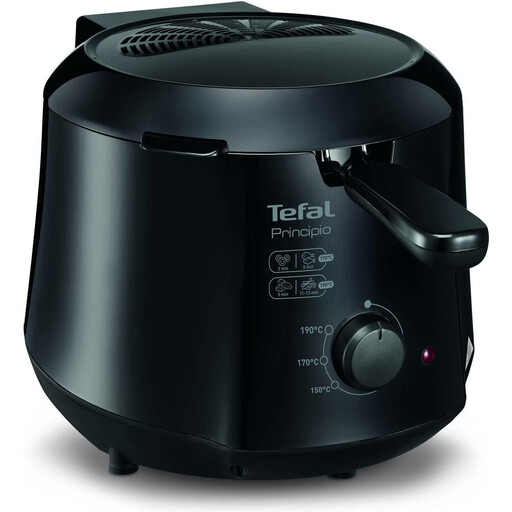
Why it suits this user: Its compact capacity and 1,000-watt power rating make it a good fit for smaller portions, students and limited worktop space.
Its modest capacity means you won’t need to use more oil than necessary for a small portion.
1.2-litre capacity, 1,000 watts, adjustable from 150 to 190 °C and overheat protection.
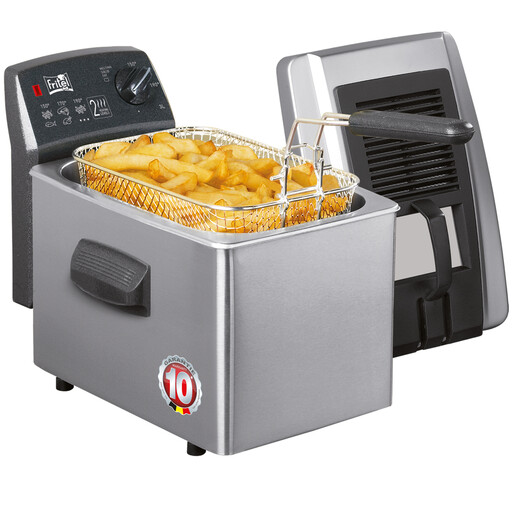
Why it suits this user: This model combines 2,400 watts with a viewing window, a permanent metal filter and a fully dismantlable design.
The product works with oil and solid fat and has a cold zone. Always check the correct fill markings before use.
3-litre capacity, 150–190 °C, cool-touch handles and removable parts that are dishwasher-safe according to the product description.
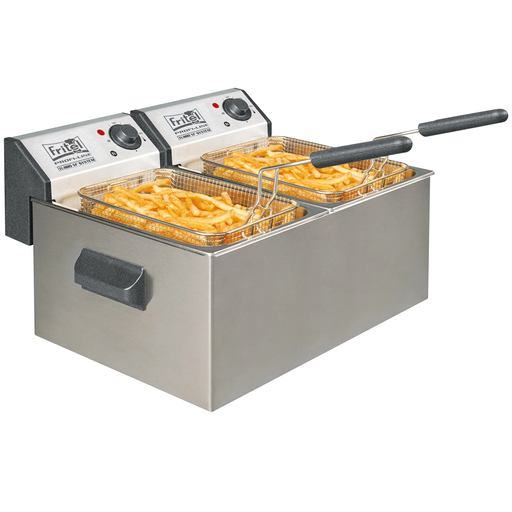
Why it suits this user: Two bowls let you cook different foods separately, making this a good choice for large families and small-scale catering.
The separate bowls keep different flavours and frying temperatures apart.
2 × 5 litres, suitable for oil and solid fat, cold zone, three-stage overheat protection and dishwasher-safe parts.
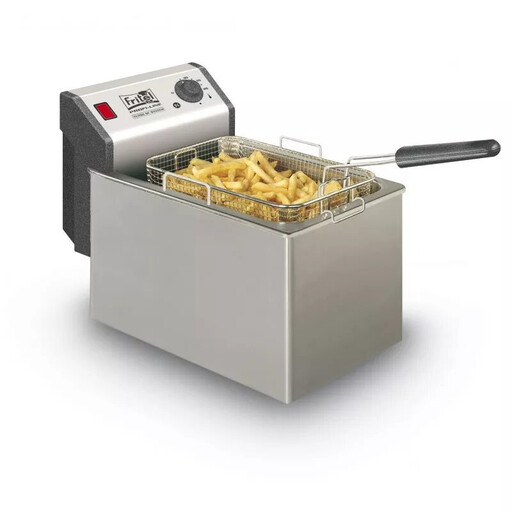
Why it suits this user: Its single 8-litre bowl has room for larger portions without the extra width of a twin deep fryer.
Its capacity is clearly suited to larger portions. Check you have enough space and that your electrical connection can handle its 3,300-watt power rating.
8-litre capacity, cold zone, adjustable from 150 to 190 °C, removable inner pan and dishwasher-safe parts.
We’ve put together a complete, up-to-date list of products that meet these strict selection criteria and the current European safety requirements.
For one or two people, 1.2 to 2 litres is often enough. For a household of two to four people, a model with a capacity of around 3 litres is a practical starting point. If you cook larger portions, you could consider a 5- or 8-litre model. As well as the capacity, check the basket size and recommended maximum fill level.
It depends on the type of oil, the food you cook and the temperature. Filter the oil when the instructions say it’s safe to do so, and replace it when it becomes dark, smells strong, foams or contains a lot of visible residue. According to the product description, a cold zone can help stop crumbs from burning as quickly, but it doesn’t guarantee that the oil will last longer.
A cold zone may be useful if you fry regularly and want to keep the oil usable for longer. Also check whether the bowl is removable, which parts are dishwasher-safe and whether the model works with oil or solid fat. That way, you’re paying for features that suit how you use the appliance, rather than just a marketing term.
