
Vandaag of morgen in huis

Kwaliteit gegarandeerd

Welkomstaanbiedingen ontgrendelen: GRATIS bezorging | Tot 80% korting | Gratis 30 dagen JoyPlus-proefperiode
Download de app
A deep-fat fryer seems simple enough: add the oil, set the temperature and start frying. Yet many households buy a model that does not suit their portion sizes, kitchen space or cleaning routine. A small fryer can quickly become overloaded, while a large deep-fat fryer requires more oil and storage space than necessary.
Marketing terms can also be misleading. A “fast” deep-fat fryer does not automatically cook food more evenly, and a “professional deep-fat fryer” is not always suitable for everyday use at home. Benefits mentioned in a brand’s own research, such as faster frying or oil lasting longer, should therefore be treated as manufacturer claims. Above all, check the underlying specifications.
A 3-litre deep-fat fryer does not automatically hold 3 litres of food. The oil capacity indicates how much oil fits in the reservoir; you should generally not fill the basket completely. Adding too many frozen chips or snacks lowers the oil temperature and can lead to less even results.
For one or two people, a 1.2 to 1.5-litre deep-fat fryer may be sufficient. For a household of two to four people, 3 litres is often more practical. Larger families, parties or several portions prepared one after another may want to consider 5 or 8 litres. A dual deep-fat fryer also allows you to prepare, for example, chips and fish separately.
Higher power does not automatically mean that an appliance is a better fit. Power mainly determines how much electrical capacity the deep-fat fryer uses and can contribute to faster heating or temperature recovery. The combination of power, capacity and heating element is more important than wattage alone.
A 3-litre model with 2,000 to 2,400 watts is intended for a different type of use than an 8-litre deep-fat fryer with 3,300 watts. Also check that your socket and circuit are suitable. A dual deep-fat fryer rated at 4,400 or 6,600 watts can place a significant load on your electrical system. Connect such an appliance according to the instructions and do not use unsuitable extension leads.
A cool-zone deep-fat fryer allows food residues to sink below the heating element. This prevents crumbs from sitting directly on the hottest element. A deep-fat fryer with a filter can help strain the oil or reduce splashes and odours, depending on the design.
Neither feature replaces regular oil changes and cleaning. The product description for some FRITEL models states that, according to the brand’s own information, the oil can remain clear for up to three times longer. This is a brand claim, not a guarantee for every user. The result depends, among other things, on the type of food, the temperature and how often you fry.
Would you like to use both liquid oil and solid frying fat? Choose a model with a clear melting function for solid fat. Solid fat should not simply be placed in a block into hot oil. A dedicated melting setting gradually distributes the fat in accordance with the usage instructions.
An adjustable temperature of around 150 to 190 °C is standard for chips, snacks, fish, meat and vegetables. A thermostat helps you set the temperature to suit the food. A viewing window is useful for monitoring the process, but it does not replace checking the cooking time and product packaging.
Look for overheating protection, a microswitch, a fail-safe system, cool-touch handles and non-slip feet. These are verifiable product features, but they do not make frying risk-free.
Place the electric deep-fat fryer on a flat, dry and heat-resistant surface. Dry frozen food before placing it in the oil, as ice and water can cause hot oil to splatter. Never move the fryer while the oil is hot, and allow the appliance to cool completely before draining the oil or cleaning any parts. Never use water on an oil fire.
An easy-to-clean deep-fat fryer should preferably have a removable inner pan, removable basket and parts that are dishwasher-safe according to the product information. The housing, plug and control panel must not be immersed in water.
Stainless steel is sturdy and easy to wipe clean, but check which parts can actually go in the dishwasher. With some models, the basket is suitable for hand-washing only. Also consider the dimensions: an 8-litre deep-fat fryer may quickly require a permanent place on the worktop.
The choices below are based on objective specifications and different household situations. This helps you avoid selecting a product based solely on its brand name or marketing copy.

Why it suits this profile: The 3-litre capacity is designed for 2 to 4 people. This model has a power rating of 2,000 watts and a manually adjustable temperature for regular use at home.
The cool zone allows food residues to sink to the bottom. The fully dismountable design makes maintenance more straightforward.
3-litre capacity, 2,000 watts, triple overheating protection and dishwasher-safe parts according to the product description.
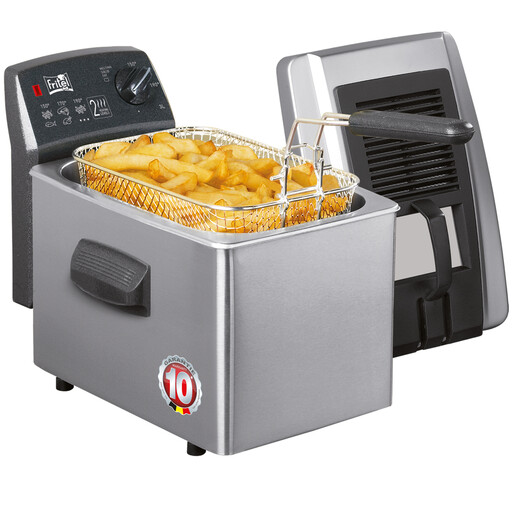
Why it suits this profile: For anyone looking for a compact deep-fat fryer with extra attention to filtering and cleaning. It has a 3-litre capacity and a power rating of 2,400 watts.
The permanent metal filter and removable parts address a common maintenance pitfall. However, check the dishwasher instructions in advance.
Cool zone, viewing window, metal filter, temperature control from 150 to 190 °C and handles that remain cool according to the product information.
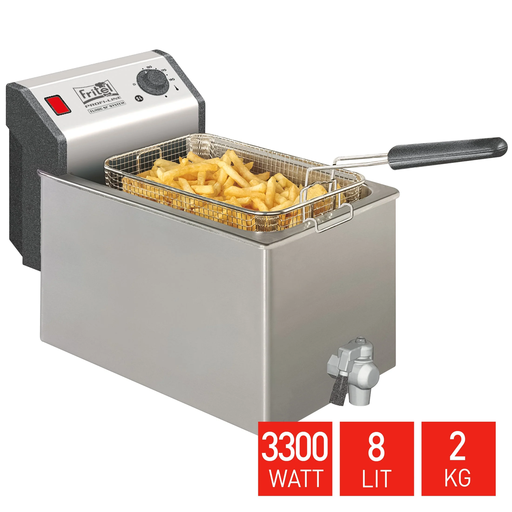
Why it suits this profile: The 8-litre capacity and 3,300 watts are designed for larger portions and more frequent use in a household. The drain tap is practical when changing the oil.
The cool zone reduces contact between crumbs and the heating element. The drain tap means you do not have to lift a full, cooled pan.
8-litre capacity, stainless-steel housing, suitable for oil or solid frying fat, temperature from 150 to 190 °C and dishwasher-safe parts according to the description.
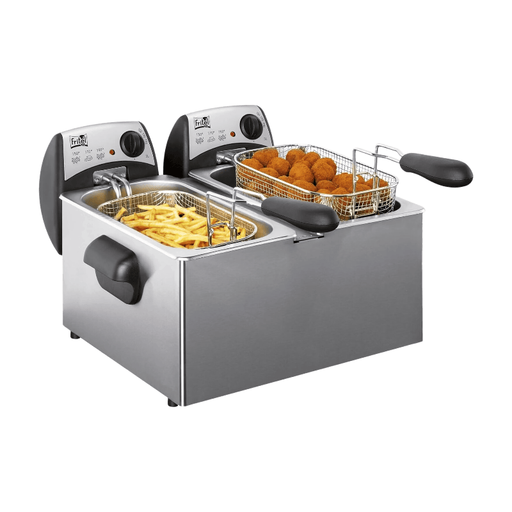
Why it suits this profile: Two separate 3-litre pans allow you to fry different ingredients at the same time. The product information states that it is suitable for 2 to 8 people.
The separate reservoirs prevent flavours from mixing directly. However, do not overfill either basket, as this can cause the temperature to drop.
2 × 3 litres, 2 × 2,200 watts, cool zone, removable pans and dishwasher-safe parts according to the product details.
We have put together a complete, up-to-date list of products that fully meet these strict selection criteria and the applicable European safety regulations.
A traditional deep-fat fryer uses hot oil or solid frying fat and is suitable for classic chips, croquettes and other snacks. An air fryer uses hot air and generally requires little or no added oil, but the cooking method, texture and capacity vary from model to model. Do not compare litres alone: also consider the basket shape, maximum food quantity, temperature, timer and available space.
If you mainly want to prepare small portions of chips, vegetables or chicken, you may find an air fryer more practical. If you are looking for the traditional method of cooking in frying oil or want to fry several snacks at once, an electric deep-fat fryer will be a better choice.
For one or two people, 1.2 to 1.5 litres is often enough. A 3-litre deep-fat fryer is generally suitable for two to four people. For larger families, 5 or 8 litres, or a dual deep-fat fryer, are logical options. Alongside the capacity, check the recommended quantity of food per batch.
Replace the oil once it becomes dark, develops a strong smell, starts to foam or begins to smoke more quickly. As a general guideline, the product information for one FRITEL model recommends replacing it after approximately 8 to 10 uses, but this depends on the food and frying temperature. Strain the oil once it has cooled and only keep it if it is still clear and suitable for use.
The main costs are electricity, oil or frying fat and maintenance. A higher wattage may allow the appliance to heat up more quickly, but it also uses more power per hour while the element is active. A small deep-fat fryer uses less oil; a larger model may be more efficient if you regularly prepare several portions one after another. Compare capacity and frequency of use rather than looking only at the purchase price.
