
Vandaag of morgen in huis

Kwaliteit gegarandeerd

Welkomstaanbiedingen ontgrendelen: GRATIS bezorging | Tot 80% korting | Gratis 30 dagen JoyPlus-proefperiode
Download de app
A deep-fat fryer seems simple enough: add oil, set the temperature and start frying. Yet many people buy a model that disappoints after just a few uses. A fryer that’s too small means cooking in several batches, a weak heating element takes longer to bring the oil back up to temperature, and parts that are awkward to clean can soon end up unused in a cupboard.
This buying guide helps you compare an electric deep-fat fryer by capacity, power, safety and maintenance. You’ll be able to see which features matter for a student, family, home cook or small catering business.
A 3-litre deep-fat fryer isn’t automatically suitable for four people. The actual amount of food you can fry in one batch also depends on the basket and the recommended fill level. Adding too many chips or snacks at once lowers the oil temperature and can lead to uneven results.
Use capacity as a guide:
Wattage tells you about the heating power, but it doesn’t determine the overall experience on its own. A 2,200-watt model may be suitable for a 3-litre deep-fat fryer. A larger fryer needs more power to bring the oil back up to temperature after cold food is added.
Also check the electrical connection. A 4,400-watt double deep-fat fryer places greater demands on the socket and circuit than a compact model. Always check the manual and use a properly earthed socket.
A fixed inner bowl makes changing the oil and cleaning the fryer less convenient. Check whether the bowl, basket and lid can be removed, and whether the manufacturer lists any parts as dishwasher-safe. Never immerse the casing, plug or heating element in water.
A deep-fat fryer with a filter lid can help reduce dust and splashes. A viewing window is handy for keeping an eye on the cooking, but it doesn’t replace setting the correct temperature or supervising the fryer.
The stated capacity is the maximum amount of oil the fryer can hold, not the amount of chips you should fry in one go. A 3-litre model is generally suitable for a smaller household. A 5-litre deep-fat fryer gives you more room for family meals, but also takes up more worktop space.
A double deep-fat fryer lets you cook chips and fish separately, for example. Check whether each well has its own thermostat and heating element. The FRITEL FR 1355 Duo has two wells, with a capacity of 3 litres each and 2,200 watts per well.
For chips, croquettes, fish and vegetables, an adjustable temperature of around 150 to 190 °C is practical. A cold zone keeps food debris below the heating element, so it’s less likely to burn directly on the element. According to Fritel’s product descriptions, this can help keep the oil usable for longer. Its actual lifespan depends on the food you cook, crumbs, moisture and filtering.
Dual heating or higher wattage can speed up heating and recovery. Claims such as ‘up to 50% faster’ come from Fritel product information and shouldn’t be taken as a guaranteed result for every dish.
Look for overheating protection, a stable non-slip base, cool-touch handles and proper earthing. Hot oil can cause fires and burns. Never fill above the maximum mark, allow wet food to drain first, and don’t move the fryer while the oil is hot.
Want to use solid frying fat? Choose a model with a specific melting setting. Not every oil fryer is suitable for solid fat. Also check whether the manufacturer approves the fryer for professional use; some larger models are designed only for household or semi-professional use.
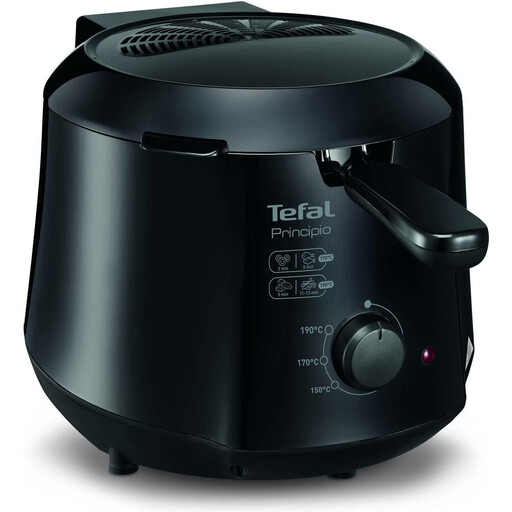
Why it suits this buyer: Its compact capacity and 1,000-watt power make it a good fit for a student, someone living alone or a household that occasionally cooks small portions.
The capacity makes it clear that this model is designed for small portions. That means you won’t pay for a large fryer that you rarely use to its full capacity.
1.2-litre capacity, adjustable from 150 to 190 °C, with a basket for one frying well. The product description lists removable parts as dishwasher-safe.
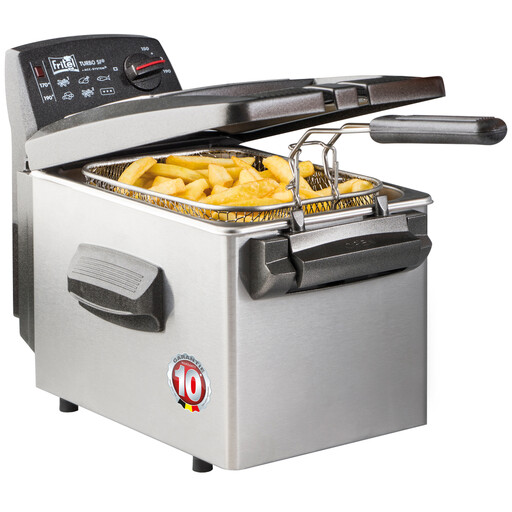
Why it suits this buyer: This model combines a 4-litre capacity with a filter lid and viewing window, and can be used with either liquid oil or solid frying fat.
The cold zone and permanent metal filter are useful for buyers who care about oil quality and maintenance. Fritel itself makes the product claims about faster frying.
3,200 watts, temperature control from 150 to 190 °C, a filter lid with viewing window and three listed safety features.
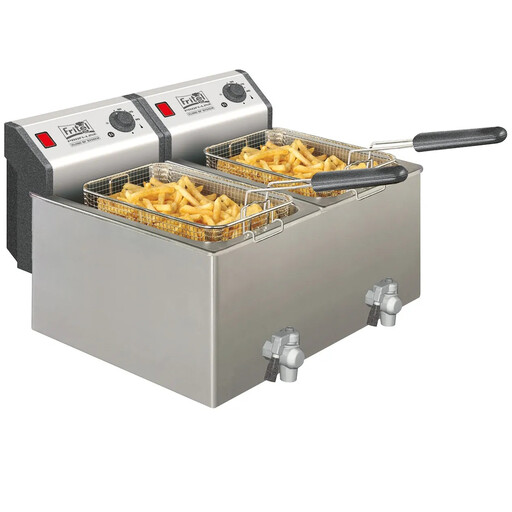
Why it suits this buyer: The two 8-litre wells are designed for large quantities, catering and semi-professional use, when you need to cook different foods side by side.
The capacity and total power of 6,600 watts are clearly specified. This makes it easier to assess the space and electrical connection you’ll need in advance.
16-litre total oil capacity, two thermostats, a cold zone, a melting setting for solid fat, a drain tap and parts listed as dishwasher-safe in the product information.
We’ve put together a complete, up-to-date list of products that meet these strict selection criteria and the applicable European safety requirements.
For one or two people, 1.2 to 2 litres may be enough. A 3-litre deep-fat fryer is often suitable for two to four people. For larger families, parties or heavier use, consider a 5-litre or 8-litre model, or a double deep-fat fryer. Remember to factor in the space you have available and the weight of the appliance.
A cold zone can prevent food debris from sitting directly on the heating element. According to Fritel’s own product information, this can help keep the oil usable for longer. It’s not guaranteed, though: filter the oil, remove crumbs and replace the oil if its smell or colour changes, or if it starts to smoke.
Switch off the appliance, unplug it and wait until the oil and all parts have cooled completely. Dispose of the oil in accordance with local waste regulations, and wash only the parts that the manual says are removable and dishwasher-safe. Wipe the casing with a slightly damp cloth, and never immerse the electrical parts in water.
