
Vandaag of morgen in huis

Kwaliteit gegarandeerd

Welkomstaanbiedingen ontgrendelen: GRATIS bezorging | Tot 80% korting | Gratis 30 dagen JoyPlus-proefperiode
Download de app
If you're serious about trolling for large predatory fish, you know that the right lure makes all the difference. A deep-diving lure is often essential to reach the zones where large sea bass, tuna, or pike congregate. However, the market offers many options, and not every lure delivers on its promise. Many anglers waste money on lures that fail to perform.
Before you make a choice, it's wise to understand the most common pitfalls:
To avoid these problems, you can focus on a few concrete specifications. These objective characteristics provide a reliable indication of a lure's performance.
The diving lip is the engine of the lure. Its size, angle, and material determine the action and how deep it dives. For a lure that needs to reach 10 meters deep, a long and wide diving lip with a relatively steep angle is a requirement. A robust plastic or polycarbonate material ensures the lip won't break on contact with the bottom or during a fight with a strong fish.
For lures for large predatory fish, a sturdy build is essential. A 165mm minnow-style lure weighing around 60 grams, like the ECOODA 165DD, provides the stability needed for trolling at speed. Check the hook specifications. Hooks with a designation like 5X strong are designed not to bend under extreme pressure. For a saltwater lure, corrosion resistance of both the hooks and split rings is a must.
Based on objective product specifications, we have selected a number of options that suit different types of anglers.
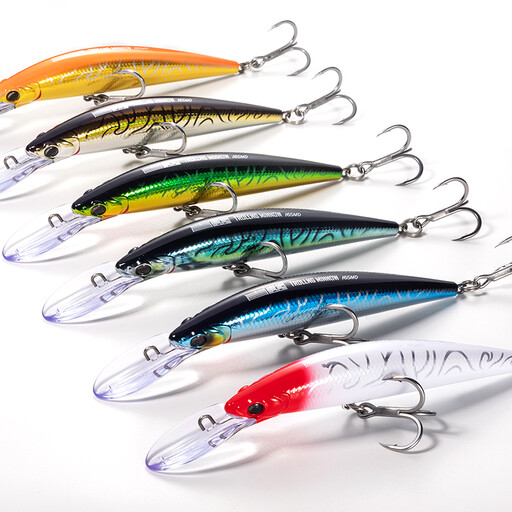
Why This Fits Their Persona: This angler fishes in the open sea or large, deep lakes and needs a lure that is guaranteed to reach depth. This model is specifically designed for deep-water trolling.
The large diving lip (66 mm long) and its design are focused on achieving the specified maximum depth of 10 meters, thus avoiding the pitfall of an unrealistic diving depth.
Equipped with SIKE 3509 5X #2 hooks that can withstand the force of large saltwater predators. The construction is built for heavy-duty work.
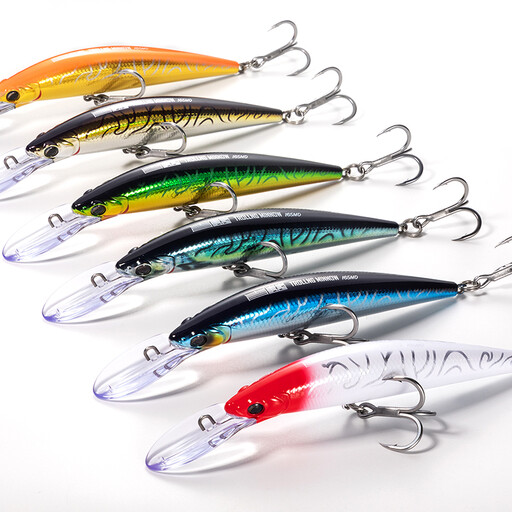
Why This Fits Their Persona: This angler needs a reliable piece of trolling lure for varying depths along the coast or on inland waters. Maximum diving depth isn't always necessary, but a stable action is.
The 'MD' (Medium Dive) model offers a stable swimming action at moderate depths (approx. 4-6 meters). This prevents the instability that some deep-divers exhibit when they cannot run at their maximum depth.
Versatile for sea bass, pike, and other predators in waters where extreme depth is not required. The robust construction is identical to the DD version.
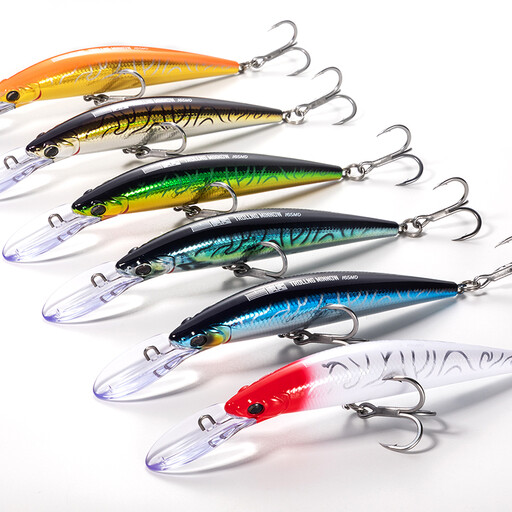
Why This Fits Their Persona: This angler wants proven gear that performs right out of the box. No time for replacing hooks or second-guessing the construction; it just has to work.
This lure is designed as a complete package. The hooks and split rings are of a quality that matches the intended fishery, thereby bypassing the pitfall of weak construction.
Ready to use without modifications. The specifications (165mm, 64g) are an established standard for catching large predatory fish, making it a reliable choice.
We've compiled a complete, up-to-date list of products that fully meet these strict selection criteria and regulations.
The ideal speed varies by lure, but a good starting point is between 2 and 4 knots (approximately 3.5 to 7.5 km/h). Watch your rod tip. You should feel a constant, rhythmic tick that indicates the lure's action. If the action stops or becomes irregular, you are likely going too fast or too slow. Adjust your speed until you find the right action.
While technically possible, these lures are not designed for it. The large diving lip creates a lot of air resistance during the cast and heavy resistance on the retrieve. This makes casting for distance difficult and fishing tiresome. They perform optimally as trolling lures. For casting, a lure with a smaller bill is a more effective choice.
This depends on multiple factors, such as your line's thickness, trolling speed, and any current. As a general guideline for a lure rated for 10 meters deep, you can start with 30 to 50 meters of line behind the boat. Using a thinner, braided line helps the lure dive deeper than a thicker monofilament line because it has less water resistance.
