If you want to keep decaf and regular beans reliably separate, the simplest approach is to use a grinder dedicated to decaf. Decaf isn’t completely caffeine-free: the Netherlands Nutrition Centre gives around 3 mg of caffeine per 125 ml cup. Sharing one grinder is also possible, but you’ll need to agree on dosing, cleaning and grind settings. Features designed to reduce retained grounds don’t prove that there’ll be no transfer.
Who is this choice for?
Decaf drinker who wants to keep the beans separate
You share the coffee area with people who drink regular coffee and want to avoid any leftover grounds ending up in your decaf unnoticed. Clive Coffee and Baratza explain how grounds can remain in a grinder.
Person in charge of the shared coffee area
You’re looking for a routine your colleagues can stick to: dosing portions, finding the right grind settings and cleaning the grinder according to the instructions.
Colleague working near the coffee area
You want grinding to cause as little disruption as possible, but you don’t automatically take a manufacturer’s noise-reduction claim as a measured noise level in your office.
What should you look for in a coffee grinder for decaf at the office?
| What to consider |
What should you check? |
Who is this most important for? |
| Keeping decaf separate |
Will the grinder be used for decaf only? If not, check how to dose each portion and clean the grinding chamber and chute according to the instructions. |
I want to minimise the chance of regular coffee grounds ending up in my decaf portion; keeping beans separate is the main reason for buying for around 33% of consumers. |
| Noise in the workplace |
Consider where the grinder is placed and how often it’s used for back-to-back portions. Don’t take a noise-reduction claim as a measurement in your office. |
If the coffee area is next to workstations, I want to be considerate of colleagues while grinding; limited noise disturbance is the top priority for around 27% of consumers. |
| Grind size for your brewing method |
Check that the adjustment range suits the machine you have, for example for espresso or filter coffee. |
I want a grind size that suits the coffee machine we actually use; this is the top priority for around 20% of consumers. |
| Operation and cleaning |
Check how to access the grinding chamber and chute according to the instructions, and whether colleagues can follow a set routine for switching beans and cleaning. |
With several users, I want dosing and maintenance to be practical to organise; easy shared use is most important for around 20% of consumers. |
Common pitfalls
-
Assuming decaf is completely caffeine-free
Decaf still contains caffeine. If you share a grinder, leftover grounds from regular coffee can add to it.
Distinguish between the caffeine already in decaf and possible mixing during grinding. If keeping the beans separate is essential, use a grinder dedicated to decaf.
-
Taking low retention as proof of zero transfer
A manufacturer may mention features designed to reduce retained grounds, but grounds can still remain in the grinding chamber or chute.
Check the cleaning method for the exact model and agree how colleagues will switch between regular beans and decaf.
Switching beans and cleaning add extra steps before the next colleague can grind.
-
Choosing a hand grinder without considering back-to-back users
Hand grinding takes effort for each portion. According to the manufacturer, the 1Zpresso Q has a grounds capacity of 15–20 g.
Match the capacity and adjustment range to your brewing method and the number of portions you’ll make in a row.
For several portions in a row, hand grinding means extra effort and waiting time.
Brands to compare
Eureka
The Mignon Zero is an electric single-dose option to compare if you often switch between beans or want to factor in noise around the coffee area.
- Eureka lists 55 mm burrs, a system for blowing out leftover grounds and vibration damping for the Mignon Zero.
- ‘Very low retention’ and ‘quiet’ are manufacturer claims; they don’t prove zero transfer or a measured noise level in the office.
Baratza
The Encore ESP is an electric option to compare if the office uses both espresso and coarser brewing methods.
- For the Encore ESP, Baratza specifies settings 1–20 for espresso and 21–40 for filter coffee, cafetière and cold brew, among other methods.
- An adjustable range doesn’t automatically prevent leftover grounds when switching beans; follow the cleaning instructions.
Hario
The manual Skerton N is an option for individual portions if you’re short on space or don’t want to use an electric grinder.
- Hario lists a ceramic burr, adjustable settings and a grounds capacity of 100 g for the Skerton N.
- Hand grinding takes effort. According to Hario, only the glass parts are dishwasher-safe. The Skerton N is a different model from the discontinued Skerton Pro.
1Zpresso
The manual Q is a compact option to compare if you grind a small portion of decaf for yourself at a time.
- 1Zpresso lists a grounds capacity of 15–20 g and tool-free disassembly for cleaning.
- The grounds capacity limits how much you can grind in one go; hand grinding also takes effort for each portion.
Coffee grinders at Joybuy
This Joybuy selection includes coffee grinders with different adjustment and dosing options. Compare the listed settings and features with your brewing method and the way you work in your office.
 No image available
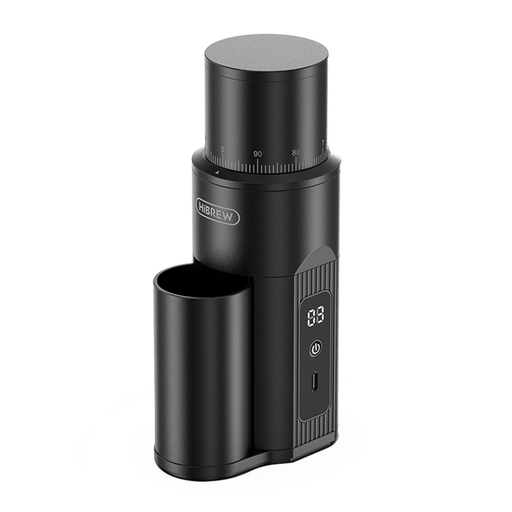
HiBREW G5MINI
An option to compare if you’re looking for a portable, battery-powered coffee grinder.
Dual 5200 mAh battery system, 420 stainless steel, 6-star conical burr, 100 levels of continuous grind adjustment and an aluminium alloy body.
View at Joybuy
 No image available
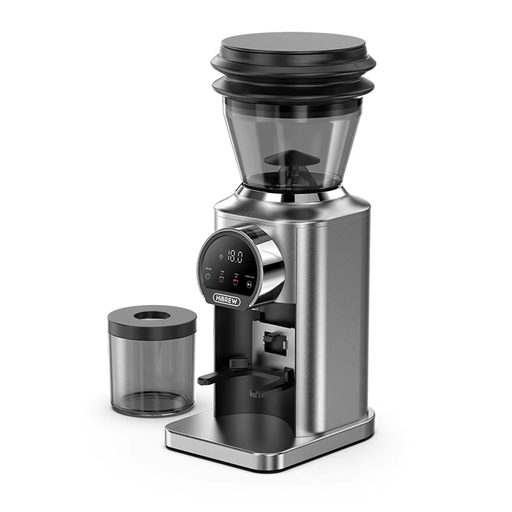
HiBREW G3 Plus
An option to compare if you need a range of grind settings and a portafilter holder.
Touchscreen, adjustable grind time, titanium-coated stainless steel burr, 31 grind settings and portafilter holder.
View at Joybuy
 No image available
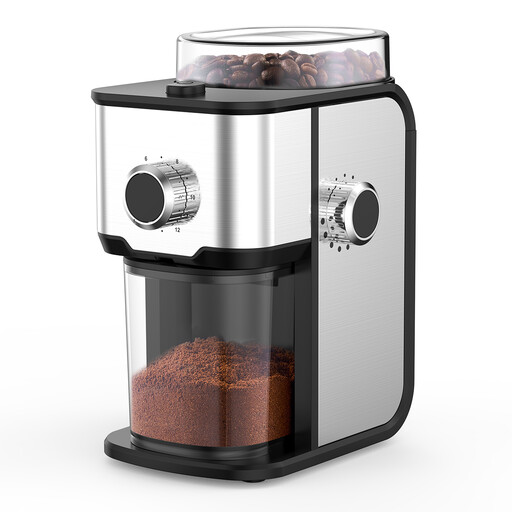
Ollygrin BG705
An option to compare if you want an electric grinder with settings for different brewing methods.
Flat burrs, 14 grind settings and a 2–12 cup setting.
View at Joybuy
 No image available
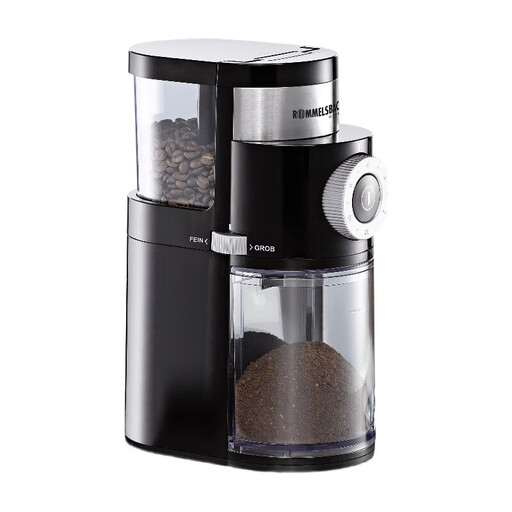
Rommelsbacher Coffee Mill EKM 200
An option to compare if you’re looking for a coffee grinder for a shared coffee area.
According to the product information, the burrs aren’t dishwasher-safe; clean them with the brush provided.
View at Joybuy
 No image available
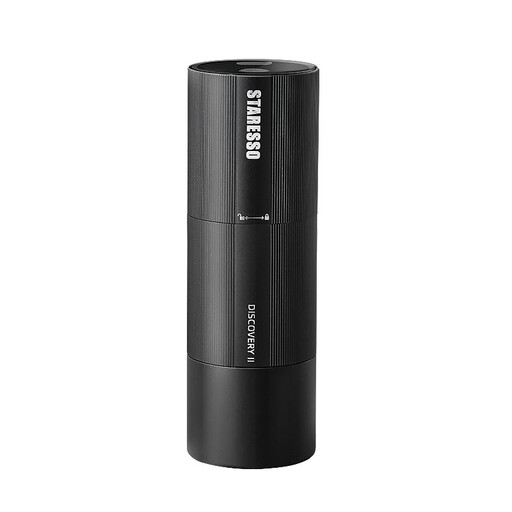
STARESSO D6E PLUS
An option to compare if you use different brewing methods and are considering a rechargeable grinder.
Adjustable grind size, stainless steel burr and a rechargeable 1000 mAh battery with a Type-C connection. The product information recommends cleaning with a dry brush and warns against rinsing the burr with water.
View at Joybuy
Frequently asked questions
Can one grinder be used for both regular beans and decaf?
Yes, but agree how to dose each portion and remove leftover grounds according to the instructions. Don’t assume there’s a guarantee of zero transfer; if keeping the beans separate is the main requirement, a grinder dedicated to decaf is the simpler option.
Is coffee made exclusively from decaf beans completely caffeine-free?
No. The Netherlands Nutrition Centre gives around 3 mg of caffeine per 125 ml cup of decaf. This is a general nutritional value, not a measurement of coffee from a particular machine.
How do you maintain a shared electric coffee grinder?
Follow the instructions for the exact model and agree who will clean the grinding chamber, chute and grounds container. Baratza explains that coffee oils and fine particles can build up there. Switch off and unplug the appliance before clearing a blockage according to the instructions.
Do cancellation rights and the legal guarantee apply if the office buys the grinder?
That depends on who makes the purchase and what the contract is primarily used for. ACM ConsuWijzer makes clear that a purchase made mainly for business purposes doesn’t automatically have consumer protection. For an online consumer purchase that qualifies, ACM generally describes a 14-day cancellation period and a legal guarantee if a product doesn’t conform to the contract. For a business order, check the agreed terms and service arrangements.


