Who is a projector suitable for?

Watching in daylight from rooms with tall windows

If you want to follow the race during the day, first check whether you can control the light around the projection wall. Tweakers explains how sunlight or artificial light falling on the image can reduce its contrast.

Watching with limited space for set-up

If you don’t want a projector in the middle of the room, check the distance between the lens and screen, as well as where the screen will go. Epson describes the EH-LS800B as an ultra-short-throw model; if you’re using a screen, check that it’s suitable for this type of projection.

Watching with a simple set-up

If you want to watch the race and hear the commentary without a complicated set-up, check the connections and audio on the exact model. BenQ, Epson and ViewSonic provide model-specific information about connections and audio.

What should you consider when choosing?

Standard-throw projection

Choose this option: if you can place the projector at the required distance and control the light on the image.

Bear in mind: the space you’ll need and the distance required by your chosen model to produce your preferred image size.

Ultra-short-throw projection

Choose this option: if having a projector in the middle of the room is impractical and you can place it close to the wall.

Bear in mind: careful positioning and a screen specifically designed for UST projection; a screen for a standard projector won’t necessarily be suitable.

A television instead of a projector

Choose this option: if the curtains need to stay open and sunlight falls directly on the intended viewing area.

Bear in mind: you won’t get a projected image, but you will avoid the contrast loss that Tweakers describes when ambient light falls on a projection.

What to consider What should you check? Who is this important for?
Watching a race in daylight See where the light from the window falls on the projection surface; then check the stated brightness for your preferred image size and whether a suitable ambient-light-rejecting screen is an option. If I want to follow the race during the day, I want to know whether I can control the light around the projection wall. Around 36% of consumers say daylight legibility is their main concern.
Positioning the projector and screen Work out the distance needed for your chosen image size and check that the screen is suitable for standard-throw or UST projection. If space is limited, I want to know in advance whether the projector, wall and screen will fit together. For around 29% of consumers, the physical set-up is their top priority.
Race source and sound Check that your broadcast provider works with your chosen playback source and find out what connections and audio features the model offers. If I want to start watching the race easily and hear the commentary clearly, I’ll check the source and sound first. Around 21% of consumers prioritise connectivity and clear commentary.
Maintenance and additional equipment For a lamp-based model, check the stated lamp life for each operating mode. Also see whether your set-up requires a screen, an external source or separate audio equipment. If I want to understand the full set-up and maintenance requirements, I’ll look beyond the projector itself. For around 14% of consumers, these are their top priorities.

Common mistakes

  • Looking only at the lumen rating

    A high stated brightness won’t prevent contrast loss if sunlight falls directly on the projection surface.

    First, work out where the daylight falls and whether you can control it. If you can’t, compare televisions too.

  • Choosing any ambient-light-rejecting screen

    Screen materials can be designed for a specific direction of projection. A UST screen won’t necessarily be suitable for a standard-throw projector.

    Before you buy, check whether the exact screen is suitable for UST or standard-throw projection.

  • Assuming a sports mode or smart platform gives you access to the broadcast

    A picture mode, built-in apps or an HDMI connection don’t confirm that your cycling race is available from your broadcast provider.

    Check how you’ll access the broadcast and how you want to play the sound.

Brands to compare

BenQ

The BenQ TH575i is a Full HD lamp-based model for standard-throw projection. BenQ specifies 3.800 ANSI lumens and includes a sports picture mode.

  • BenQ lists HDMI, a 10 W speaker and an included Google TV dongle.
  • Its stated throw ratio of 1,49–1,64 means you’ll need enough space. BenQ’s description of daylight use doesn’t confirm performance in direct sunlight.

Epson

The Epson EB-FH54 is a Full HD model for standard-throw projection; the EH-LS800B is a separate ultra-short-throw option.

  • Epson specifies a maximum of 4.100 lumens for the EB-FH54 and lists a built-in 16 W speaker.
  • Epson states that the EB-FH54 lamp lasts 12.000 hours in eco mode. This figure applies to that mode and doesn’t describe the lamp life for every operating setting.

ViewSonic

The ViewSonic PX749-4K is a 4K home projector with a stated brightness of 4.000 ANSI lumens and optical zoom. It’s worth comparing if image size and positioning are important to you.

  • ViewSonic lists HDMI 2.0b/HDCP 2.2 and a built-in speaker.
  • ViewSonic gives 60 Hz as the general refresh rate; the separately listed 240 Hz isn’t a general display refresh rate. The specifications don’t show how the model performs in direct sunlight.

Projectors at Joybuy

These projectors suit a range of set-ups, from standard-throw to ultra-short-throw projection. Where possible, control the light on the projection surface and check that the distance, image size and screen are suitable for your chosen model.

Yaber L2 projector

Yaber L2

Worth considering if you’re looking for a compact set-up and can control the light on the image.

Native 1080p; stated brightness of 520 ISO lumens and a throw ratio of 1,17:1. The product name lists autofocus, keystone correction, Google TV, HDMI and dual 5 W speakers.

View at Joybuy

Optoma Photon Beam PK52 projector

Optoma Photon Beam PK52

Worth considering if the stated throw distance and zoom suit the spot where you want to place the projector.

The product information lists 4K UHD, 3.500 lumens, a throw ratio of 1,21:1–1,59:1 and 1,3× manual zoom. The stated throw distance is 1–8 m.

View at Joybuy
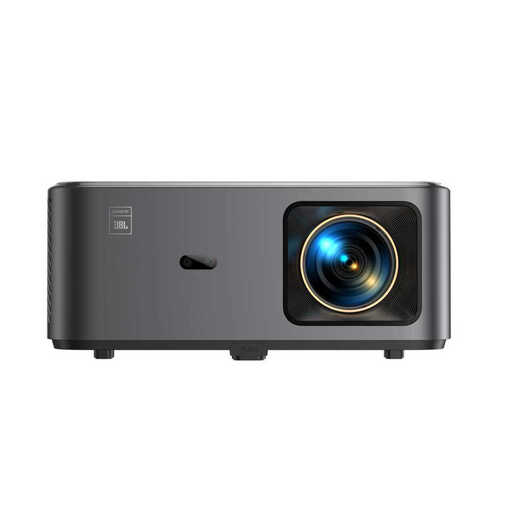
Yaber K2s ultra-short-throw projector

Yaber K2s

Worth considering if the projector needs to sit close to the wall; also check that your chosen screen is suitable for UST projection.

Native 1080p and stated brightness of 650 lumens. The product information lists a throw ratio of 0,18:1 and a throw distance of 0,26–0,4 m.

View at Joybuy

Optoma H117ST short-throw projector

Optoma H117ST

Worth considering if you need a short throw distance; its lower-than-Full-HD resolution is an important trade-off for detailed images.

Native WXGA (1280 × 800), stated brightness of 3.800 ANSI lumens and a throw ratio of 0,52:1. The product information lists HDMI and a sports mode.

View at Joybuy

Epson EB-1780W projector

Epson EB-1780W

Worth considering if you’re looking for a short-throw model and WXGA resolution suits your viewing distance and image size.

WXGA (1280 × 800) and stated brightness of 3.000 ANSI lumens. The product information lists 3LCD, HDMI and automatic horizontal and vertical keystone correction.

View at Joybuy

Frequently asked questions

Can an ALR screen help with light from tall windows?

An ambient-light-rejecting screen can help, but the direction of the incoming light and the type of projection matter. Check that the exact screen is suitable for your projector. For example, Elite Screens states that the Aeon CLR for UST isn’t suitable for short- or standard-throw projectors.

Can I watch the cycling race using built-in smart features?

That depends on your broadcast provider and the supported app or external source. A listing for Google TV or HDMI doesn’t in itself confirm that a particular cycling race is available.

What should I check when installing and maintaining a projector?

First, calculate the lens-to-screen distance using the throw ratio of your chosen model, and keep direct light from windows off the image. For a lamp-based model, check the maintenance instructions and the stated lamp life for the operating mode you plan to use.

What are my rights if I buy online or a product is faulty?

For a standard online product purchase in the Netherlands, you generally have a statutory cooling-off period of up to 14 days after delivery; ACM ConsuWijzer also lists some exceptions. If a product is faulty, you’re also entitled to a statutory guarantee from the seller, in addition to any manufacturer’s warranty.
