When choosing a dark chocolate biscuit, don’t base your decision on the word ‘dark’ or the cocoa percentage alone. If you want to keep an eye on your energy intake, compare similar biscuits per 100 g, then consider how much you actually eat in one sitting. The Netherlands Nutrition Centre points out that manufacturers set their own serving sizes, so a small serving shown on the pack won’t necessarily match the amount you eat.
Who is this comparison for?
Anyone who wants to plan a biscuit break
You want to enjoy a biscuit with your coffee or tea and decide in advance how many biscuits or how many grams to have. Nutritional values per 100 g help you compare products; the amount you eat determines what that biscuit break adds up to.
Anyone who wants to compare labels
You compare the energy, sugars and saturated fat in similar biscuits, and may also consider fibre as an additional point of difference. A more favourable value for one nutrient doesn’t automatically make a biscuit a good fit for your overall diet.
Anyone looking for a pronounced dark chocolate flavour
You want to know what a stated cocoa percentage refers to and how the rest of the product is made. This is particularly relevant for a biscuit with a chocolate coating or a chocolate product with a biscuit filling.
What should you look for when choosing?
Start by comparing the nutritional information per 100 g for similar products. Then decide on your own portion size. Use the cocoa percentage, ingredients and any Nutri-Score as additional information, each for its own purpose.
| What to consider |
What to check before buying |
Who is this important for? |
| Energy and portion size |
Compare kcal per 100 g, then work out the value for the number of grams or biscuits you plan to eat. Check how many portions the manufacturer says are in the pack. |
I want to have a biscuit without losing track of how much I’m eating. For around 50% of consumers, having a set portion size is the top priority. |
| Nutritional composition |
Check sugars and saturated fat per 100 g alongside the energy value; use fibre as an additional point of comparison. Compare any Nutri-Score only within the same type of product, as advised by the Dutch government. |
When choosing between two similar biscuits, I want to know what’s in them besides dark chocolate. Around 33% of consumers give this nutritional comparison the highest priority. |
| Cocoa flavour and ingredients |
Check what the cocoa percentage applies to. If you have an allergy, also read the ingredients list and warnings on the current packaging. |
I’m looking for a distinctly dark chocolate flavour and want to know whether the ingredients suit my preferences. For around 17% of consumers, this is the most important consideration. |
Common mistakes
-
Assuming ‘dark’ means ‘lower in energy’
A cocoa percentage doesn’t tell you how much energy the whole biscuit provides. Albert Heijn lists Galler Dark with Biscuit Filling as containing at least 60% cocoa, but also 536 kcal per 100 g.
Use the cocoa percentage to assess the chocolate flavour and the nutrition table to compare products nutritionally.
-
Comparing only the stated portion sizes
The Netherlands Nutrition Centre says manufacturers decide what serving size to show. Comparing different serving sizes can therefore give you a misleading impression.
Compare products per 100 g first, then calculate the values for the amount of biscuits you plan to have.
-
Using Nutri-Score to compare different product types
The Dutch government describes Nutri-Score as a tool for comparing the same type of product. On its own, the score doesn’t tell you whether a chocolate biscuit is a good fit for your diet.
If a score is shown, use it to compare similar biscuits, and also check the nutritional information and portion size.
-
Relying only on the online description if you have an allergy
For chocolate biscuits, both the biscuit and the chocolate coating can contain relevant ingredients. When making a purchase decision because of an allergy, always follow the information on the current packaging.
Before eating the product, check the ingredients list, the allergens listed and any ‘may contain’ warnings on the packaging.
Relevant brands and product ranges
Albert Heijn
AH Zaans huisje dark chocolate is a butter biscuit topped with a layer of dark chocolate.
- Albert Heijn lists a 14 g serving and says the product contains 63% dark chocolate.
- Per 100 g, Albert Heijn lists 505 kcal, 37 g sugars and 16 g saturated fat; the chocolate percentage doesn’t replace those values.
Jumbo
Jumbo Chocolate Cookies with Dark Chocolate Chips are cookies with nutritional values listed both per 100 g and per serving.
- Jumbo lists 12 servings per pack and gives values for an 18.75 g serving.
- According to Jumbo, one serving contains 92 kcal; check how many cookies you have at a time.
McVitie's
McVitie's Digestives Dark Chocolate combines a biscuit with a layer of dark chocolate.
- Jumbo lists 4.3 g of fibre per 100 g for this product, which you can compare with other biscuits.
- Jumbo also lists 496 kcal, 26.6 g sugars and 12.9 g saturated fat per 100 g. The name ‘Digestives’ is no reason to assume that the product aids digestion.
Galler
Galler Dark with Biscuit Filling is sold as dark chocolate with a biscuit filling, rather than as an ordinary cookie with chocolate chips.
- Albert Heijn lists at least 60% cocoa in the chocolate for this product.
- Albert Heijn lists 536 kcal, 39 g sugars and 17 g saturated fat per 100 g. Compare it with other products bearing in mind its different composition.
Dark chocolate biscuits on Joybuy
If you’re considering a digestive biscuit topped with dark chocolate, this product provides nutritional values per 100 g to help you compare labels. Also decide how many biscuits you want to have at a time.
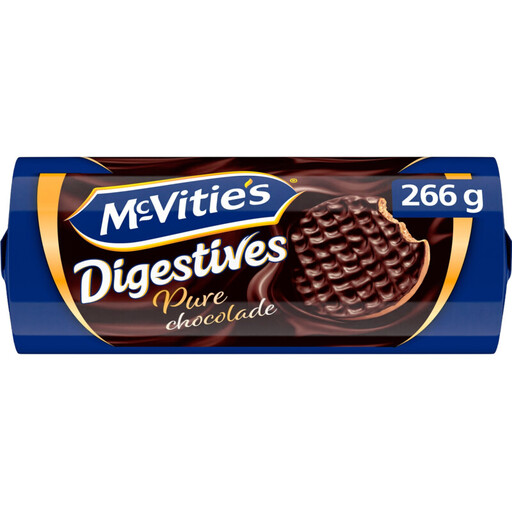 Image unavailable
McVitie's Digestives with Dark Chocolate 266 g
A digestive biscuit with a layer of dark chocolate, for anyone who wants to compare this type of biscuit with other chocolate biscuits.
The pack contains 266 g. For McVitie's Digestives Dark Chocolate, Jumbo lists 496 kcal, 26.6 g sugars, 12.9 g saturated fat and 4.3 g fibre per 100 g. Check the nutritional information on the pack and calculate the values for the amount you eat.
View on Joybuy
Frequently asked questions
Are dark chocolate biscuits automatically a better choice if I’m managing my weight?
No. The word ‘dark’ alone doesn’t tell you how much energy, sugar or saturated fat a biscuit contains. Compare similar biscuits per 100 g, then consider how much you actually eat.
How should I use Nutri-Score when comparing chocolate biscuits?
Use Nutri-Score, if shown, to compare the same type of product. The Dutch government says that’s what the score is designed for. Also check the nutritional information, and don’t judge your overall diet by a single letter.
Should I stick to the serving size shown on the pack?
No. The stated serving size doesn’t have to match the amount you eat. The Netherlands Nutrition Centre points out that manufacturers set their own serving sizes, so compare products per 100 g and then calculate the values for your own portion.
What should I check if I have an allergy?
Read the current ingredients list and allergen information for the specific biscuit, including any ‘may contain’ warnings. Don’t rely on the words ‘dark chocolate’ alone: other ingredients in the product matter too.


