
Fans of a pronounced cocoa profile
You’re looking for dark chocolate sprinkles for bread, yoghurt or a dessert and want to compare varieties by their stated cocoa content. That percentage is a useful guide, but it can’t fully predict the taste.


For dark chocolate sprinkles with a pronounced cocoa profile for an autumn half-term snack, compare the stated cocoa content: Albert Heijn lists at least 52% cocoa solids for De Ruijter Specials Intens Puur, compared with at least 32% for the standard Venz and AH varieties reviewed. If sugar content is your priority, check the nutritional information per 100 g and what a claim such as ‘less sugar’ is being compared with. If you’re buying for guests, always check the allergens on the pack you buy.
You’re looking for dark chocolate sprinkles for bread, yoghurt or a dessert and want to compare varieties by their stated cocoa content. That percentage is a useful guide, but it can’t fully predict the taste.
You compare sugar per 100 g and check exactly what a ‘less sugar’ claim is being compared with. The amount of sprinkles you use also matters when it comes to a snack.
You’re buying for several people and want to check the ingredients, allergens and any ‘may contain’ warnings on the current pack before serving.
Start with what matters most for your snack: cocoa content, sugar, ingredients or pack size. Then compare only the varieties that meet your first requirement.
| What to consider | What to check when buying | Who is this most important to? |
|---|---|---|
| Cocoa profile | Compare the minimum percentage of cocoa solids; the word ‘dark’ alone doesn’t tell you how much cocoa a variety contains. | If I’m looking for a pronounced cocoa profile for an adult snack, I don’t want to rely on the product name alone. For around 36% of consumers, the cocoa profile comes first. |
| Sugar | Check the sugar per 100 g, the ingredients and the reference product behind any reduction claim. | For a dessert, I want to know how much sugar the chosen sprinkles contain, even if the pack says ‘less sugar’. Around 29% of consumers prioritise this comparison. |
| Allergens | Read the ingredients list and any ‘may contain’ warnings on the pack you buy. | When I’m buying for guests with a relevant allergy or intolerance, I first need to know which ingredients and warnings are listed on their pack. For around 21% of consumers, this check comes before the other selection criteria. |
| Pack size | Choose a net weight that suits the number of snack occasions and check the storage instructions. | If I’m planning several breakfasts or desserts for a group, I want to buy enough without having too much left over. For around 14% of consumers, choosing the right pack size is the first consideration. |
Albert Heijn lists at least 32% cocoa solids for AH Puur and Venz XXL Puur, but at least 52% for De Ruijter Specials Intens Puur. So the same category label doesn’t mean the stated cocoa content is the same.
Compare the percentages on the specific packs. Use them as a point of comparison, not as a guarantee of a particular taste.
Albert Heijn still lists 43 g of sugar per 100 g for AH Puur Minder Suiker. Céréal lists sugar and maltitols among the ingredients in its sprinkles with a sugar-reduction claim.
Check the nutritional information per 100 g and see which product the claim is compared with.
The dark varieties reviewed may contain milk or soya, or carry warnings about the possible presence of other allergens. The product name doesn’t tell you which ingredients apply to a specific pack.
Check the current label every time you’re buying for someone with a relevant allergy or intolerance.
The packs reviewed range from 200 g to 600 g. A larger pack is most practical when it suits the number of planned snack occasions and the storage instructions.
Work out how much you expect to use in advance and follow the storage instructions on the pack.
For a comparison based on cocoa content, Albert Heijn lists at least 52% cocoa solids and a 200 g pack for De Ruijter Specials Intens Puur.
Albert Heijn lists Venz XXL Puur in a 380 g pack, with at least 32% cocoa solids.
Albert Heijn lists AH Puur in a 600 g pack with at least 32% cocoa solids, and AH Puur Minder Suiker in a 250 g pack with at least 50% cocoa solids.
Jumbo lists a 200 g pack of Chocolade Hagelslag Puur, with at least 50% cocoa solids and 43.1 g of sugar per 100 g.
Lidl Netherlands lists Mister Choc Hagelslag Puur in a 600 g pack.
ALDI Netherlands describes Kiekeboe Puur as 600 g of dark chocolate sprinkles made with Rainforest Alliance cocoa.
These products include dark chocolate sprinkles in different pack sizes, plus one variety of chocolate flakes as an alternative topping. Chocolate flakes are not the same product as sprinkles, so if you’re choosing based on cocoa profile, always compare the information for the specific pack.
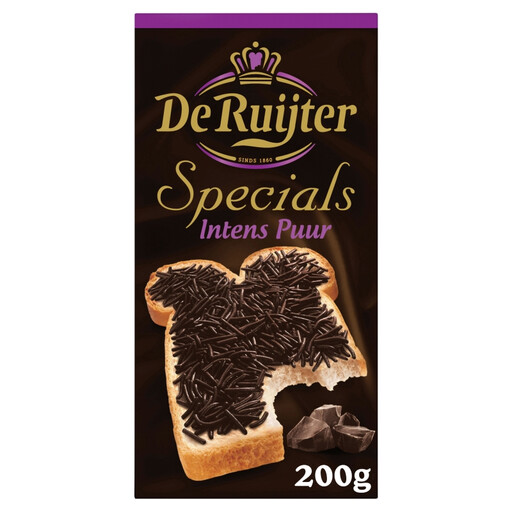 No image available
A variety to consider if you’re looking for dark chocolate sprinkles for a snack or dessert. The pack contains 200 g; check the cocoa content and allergens on the current label before choosing it for a particular flavour profile or for guests with an allergy.
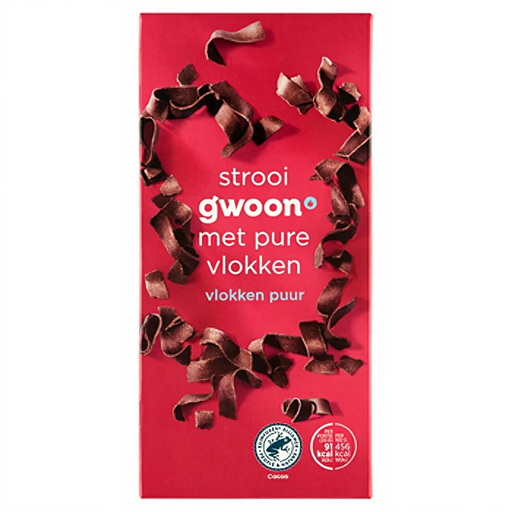 No image available
An alternative to consider if you’d like chocolate flakes as a topping instead of sprinkles. The pack contains 300 g; to compare cocoa, sugar or allergens, check the information on the pack.
 No image available
A larger pack of dark chocolate sprinkles to consider for several snack occasions. The pack contains 390 g; if a pronounced cocoa profile is your priority, compare the cocoa content on the current pack, and check the allergens if you’re buying for others.
No. The word ‘dark’ doesn’t indicate a fixed level of flavour intensity on its own. Albert Heijn lists at least 32% cocoa solids for AH Puur and Venz XXL Puur, compared with at least 52% for De Ruijter Specials Intens Puur. The percentage is a point of comparison, not a complete prediction of the taste.
The claim compares a product with a reference product; it doesn’t mean the sprinkles are sugar-free. Albert Heijn lists AH Puur Minder Suiker as containing 30% less sugar than AH Chocolade Hagel Puur, and 43 g of sugar per 100 g. Also check the ingredients and nutritional information on the pack you choose.
Read the ingredients list and any ‘may contain’ warnings on the current pack. The Netherlands Food and Consumer Product Safety Authority says allergens must be clearly distinguished in the ingredients list. Don’t rely on the product name alone or on an older product page.
Follow the storage instructions and date on the pack. The product pages for the varieties reviewed from De Ruijter, AH and Jumbo recommend storing them in a cool, dry, dark place.
When buying and using a product, use the information on the current pack. Albert Heijn notes that product information can change, so check the ingredients, allergens and nutritional information again, especially when they matter to your choice.