
Fans of dark chocolate sprinkles with coffee
You want a variety for your rusks with a clearly stated cocoa content, so you compare the exact products rather than relying on the word ‘dark’ alone.


Planning to serve rusks with dark chocolate sprinkles at a coffee morning, and is the stated cocoa content important to you? De Ruijter Intens Puur is one option, with at least 52% cocoa solids; the standard Venz and Albert Heijn varieties reviewed state at least 32%. If sugar content is your priority, compare the nutritional values per 100 g: AH Minder Suiker states 43 g of sugars and Céréal 7.7 g, but Céréal also contains polyols and warns that excessive consumption may have a laxative effect. If you’re serving guests, check the labels on both the sprinkles and the rusks for ingredients and allergens.
You want a variety for your rusks with a clearly stated cocoa content, so you compare the exact products rather than relying on the word ‘dark’ alone.
You compare sugars per 100 g for your guests. If you’re considering an alternative, you also want to know whether it contains polyols and what usage warning appears on the pack.
You want enough sprinkles for several rusks, so you compare pack sizes without overlooking the ingredients and allergens.
First decide what matters most to your guests: the stated cocoa content, the sugars, the ingredients or the amount in each pack. Then compare the exact varieties, as ‘dark’ doesn’t refer to one fixed recipe.
| What to consider | What to check when buying | Who it matters to |
|---|---|---|
| Stated cocoa content | Compare the minimum percentage of cocoa solids for the exact variety; don’t treat it as a taste test. | If cocoa is the main reason I’m serving the sprinkles with coffee, I want more to go on than just ‘dark’ on the pack. An estimated 33% of consumers would make the stated cocoa content their main consideration. |
| Sugars and sweeteners | Check sugars per 100 g. For alternatives, look at the polyols and any usage warnings too. | I want to compare sugars for my guests, but also find out what an alternative contains instead. An estimated 27% of consumers would weigh this up first. |
| Ingredients and allergens | Check the current labels on the sprinkles and rusks separately, including any warnings about traces. | If guests need to avoid certain ingredients, I want to check what’s in both products. Around 20% of consumers would put this check first. |
| Amount per pack | Estimate how many rusks you’ll serve and compare the pack sizes. | For a larger coffee gathering, I want to have enough topping ready without guessing from the product name. Around 20% of consumers would give the quantity needed the greatest weight. |
The standard Venz and Albert Heijn varieties reviewed state at least 32% cocoa solids, De Ruijter Royaal Extra Puur at least 43%, and De Ruijter Intens Puur at least 52%. The word ‘dark’ on its own doesn’t show you the difference.
Check the stated minimum for the exact variety you want to buy. A percentage describes the composition, not how every guest will experience the taste.
Céréal states 7.7 g of sugars and 40 g of polyols per 100 g. Product information from Jumbo warns that excessive consumption may have a laxative effect.
As well as the nutritional information, read the ingredients and usage warning before choosing this variety for guests.
A 200 g pack and a 600 g pack won’t provide the same amount of topping for a coffee gathering. A high cocoa content also tells you nothing about how many rusks you’ll want to serve.
Estimate how many rusks you’ll need in advance, then check the size of the pack you choose.
The sprinkles’ label won’t tell you which ingredients are in the rusks. Nor should you assume that a reference to baker’s salt applies to the sprinkles.
Read both labels separately if allergens, salt or iodine matter to your guests.
Cocoa content, nutritional values and pack sizes vary across these product ranges. The details listed apply to the varieties described, not automatically to every product from a brand.
Varieties with different stated cocoa contents, including Royaal Extra Puur and Intens Puur.
A standard dark chocolate sprinkle in a 400 g pack.
Own-brand range with a standard dark chocolate sprinkle and a variety with less sugar than the standard one.
Dark chocolate sprinkles whose nutritional values and polyol content are worth checking separately.
ALDI dark chocolate sprinkles in a 600 g pack.
Lidl dark chocolate sprinkles in a 600 g pack, listed by Lidl as a store-exclusive product.
This selection includes a dark chocolate sprinkle with a stated minimum of 52% cocoa solids, for anyone who wants to choose based on that product feature to enjoy with coffee. Compare the pack and ingredients with what you need for your guests.
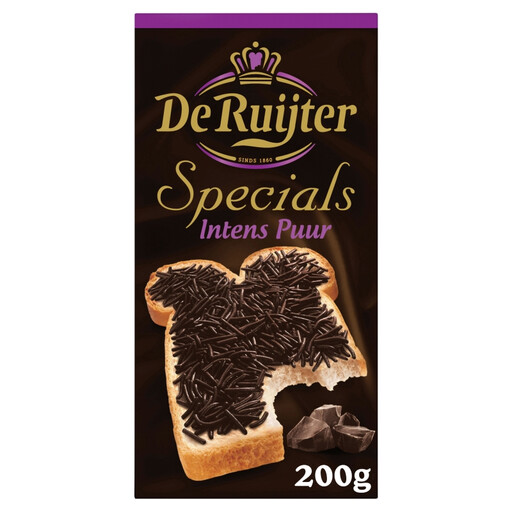 Image unavailable
A choice for rusks with coffee if you’re looking for a variety with a high stated cocoa content.
200 g pack; at least 52% cocoa solids and 43 g of sugars per 100 g.
The product information lists milk and soya. Check the current pack and make sure the quantity is suitable for the number of guests.
Choose based on the product feature that matters to your guests, not just the word ‘dark’. Albert Heijn states that De Ruijter Intens Puur contains at least 52% cocoa solids and Royaal Extra Puur at least 43%; the standard Venz and AH varieties described state at least 32%. These percentages aren’t an independent assessment of taste.
No. The word ‘dark’ on its own doesn’t tell you how much sugar a variety contains. The AH Puur described contains 64 g of sugars per 100 g, AH Minder Suiker 43 g, and Céréal 7.7 g. Céréal also states 40 g of polyols per 100 g and warns that excessive consumption may have a laxative effect.
Just before serving, read the current labels on both the sprinkles and the rusks. The varieties described differ: De Ruijter and Venz list milk and soya, AH lists milk and lactose, and Céréal lists soya and says the product may contain milk. Never infer the ingredients from the name ‘dark’ alone.
No. A reference to baker’s salt doesn’t mean the sprinkles contain iodine. A 2008 publication from the Ministry of Health, Welfare and Sport describes an agreement on iodised baker’s salt in bread and other bakery products. If iodine or salt matters to your choice, check the ingredients of the specific rusks and sprinkles separately.
Follow the storage instructions and best-before date on the pack of your chocolate sprinkles. Seal the pack carefully after use and check the label for storage instructions for the variety you’ve chosen.