
Fans of a pronounced dark chocolate flavour
You want a clear dark chocolate flavour on your rusks. Compare the stated cocoa solids percentage for the exact variety, as ‘dark’ doesn’t tell you how much cocoa it contains.


If you’re looking for dark chocolate sprinkles with a pronounced cocoa flavour to put on rusks, the stated cocoa content is a more useful guide than the word ‘dark’ alone. Albert Heijn states that De Ruijter Intens Puur contains at least 52% cocoa solids, while Jumbo states that Venz Puur contains at least 32%. If sugar content is your main concern, compare the nutritional information per 100 g. For a shared office lunch, check the ingredients and allergens too.
You want a clear dark chocolate flavour on your rusks. Compare the stated cocoa solids percentage for the exact variety, as ‘dark’ doesn’t tell you how much cocoa it contains.
You’re buying chocolate sprinkles for yourself or your colleagues and want to compare sugar per 100 g. A claim such as ‘less sugar’ doesn’t mean ‘sugar-free’; if you’re considering varieties with sweeteners, check the usage warning too.
You’re putting out rusks and toppings for several colleagues. In that case, the ingredients and allergens on the chosen pack matter more than just the flavour name or pack size.
If you’re putting together a shared lunch spread, first check which ingredients matter to those taking part. Then compare cocoa content, sugar and pack size according to your main reason for buying.
| What to consider | What to check when buying | Who it matters to |
|---|---|---|
| Cocoa content | Compare the minimum cocoa solids percentage on the exact pack. Albert Heijn states 52% for De Ruijter Intens Puur; Jumbo states 32% for Venz Puur. | I want a pronounced dark option for my rusks and don’t want to rely on the name alone. For around 36% of consumers, a stated cocoa content is the top priority. |
| Sugar | Read the nutritional information per 100 g and check what a claim such as ‘less sugar’ is being compared with. If the product contains polyols, check the warning on the pack too. | When I’m buying for the office, I want to compare sugar without mistaking ‘less sugar’ for sugar-free. Around 29% of consumers put reducing sugar first. |
| Ingredients and allergens | Read the ingredients, allergens and any ‘may contain’ information on the current pack of both the topping and the rusks. | When several colleagues share the same food, I want to know in advance whether the ingredients suit their needs. This check is the top priority for around 21% of consumers. |
| Pack size | Compare the net weight and choose a pack size that suits how many people will be sharing it. | For a shared lunch supply, I want to put out an appropriate amount. Around 14% of consumers prioritise pack size. |
Dark chocolate sprinkles can have different stated cocoa contents depending on the variety. Albert Heijn states that De Ruijter Intens Puur contains at least 52% cocoa solids; Jumbo states that Venz Puur contains at least 32%.
Compare the percentage on the pack of the variety you actually want to buy.
According to their product information, Albert Heijn and Jumbo’s reduced-sugar varieties still contain 43 g and 43.1 g of sugar per 100 g respectively. Jumbo states that Céréal Hagelslag Puur contains 7.7 g of sugar and 40 g of polyols per 100 g, and includes a warning against excessive consumption.
Compare sugar per 100 g. For a variety containing polyols, check the ingredients and usage warning too.
Milk and soya feature in the varieties mentioned; some products also state that they contain lactose or may contain traces of gluten and wheat. The word ‘dark’ doesn’t mean these ingredients are absent.
Keep the pack with its ingredients and allergen information available alongside the lunch spread, and check the rusks you’ve chosen too.
According to the Netherlands Nutrition Centre, using baker’s salt when baking bread isn’t compulsory. The chocolate sprinkles won’t tell you what kind of salt was used in the base.
If the type of salt matters to your choice, check the ingredients on the bread or rusk pack separately.
De Ruijter offers regular dark chocolate sprinkles as well as a separate Intens Puur variety.
Venz Puur is a regular dark chocolate sprinkle product in a 400 g pack.
The own-brand AH Hagelslag puur minder suiker combines a stated cocoa content with a sugar-reduction claim.
Jumbo offers an own-brand dark variety with a claim of 30% less sugar than its regular dark variety.
Kiekeboe Hagelslag Puur is an own-brand option in a 600 g pack.
These products offer two different kinds of dark chocolate topping for a lunch spread with rusks: sprinkles and flakes. Compare the texture you’d like to use and, if sharing, check the packaging.
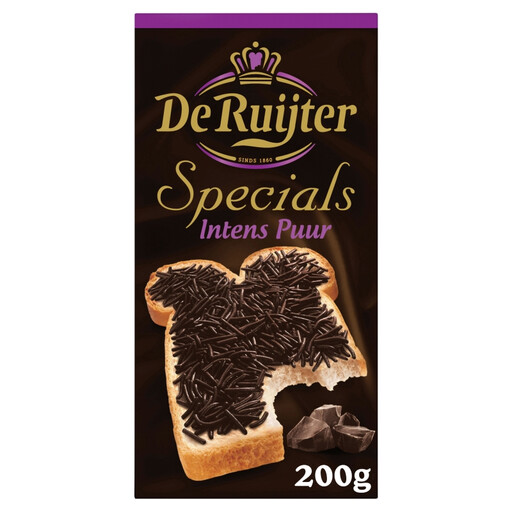 Image unavailable
An option if you’d like dark chocolate sprinkles on your rusks. If sharing, check the ingredients and allergens on the pack.
Pack size: 200 g.
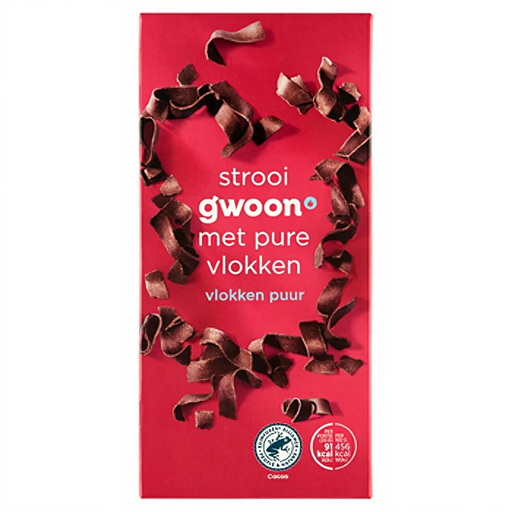 Image unavailable
For anyone who’d rather have dark chocolate flakes than sprinkles on their rusks. Check the ingredients if several colleagues will be eating them.
Pack size: 300 g.
No, the stated percentages vary by variety. Albert Heijn states that De Ruijter Intens Puur contains at least 52% cocoa solids and AH Hagelslag puur minder suiker at least 50%; Jumbo states that Venz Puur contains at least 32%. So if cocoa content is your main criterion, compare the exact pack.
No. The Albert Heijn and Jumbo reduced-sugar varieties reviewed state that they contain 43 g and 43.1 g of sugar per 100 g respectively. Jumbo states that Céréal Hagelslag Puur contains 7.7 g of sugar and 40 g of polyols per 100 g; check the warning against excessive consumption for this variety too.
Check the ingredients and allergens on the packs of both the chocolate sprinkles and the rusks. The varieties mentioned list ingredients including milk and soya, while lactose or possible traces of gluten and wheat are also worth checking for in some varieties.
Don’t assume so. If the type of salt used matters to your purchase, check the ingredients of the rusks you’ve chosen. The Netherlands Nutrition Centre states that using baker’s salt in bread isn’t compulsory, so you can’t rely on the product category alone to tell you what’s in the base for your lunch.