
Those who put cocoa first
You want a distinct cocoa flavour on your rusks, so you compare the stated cocoa content of dark chocolate variants. Albert Heijn’s product listings show that this percentage varies between variants.


If you’re choosing chocolate sprinkles for rusks at a university lunch and want a pronounced cocoa flavour, compare the stated cocoa content of the exact variant: Albert Heijn lists at least 52% cocoa solids for De Ruijter Specials Intens Puur, compared with at least 32% for Venz Puur. A higher percentage alone doesn’t tell you how sweet the sprinkles will taste. If they’ll be served regularly at lunch, also compare sugars per 100 g, the intended portion size and the allergens listed on the packaging.
You want a distinct cocoa flavour on your rusks, so you compare the stated cocoa content of dark chocolate variants. Albert Heijn’s product listings show that this percentage varies between variants.
You want to choose a pack size that suits regular use in the canteen, without opening more chocolate sprinkles than can be used within the stated storage conditions.
Before serving rusks, you want to check the sugars, fats, ingredients and allergens in the chocolate sprinkles you’ve chosen. The label for the exact variant is particularly important when serving lunch to a group.
Start with why you’re choosing dark chocolate sprinkles: cocoa flavour, nutritional information, practical usage or clear ingredient information. The word ‘dark’ doesn’t answer all these questions in the same way for every variant.
| What to consider | What to check before buying | Who is this most important for? |
|---|---|---|
| Cocoa flavour | Compare the stated minimum percentage of cocoa solids for the exact variant; try a small pack before choosing a larger quantity. | I’m looking for a pronounced cocoa flavour on my rusks and don’t want to rely on the word ‘dark’ alone. This flavour preference comes first for around 33% of consumers. |
| Nutritional information and portion size | Compare sugars and saturated fats per 100 g, and consider how much chocolate sprinkles you want to serve on each rusk. | If I’m serving lunch regularly, I want to know what a typical serving means for my rusks. Around 27% of consumers say this nutritional and portion-size question is their priority. |
| Packaging and usage | Compare the net weight with the amount you expect to use, and follow the storage instructions on the packaging. | When I’m putting out chocolate sprinkles for a shared lunch, I want the opened pack to suit expected usage; this is the main concern for around 20% of consumers. |
| Ingredients and allergens | Check the ingredients and allergens, including any ‘may contain’ statements, on the current label. | Before serving, I want to be able to say what’s in the variant I’ve chosen, without making assumptions based on the brand name. This clarity comes first for around 20% of consumers. |
Dark chocolate variants can differ considerably. Albert Heijn lists 43 g of sugars per 100 g for De Ruijter Specials Intens Puur and 65 g per 100 g for Venz Puur. The cocoa percentage doesn’t tell you how much sugar or saturated fat is in a portion.
Use the cocoa percentage to compare variants, but check the nutritional information separately and decide how much chocolate sprinkles you want to serve.
A larger pack isn’t automatically more convenient if you haven’t tried the flavour yet or you’re unsure how much the canteen will use.
If you’re trying a new variant, start with a smaller pack and base your next purchase on usage and the storage instructions.
According to Albert Heijn’s product information, the De Ruijter Specials Intens Puur and Venz Puur variants reviewed contain milk and soya. For its reviewed 200 g dark variant, Jumbo lists milk and possible traces of gluten and wheat.
Before serving these to a group, check the current label for the exact variant you’re offering and make the relevant allergen information easy to see.
For Céréal Hagelslag Puur, Jumbo lists 40 g of polyols per 100 g and warns that excessive consumption may have a laxative effect.
Bear this warning in mind if you’re considering this variant for a shared lunch; a lower sugar content doesn’t make products interchangeable.
Compare the specific product variants listed below, rather than the brands as a whole. Pack sizes, ingredients and allergens can vary between variants.
If you want to compare a clearly stated cocoa content, Albert Heijn lists at least 52% cocoa solids for Specials Intens Puur and at least 43% for Royaal Extra Puur.
The Venz Puur variant reviewed comes in a 400 g pack; Albert Heijn lists at least 32% cocoa solids.
The AH Hagelslag Puur variant reviewed is an own-brand product for which Albert Heijn lists at least 32% cocoa solids.
The Jumbo Chocolade Hagelslag Puur 200 g variant reviewed lists at least 50% cocoa solids and 43.1 g of sugars per 100 g.
ALDI describes the Kiekeboe Hagelslag Puur variant reviewed as a 600 g pack made with Rainforest Alliance cocoa.
These products are dark chocolate sprinkles or dark chocolate flakes to consider as toppings for rusks. Flakes aren’t the same type of product as chocolate sprinkles; for all three, check the exact pack if cocoa content, sugars or allergens will influence your choice.
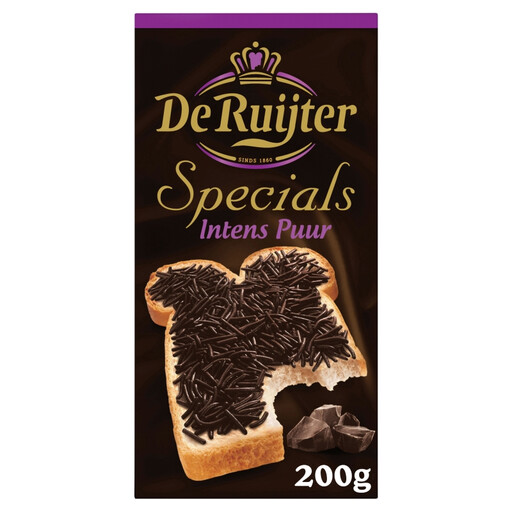 Image unavailable
A 200 g pack to consider if you’d like to try dark chocolate sprinkles on rusks first. If you’re stocking up for a larger lunch, compare the cocoa content, nutritional information and allergens on the exact pack.
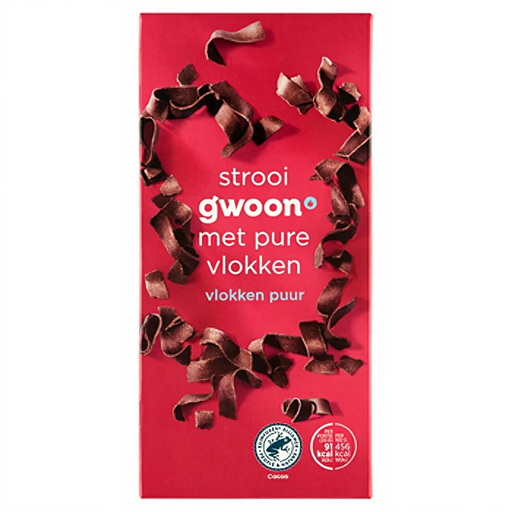 Image unavailable
300 g of dark chocolate flakes for anyone who wants to compare flakes as a topping for rusks with chocolate sprinkles. Note the difference in product type and check the nutritional and allergen information for this variant.
 Image unavailable
Dark chocolate sprinkles in a 390 g pack to compare with your expected canteen usage. If a high cocoa content is the deciding factor, check the percentage on the label for this specific variant.
No. ‘Dark’ doesn’t guarantee a low sugar content. For example, Albert Heijn lists 43 g of sugars per 100 g for De Ruijter Specials Intens Puur and 65 g per 100 g for Venz Puur. Compare the nutritional information for the exact pack, as well as the amount you use on your rusks.
Don’t assume so without checking the label for the variant you’ve chosen. According to Albert Heijn’s product information, the De Ruijter Specials Intens Puur and Venz Puur variants reviewed contain milk and soya. Ingredients and any ‘may contain’ statements can differ for other variants.
No. Don’t assume that rusks contain baker’s salt. The Netherlands Nutrition Centre says bakers aren’t required to use baker’s salt. If the salt used matters to your purchase, check the ingredients of the rusks you’ve chosen.
Follow the storage instructions on the pack you’ve chosen and seal it after use. The product information reviewed for De Ruijter, Venz and Jumbo says to store in a cool, dry place; for its 200 g variant reviewed, Jumbo also says to store in a dark place.