
Guests who enjoy a pronounced cocoa flavour
Are you serving chocolate sprinkles with coffee, perhaps on bread, yoghurt or porridge? Compare the stated minimum cocoa solids percentage, but don’t treat it as a complete guide to the flavour.


For a coffee morning with a stronger focus on cocoa, compare extra dark chocolate sprinkles with regular dark varieties. Albert Heijn listed at least 40% cocoa solids for a De Ruijter Royaal variety; the regular varieties mentioned from De Ruijter, AH, Jumbo and PLUS list at least 32% or 35%. Check the current pack: the cocoa percentage does not tell you everything about the flavour, and on its own it says nothing conclusive about sugar, saturated fat or allergens.
Are you serving chocolate sprinkles with coffee, perhaps on bread, yoghurt or porridge? Compare the stated minimum cocoa solids percentage, but don’t treat it as a complete guide to the flavour.
If several guests want to use sprinkles as a topping, the pack size will help you work out how many packs you need. The own-brand varieties mentioned from AH, Jumbo and PLUS come in 300 g packs.
A dark chocolate label doesn’t mean the sprinkles are free from milk or soya. Before serving, check the ingredients and allergen warnings on the pack you’re using.
First, decide whether regular dark or extra dark sprinkles are right for your guests. Then check the nutritional information, allergens and pack size for the specific sprinkles.
| What to consider | What to check | Who it matters to |
|---|---|---|
| Cocoa flavour | Check the minimum cocoa solids percentage on the pack. The regular varieties mentioned list 32% or 35%; Albert Heijn listed 40% for a De Ruijter Royaal variety. | If I’m serving sprinkles with coffee, I want to know whether the variety is positioned as distinctly extra dark. For around 27% of consumers, cocoa intensity is the top priority. |
| Portion and nutritional value | Compare sugars and saturated fat per 100 g, and consider how many sprinkles you use per portion. | With a sweet topping, I want to adjust the amount to suit what I’m serving. Around 27% of consumers give portion size and nutritional value the highest priority. |
| Ingredients and allergens | Read the ingredients list, including both ‘contains’ statements and ‘may contain’ warnings. | If any guests avoid milk or soya, I want to check the exact pack before serving. For around 20% of consumers, ingredients and allergens are the first thing they consider. |
| Pack size | Check the weight in grams and work out how many packs you want to put out for the group. | When several guests want sprinkles on bread or as a topping, I want to have enough to serve without basing it on a single portion. For around 26% of consumers, the amount for the group matters most. |
The regular dark sprinkles mentioned don’t all list the same minimum: De Ruijter, AH and PLUS state 32%, while Jumbo states 35%. Albert Heijn listed 40% for a De Ruijter Royaal variety.
Check the minimum percentage on the current pack rather than relying on words such as ‘dark’ or ‘intense’.
According to the Netherlands Nutrition Centre (Voedingscentrum), chocolate sprinkles are not included in the Wheel of Five. A dark chocolate label doesn’t tell you how much sugar or saturated fat a specific variety contains.
Compare the nutritional information per 100 g and bear in mind how much you’re serving.
The AH variety mentioned contains milk and lactose. The PLUS variety reviewed is labelled vegan, but also states that milk and lactose may be present.
For the pack you choose, check the ingredients and warnings about the possible presence of allergens separately.
Regular dark chocolate sprinkles, plus a Royaal range presented as offering an extra dark flavour.
Own-brand dark chocolate sprinkles in a 300 g pack.
Own-brand dark chocolate sprinkles in a 300 g pack.
Own-brand dark Fairtrade chocolate sprinkles in a 300 g pack.
ALDI lists Kiekeboe chocolate sprinkles in milk and dark varieties, both in 300 g packs.
These De Ruijter varieties are options if you want to serve dark chocolate sprinkles at a coffee morning. Compare the pack sizes, and check the current label if a particular cocoa percentage or avoiding allergens is important to you.
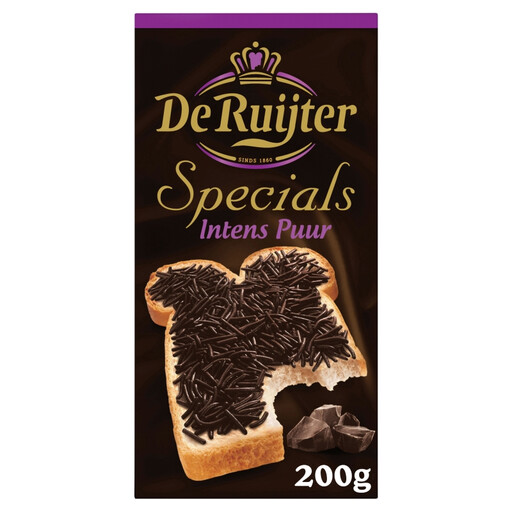 Image unavailable
A dark variety to compare if you want to put the focus on cocoa.
200 g pack. When choosing, check the listed soya and milk fat, along with warnings about milk solids and lactose; refer to the current pack for details.
 Image unavailable
A dark variety for serving on bread, yoghurt or porridge.
390 g pack. If you’re choosing by cocoa percentage, check the information on the current pack. Also check the allergen information for milk and soya.
No. The AH variety mentioned contains milk and lactose, while the PLUS variety labelled vegan warns that milk and lactose may be present. Always check the ingredients and allergen information on the specific pack.
No. A higher minimum percentage of cocoa solids doesn’t, by itself, mean less sugar as a general rule. Compare the sugar content per 100 g in the nutritional information for the varieties you’re considering.
Follow the storage instructions on the pack and seal it carefully after use. Check the best-before date on the pack you plan to serve.
A dark chocolate label doesn’t automatically make chocolate sprinkles a suitable everyday choice. The Netherlands Nutrition Centre (Voedingscentrum) places chocolate sprinkles outside the Wheel of Five; consider the portion size and the product’s nutritional information when making your own choice.