
Coffee drinkers choosing by cocoa content
If you serve chocolate sprinkles with coffee, you can compare the stated cocoa content and sugars per 100 g. A higher cocoa percentage won’t tell you exactly how you’ll find the combination.


If you want to choose chocolate sprinkles for coffee based on a higher stated cocoa content, De Ruijter Intens Puur is one option, with at least 52% cocoa solids; Venz Puur states at least 32%. That difference isn’t a measure of taste. You can also use regular dark chocolate sprinkles on cakes or cupcakes, but compare the sugars per 100 g, ingredients, allergens and pack size too.
If you serve chocolate sprinkles with coffee, you can compare the stated cocoa content and sugars per 100 g. A higher cocoa percentage won’t tell you exactly how you’ll find the combination.
You’re looking for sprinkles to use as a topping, and a pack size that suits how often you bake. Some varieties are also suggested for bread or yoghurt.
Look beyond the ‘dark’ label and check the sugars, any sweeteners and the allergens on the pack you buy.
First, decide what matters most to you: the stated cocoa content for coffee, the nutritional information, use as a topping or a pack for regular use. Then check the ingredients and allergens for the variety you’ve chosen.
| What to consider | What should you check? | Who is this most important to? |
|---|---|---|
| Cocoa content for coffee | Compare the stated minimum cocoa solids; also check the sugars per 100 g. | I want to choose a variety with a higher stated cocoa content for coffee, without assuming that the percentage determines the taste. This is the top priority for roughly 33% of consumers. |
| Sugars and sweeteners | Check sugars and any polyols per 100 g, as well as the ingredients and usage warnings. | If I’m keeping an eye on sugars, I also want to know whether another sweetener has been used and what warning comes with it. This is the main priority for around 25% of consumers. |
| Topping for cake | Check whether cakes, cupcakes or baked goods are mentioned as uses, and whether the pack size suits your needs. | For decorating cakes, I’m looking for a variety I can use at other times too. This use as a topping matters most to around 25% of consumers. |
| Pack size | Compare the pack sizes and, for a less familiar variety, check the nutritional information and allergens too. | If I use chocolate sprinkles often, I want a quantity that suits me without losing sight of my other requirements. Pack size is the first consideration for around 17% of consumers. |
According to the product information at Albert Heijn, De Ruijter Intens Puur contains at least 52% cocoa solids, while Jumbo’s product information states at least 32% for Venz Puur. The ‘dark’ label alone doesn’t tell you about this difference.
If cocoa content matters for your coffee pairing, compare the minimum percentage on the pack.
According to Jumbo, Céréal Hagelslag Puur contains 7.7 g of sugars and 40 g of polyols per 100 g, and includes maltitols. The product information warns that excessive consumption may have a laxative effect.
Check both the nutritional information and the ingredients and warnings before choosing this variety.
Dark chocolate sprinkles can contain milk or soya. Warnings about the possible presence of other allergens also vary from product to product.
Check the ingredients and allergens on the current pack. The Netherlands Food and Consumer Product Safety Authority says that allergens must be clearly identified in the ingredients list.
De Ruijter has several dark varieties to compare for coffee and cake, including Puur, Royaal and Intens Puur.
Venz Puur is a regular chocolate sprinkle that, according to the product information, can also be used in baking.
Jumbo’s own-brand dark variety gives you a basis for comparing cocoa content and sugars.
Céréal Hagelslag Puur is an option for shoppers who want to compare sugars and the sweeteners used.
ALDI’s Kiekeboe Puur is a dark chocolate sprinkle in a 600 g pack, making it worth considering if you use sprinkles regularly.
These two De Ruijter varieties are worth considering if you want dark chocolate sprinkles for coffee or to decorate cupcakes. One states a minimum cocoa content; the other comes in a larger pack for different occasions.
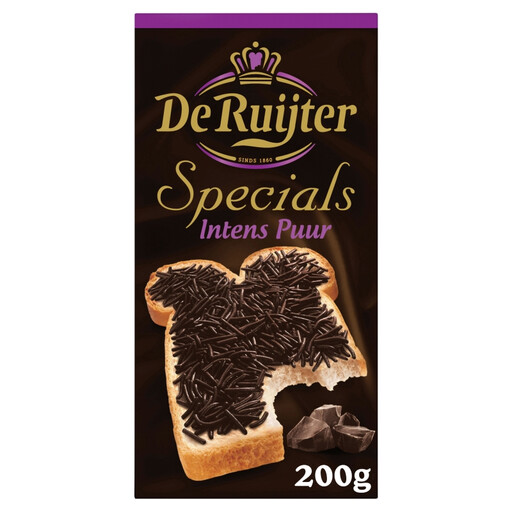 Image unavailable
A variety to compare by stated cocoa content for coffee, or to use as a cupcake topping.
The product information states that it contains at least 52% cocoa solids and 43 g of sugars per 100 g, and comes in a 200 g pack. The product contains milk and soya; check the current pack for full allergen information. Cocoa content is not an independent assessment of taste.
 Image unavailable
A regular dark variety if you want to use chocolate sprinkles on cupcakes and at other times too.
The pack contains 390 g. The product description suggests using them on bread, yoghurt, porridge and cupcakes, among other things. If you want to choose based on cocoa content specifically, check the percentage on the current pack. The product contains milk and soya.
If you want to choose by cocoa content, compare the stated minimum percentage: Albert Heijn’s product information states at least 52% for De Ruijter Intens Puur and 43% for De Ruijter Royaal; Jumbo states at least 50% for Jumbo Puur and 32% for Venz Puur. These specifications won’t tell you exactly how you’ll find the sprinkles with coffee.
Yes. Albert Heijn’s product information for De Ruijter and Jumbo’s for Venz both mention cupcakes or baked goods as uses. Choose a pack size based on how often you’ll use the sprinkles outside of baking too.
No. According to Jumbo, Céréal Hagelslag Puur contains 7.7 g of sugars and 40 g of polyols per 100 g, and includes maltitols. Check the warning on the pack too: excessive consumption may have a laxative effect.
Read the ingredients list and allergen information on the current pack for the variety you’ve chosen; ‘dark’ doesn’t rule out milk or soya. The Netherlands Food and Consumer Product Safety Authority says that allergens must be clearly identified in the ingredients list. Also check for any warnings about the possible presence of other allergens.
Follow the storage instructions on the pack you’ve chosen. The product information for the De Ruijter and Venz varieties reviewed recommends storing them in a cool, dry place; Jumbo says to store its own-brand dark variety in a cool, dry and dark place.