To choose dark chocolate sprinkles for biscuits, compare the stated minimum cocoa solids: De Ruijter Intens Puur lists at least 52%, while AH Puur Minder Suiker lists at least 50%. This percentage doesn’t guarantee a particular flavour or baking result. For a decorative finish, add the sprinkles to cooled biscuits while the icing is still soft. Also check the sugar content, ingredients and allergens on the pack you choose.
Who is this choice relevant to?
Biscuitemakers looking for a distinct cocoa flavour
You want more to go on than just the word ‘dark’ on the pack. A stated minimum cocoa solids content can help you compare varieties, but it won’t tell you exactly how the sprinkles will taste in your biscuits.
Bakers adjusting the sweetness of a recipe
You may be using both dough and icing, as well as sprinkles. In that case, the sugar content and any sweeteners in the topping are relevant when choosing ingredients for the recipe as a whole.
Bakers checking ingredients and allergens
You’re baking for someone who needs to avoid milk, soya or other ingredients. Check the variety you choose and any warnings on the current packaging.
What should you look for when choosing?
First decide whether the dark chocolate profile, the finish, the sweetness or the ingredients matter most to you. The cocoa percentage is a product specification, not a prediction of flavour or how the sprinkles will behave in the oven.
| What to consider |
What to check before buying |
Who is this most important to? |
| Cocoa solids |
Compare the stated minimum percentage for the variety you’ve chosen. Also consider the ingredients and sugar content if these affect your choice. |
I want a pronounced dark chocolate profile for my biscuits, but I can’t tell from the name alone. For around 42% of consumers, this flavour choice comes first. |
| Finishing |
Decide whether the sprinkles will go into the dough or be used as a visible topping after baking. For a topping, adding them to soft icing on cooled biscuits is a method from an Albert Heijn Allerhande recipe. |
I want the sprinkles to remain visible on top of the biscuit and stick firmly. This finish matters most to around 25% of consumers. |
| Sugar and sweeteners |
Check the sugars per 100 g and, for varieties containing polyols, read the usage warning too. Consider the sprinkles alongside the dough and icing. |
If I’m also using icing, I want to know how much sweetness the sprinkles will add to my recipe. Around 25% of consumers prioritise this consideration. |
| Ingredients and allergens |
Check the ingredients, allergen information and any may-contain warning on the pack of the exact variety you’ve chosen. |
When I’m baking for someone else, I need to be able to check which ingredients are in the sprinkles. For around 8% of consumers, this is their main concern when buying. |
Common mistakes
-
Assuming ‘dark’ means one specific cocoa content
The stated minimums vary between varieties. For example, Jumbo lists at least 32% cocoa solids for Venz Puur, while De Ruijter Intens Puur product information lists at least 52%. This isn’t a ranking of flavour.
Check the minimum percentage for the variety you want to buy, and consider the other ingredients too.
-
Planning a visible topping without something to make it stick
Albert Heijn Allerhande describes a biscuit-making method where the biscuits are left to cool first, then the sprinkles are stuck on with icing. Adding sprinkles before baking is a different method, and the result will depend on your recipe.
If you want the sprinkles to show on top, add them while the icing is still soft. Try a different method on a small batch of biscuits first.
-
Taking ‘less sugar’ to mean ‘sugar-free’
According to Albert Heijn, AH Puur Minder Suiker contains 43 g of sugars per 100 g. For Céréal Hagelslag Puur, Jumbo lists polyols as well as sugars and warns that excessive consumption may have a laxative effect.
Check the nutritional information per 100 g, the ingredients and any usage warnings before adding a variety to your recipe.
-
Guessing allergens from the name
Even dark chocolate sprinkles may contain milk or soya, or carry a may-contain warning. The ingredients in one variety don’t tell you for certain what’s in another.
Read the label on the pack you’ve bought before baking or serving, especially if you’re baking for someone with an allergy or intolerance.
Relevant brands and product ranges
De Ruijter
The standard 390 g dark chocolate sprinkles and the 200 g Intens Puur variety offer two different pack sizes for baking.
- Intens Puur product information lists at least 52% cocoa solids; this percentage applies to this variety.
- Check the ingredients and allergens on each pack. The cocoa percentage alone doesn’t determine how the sprinkles will taste in a biscuit.
Albert Heijn
AH Puur Minder Suiker is a specific variety for anyone who also considers sugar content when choosing.
- Albert Heijn lists at least 50% cocoa solids and 43 g of sugars per 100 g for these sprinkles.
- The name ‘Minder Suiker’ doesn’t mean the sprinkles are sugar-free; check the allergen information too.
Delicata
Delicata dark chocolate sprinkles are worth comparing if the stated origin of the cocoa is also important to you.
- For this variety, Albert Heijn lists at least 43% cocoa solids, cocoa mass as an ingredient and Fairtrade-certified cocoa.
- The product information lists milk solids and lactose; check the pack you choose if allergens are a concern.
Venz
Venz Puur is a standard dark chocolate sprinkle product in a 400 g pack.
- Jumbo lists at least 32% cocoa solids for this variety.
- The label lists milk and soya and notes that traces may be present; check the current packaging.
Céréal
Céréal Hagelslag Puur offers a different approach to sweetening, which should be assessed separately from standard dark chocolate sprinkles.
- For this variety, Jumbo lists 7.7 g of sugars and 40 g of polyols per 100 g.
- The product information warns that excessive consumption may have a laxative effect. Try using it in a small batch of biscuits first.
Dark chocolate sprinkles on Joybuy
These two De Ruijter varieties are dark chocolate sprinkles in 200 g and 390 g packs. Don’t choose based on pack size alone: if a stated high cocoa content is important to you, compare the specifications for the variety you’re buying.
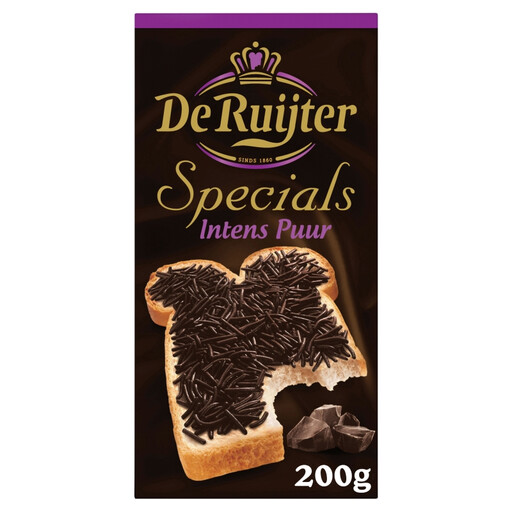 Image unavailable
De Ruijter Intens Puur dark chocolate sprinkles 200 g
A good option if you want to compare a clearly stated cocoa percentage for your biscuits. The product information lists at least 52% cocoa solids; this alone doesn’t tell you exactly how the sprinkles will taste or bake.
Check the current label for ingredients and allergens, including any mention of milk and soya.
View on Joybuy
 Image unavailable
De Ruijter dark chocolate sprinkles 390 g
The 390 g pack may suit you if you want to use dark chocolate sprinkles for several batches of baking. Check the cocoa percentage on the current pack if a high minimum content is important to you.
Also read the ingredients and allergens for this variety. Using the sprinkles as a cupcake topping won’t tell you how they’ll turn out on or in your biscuits.
View on Joybuy
Frequently asked questions
What does ‘dark’ tell you about chocolate sprinkles for biscuits?
The name alone doesn’t tell you the minimum cocoa solids content of a variety. Jumbo lists at least 32% for Venz Puur, while De Ruijter Intens Puur product information lists at least 52%. Compare these percentages as specifications, not as a measure of flavour.
Should I add sprinkles before or after baking?
For a decorative finish, bake the biscuits and leave them to cool first, then press the sprinkles into icing while it’s still soft. Albert Heijn Allerhande describes this method in a biscuit recipe. If you want to mix the sprinkles into the dough or add them before baking, try it with a small batch first.
Are ‘less sugar’ sprinkles sugar-free?
No. Albert Heijn lists 43 g of sugars per 100 g for AH Puur Minder Suiker. If you’re considering a different approach to sweetening, check the rest of the nutritional information too: Jumbo lists polyols for Céréal Hagelslag Puur and warns that excessive consumption may have a laxative effect.
Which allergens should I check in dark chocolate sprinkles?
Check the ingredients and allergen information on the exact pack you’re using. The varieties discussed here may list milk, soya or possible traces; the name ‘dark’ doesn’t rule out these ingredients.


