If you’re looking for an option with a higher stated cocoa content for your coffee table, De Ruijter Royaal Extra Dark is one to consider: Albert Heijn states that it contains at least 40% cocoa solids, compared with at least 32% for regular De Ruijter dark flakes. If you’re serving several guests, pack size may matter more; whichever option you choose, check the current ingredients, allergens and nutritional information too. A higher cocoa percentage alone tells you nothing about the flavour or nutritional profile.
Who might be interested in dark flakes?
Fans of a pronounced cocoa flavour
If you want to choose your coffee accompaniment based on cocoa content, compare the stated minimum percentages. According to the product information on Albert Heijn, De Ruijter Royaal Extra Dark contains at least 40% cocoa solids, while regular De Ruijter dark flakes contain at least 32%. This difference is not an independent taste assessment.
Hosts serving several guests
If the flakes will be served on several slices of bread, rusks or as toppings, pack size is a practical consideration. Product information from Albert Heijn, Jumbo, PLUS and ALDI lists 300 g packs for the relevant own-label options.
Shoppers who check ingredients
If a guest needs to avoid certain ingredients, check the label of your chosen option before serving. Dark chocolate flakes may contain milk or soya, or carry a warning that they may contain milk.
What should you look for when choosing?
First decide whether the stated cocoa content, pack size or ingredients matter most for your coffee table. Then compare the options that meet your priorities.
| What to consider |
What to check before buying |
Who it matters to |
| Stated cocoa content |
Compare the minimum cocoa solids percentage of the options you’re considering; don’t treat it as a taste test. |
If I want to serve a distinctly dark option, I look for a clearly stated cocoa content. Around 45% of consumers put this first. |
| Pack size |
Check how many grams are in each pack and think about how many flakes you’ll need for your guests. |
When I’m serving several guests, I don’t want to run out of flakes halfway through coffee. Around 33% of consumers prioritise having enough in the pack. |
| Ingredients and nutritional information |
Check the current pack for ingredients, allergens and warnings; if you wish, compare sugars and saturates per 100 g. |
When I need to consider what my guests can eat, the information on the pack matters more than the word ‘dark’. This is the main concern for around 22% of consumers. |
Common mistakes
-
Assuming ‘extra dark’ means a better nutritional profile
A higher cocoa percentage doesn’t tell you how much sugar or saturated fat a serving contains. Albert Heijn’s product information lists 56 g of sugars and 11 g of saturates per 100 g for De Ruijter Royaal Extra Dark; for regular De Ruijter dark flakes, the figures are 63 g and 9.5 g respectively.
As well as checking the cocoa percentage, read the nutritional information per 100 g and consider the serving size.
-
Assuming every pack contains the same amount
The product information compared lists De Ruijter Royaal Extra Dark in a 240 g pack, while the relevant Albert Heijn and Jumbo own-label options come in 300 g packs. This difference matters if you’re serving several guests.
Check the size of the specific option before deciding how many packs you’ll need.
-
Taking ‘dark’ or ‘vegan’ as a guarantee that a product contains no milk
According to PLUS’s product information, its dark Fairtrade option is labelled vegan, but it also states that it may contain milk and lactose. The De Ruijter dark options reviewed contain soya and may contain milk.
If someone has an allergy, don’t rely on the front of the pack: check the current ingredients and warnings before serving the flakes.
Brands and supermarket own-label options
Always compare the specific option: cocoa content, nutritional values and allergen information can vary within the same brand.
De Ruijter
Albert Heijn’s product information lists a regular dark option and a Royaal option with a higher stated minimum cocoa percentage.
- Royaal Extra Dark contains at least 40% cocoa solids; regular dark contains at least 32%.
- Both options reviewed contain soya and may contain milk. Compare their nutritional information per 100 g too.
Albert Heijn
AH Dark Chocolate Flakes are an own-label option in a 300 g pack.
- Albert Heijn states that they contain at least 32% cocoa solids and gives a serving size of 20 g.
- According to the product information, this option contains milk and lactose.
Jumbo
Jumbo Dark Chocolate Flakes are a 300 g own-label option.
- Jumbo states that they contain at least 35% cocoa solids.
- The product information warns that they may contain milk; check the label if this matters to your guests.
PLUS
PLUS offers dark chocolate flakes in a 300 g pack labelled Fairtrade Cocoa.
- The product information states that they contain at least 32% cocoa solids and labels the option vegan.
- The same product information warns that the flakes may contain milk and lactose.
Kiekeboe
Kiekeboe is ALDI’s own label, under which 300 g packs of milk or dark chocolate flakes are listed.
- ALDI lists Rainforest Alliance certification for this product.
- For the dark option, check the pack if ingredients, allergens or nutritional values will affect your choice.
Lidl eigenmerk
Lidl lists 300 g packs of dark chocolate flakes as an in-store purchase.
- The stated pack size makes it easy to compare with other 300 g packs.
- Check the label in store if cocoa content, ingredients or allergens are key to your choice.
Dark flakes on Joybuy
These De Ruijter packs are options to consider if you’re looking for dark chocolate flakes to spread on bread or serve as a topping with coffee. Pay particular attention to the pack size and check the ingredients on the packaging; don’t judge the flavour by the product name alone.
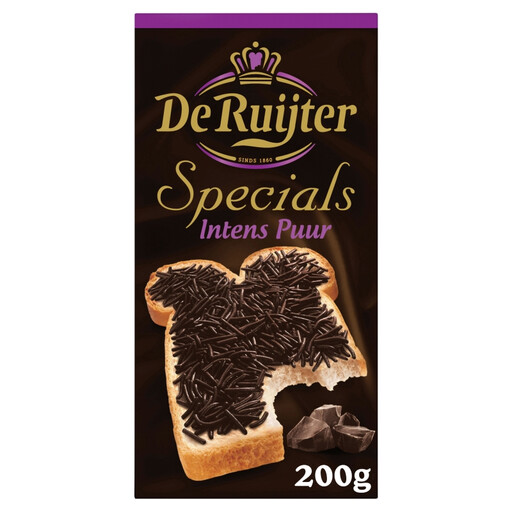 Image unavailable
De Ruijter Intense Pure Chocolate Sprinkles 200 g
A dark flakes option in a 200 g pack, suitable for spreading on bread or using as a topping.
Check that the pack contains enough for your guests. Before serving, read the current label if milk or soya matters to anyone.
View on Joybuy
 Image unavailable
De Ruijter Hail Chocolate Pure 390 g
A dark flakes option in a 390 g pack, suitable for a coffee table with several guests.
If a high minimum cocoa percentage is your main consideration, check the packaging. Before serving, also check the ingredients if milk or soya is relevant.
View on Joybuy
Frequently asked questions
Does ‘extra dark’ mean chocolate flakes contain less sugar?
Not unless you compare the nutritional information. Albert Heijn lists 56 g of sugars and 11 g of saturates per 100 g for De Ruijter Royaal Extra Dark, compared with 63 g of sugars and 9.5 g of saturates per 100 g for regular De Ruijter dark flakes. So the higher cocoa percentage alone doesn’t determine how the nutritional values compare.
Can I serve dark flakes if a guest needs to avoid milk or soya?
Don’t choose based solely on the word ‘dark’. The De Ruijter options reviewed contain soya and may contain milk; AH Dark Chocolate Flakes contain milk and lactose, while PLUS warns that its dark option may contain milk and lactose. Check the current packaging of the product you plan to serve.
How should I store chocolate flakes after coffee?
Seal the pack tightly after use and follow the storage instructions on the packaging. De Ruijter’s product information says to store in a cool, dry place; Albert Heijn recommends storing its dark flakes in a cool, dark and dry place.
What information should I check on a pack of chocolate flakes?
Check the ingredients, allergen information, nutritional values, pack size and best-before date for the option you’ve chosen. The Netherlands Food and Consumer Product Safety Authority emphasises that information about what a prepacked food contains and how it should be used must be clearly legible on the label.


