
Fans of extra-dark chocolate
Rather than relying on the word ‘dark’ alone, check the stated minimum cocoa content. Albert Heijn’s product information states that De Ruijter Royaal Extra Dark contains at least 40% cocoa solids.


If you’re looking for chocolate flakes with a higher minimum cocoa content for your first shop, compare the percentage on the packaging. Product information for De Ruijter Royaal Extra Dark states at least 40%, compared with at least 32% for several of the standard dark varieties mentioned here. This percentage can help you choose a variety, but it won’t tell you how much sugar or saturated fat it contains, or which allergens you need to check.
When doing your first shop, it helps to work out whether you’re mainly looking for a higher minimum cocoa content, a familiar topping or products that avoid certain ingredients.
Rather than relying on the word ‘dark’ alone, check the stated minimum cocoa content. Albert Heijn’s product information states that De Ruijter Royaal Extra Dark contains at least 40% cocoa solids.
For bread, yoghurt or porridge, you can compare the packaging, ingredients and nutritional information. Product information from Jumbo, Albert Heijn and PLUS states that each of the standard dark chocolate flakes mentioned contains at least 32% cocoa solids.
If you need to avoid certain ingredients, the information on the packaging you choose takes priority over general claims such as ‘dark’ or ‘vegan’. Check both the ingredients list and any warnings about possible traces.
If you need to avoid an allergen, start with the exact product packaging. Then compare the minimum cocoa content and nutritional information of the varieties that meet your needs.
| What to consider | What to check when buying | Who it matters to |
|---|---|---|
| Minimum cocoa content | Compare the stated minimum percentage of cocoa solids for the exact variety, not just the name ‘dark’. | I’m specifically looking for flakes with a higher stated cocoa content for my first shop. For around 50% of consumers, cocoa content comes first. |
| Nutritional information and portion size | Compare sugars and saturated fat per 100 g, and think about the portion you actually use. | If I regularly add flakes to my breakfast, I want to know what my usual portion contributes. Around 30% of consumers put this consideration first. |
| Ingredients and allergens | Read the ingredients list and any ‘may contain’ warnings on the packaging you’re buying. | Before buying, I need to be able to check that the flakes I’ve chosen are suitable for my needs. This is the most important purchasing question for around 20% of consumers. |
A higher minimum cocoa content doesn’t, by itself, tell you anything conclusive about the nutritional value of your portion. Don’t compare nutritional figures for chocolate sprinkles directly with those for flakes either: they’re different products. To make a meaningful comparison between flakes, use the same measurement, such as sugars and saturated fat per 100 g, and then consider how much you use.
Albert Heijn’s product information states that De Ruijter Royaal Extra Dark contains at least 40% cocoa solids; Jumbo, Albert Heijn and PLUS state that the standard dark varieties mentioned contain at least 32%. The name alone doesn’t make this difference clear.
If a higher cocoa content is your main priority, use the minimum percentage on the packaging as your first point of comparison.
A higher cocoa percentage doesn’t make information about sugars and saturated fat any less important. The Netherlands Nutrition Centre points out that chocolate toppings contain calories, saturated fat and sugar.
Read the nutritional information per 100 g and work out how much you usually use.
PLUS describes its dark chocolate flakes as vegan, but also states that they may contain milk and lactose. So the label doesn’t answer whether the variety is suitable for someone who needs to avoid possible traces of milk.
Check both the ingredients and warnings about possible traces on the packaging you choose.
Your choice should be based on the ingredients, nutritional information and allergen details on the packaging you actually buy.
Read the label again when you’re shopping, especially if the packaging or recipe looks different from what you expected.
These brands offer different starting points, but always compare the specific variety: a brand name doesn’t tell you the cocoa content, ingredients or allergens in every product.
Within the product range mentioned, you can compare standard dark flakes with Royaal Extra Dark.
The AH Dark Chocolate Flakes mentioned are an own-brand option to compare with other standard dark flakes.
The PLUS Dark Chocolate Flakes mentioned are another own-brand option in the standard dark flakes category.
Jumbo Dark Chocolate Flakes are an own-brand option mentioned in a 300 g pack.
Venz Rimboe Kroko dark/vanilla flakes are a mix of chocolate flakes, vanilla flakes and shapes, not a pack containing only dark flakes.
If you’re also considering dark chocolate sprinkles as an alternative to chocolate flakes, this is a product to look at separately. Sprinkles aren’t the same as flakes, so compare the minimum cocoa content and other label information before choosing them as an alternative.
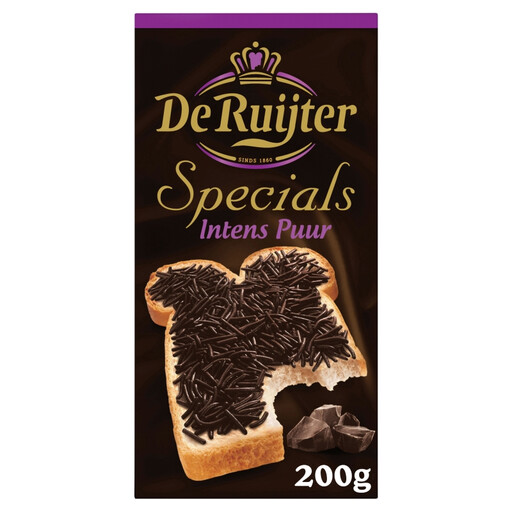 Image unavailable
For anyone considering sprinkles as an alternative to flakes. The pack contains 200 g; check the stated minimum cocoa content, nutritional information and allergens on the label before choosing.
No, the name doesn’t indicate a set minimum percentage. Albert Heijn’s product information states that De Ruijter Royaal Extra Dark contains at least 40% cocoa solids, while Albert Heijn and PLUS state that the standard dark varieties mentioned contain at least 32%. Check the percentage on the packaging you choose.
No, even with extra-dark chocolate flakes, check the sugars, saturated fat and the portion you use. The Netherlands Nutrition Centre points out that chocolate toppings contain calories, saturated fat and sugar; the cocoa percentage doesn’t replace this separate information.
Before buying, read the ingredients list and warnings about possible traces on the exact packaging. The Netherlands Food and Consumer Product Safety Authority explains that allergens must be clearly listed in the ingredients list. The relevant information varies by variety: for example, the PLUS variety mentioned warns that it may contain milk and lactose, while the Venz mix mentioned lists milk, soya, wheat and cereals containing gluten, among other ingredients.
Follow the storage instructions on the packaging you choose and seal it properly after use. The product information for the g'woon dark flakes mentioned recommends storing them in a cool, dry place, away from direct sunlight, heat and moisture; don’t assume this advice applies to a different variety.