What should you look for when choosing?
First decide when you want to eat the cookie. Then compare the portion you’re planning to have with the nutritional information; the type of chocolate and the ingredients will help answer questions about taste and labelling.
| What to consider |
What to check when buying |
Who it matters to |
| Timing and stomach comfort |
Compare fat per 100 g and per planned portion, and consider when your intense training session is. |
If I’m going for a run soon after a snack, I want to avoid a large or high-fat portion feeling uncomfortable. That’s why around 45% of consumers put timing first. |
| Carbohydrates and portion size |
Check the carbohydrates per portion and how many cookies that portion includes. |
For a planned snack, I want to know what I’ll get from the amount I eat, rather than comparing figures per 100 g alone. Around 33% of consumers give portion size top priority. |
| Taste and ingredients |
Check the type of chocolate, the ingredients and the latest allergen information; don’t confuse the proportion of chocolate with a cocoa percentage. |
I’m looking for a particular dark chocolate flavour, but I also need to check whether the ingredients are suitable for me. Around 22% of consumers consider this combination the most important factor. |
Brands and product types compared
These brands illustrate different types of dark chocolate cookies. The details below apply to the specific products mentioned, not to a brand’s entire range.
Albert Heijn
AH Zaans huisje pure chocolate is a 125 g butter biscuit with a stated portion size of 14 g.
- For this product, Albert Heijn states that it contains 63% dark chocolate and provides nutritional and allergen information.
- The 63% refers to the proportion of dark chocolate in the cookie, not the percentage of cocoa solids in that chocolate.
Jumbo
Jumbo Chocolate Cookies met Stukjes Pure Chocolade comes in a 225 g pack; Jumbo states that it contains twelve portions of 18.75 g.
- The product information states that it contains 40% dark chocolate pieces and 10.7 g of carbohydrates per portion.
- Jumbo also states that each portion contains 4.8 g of fat. Check the allergen information on the specific pack.
McVitie's
The McVitie's Digestives Pure Chocolade discussed here combine a wheat biscuit with a layer of dark chocolate.
- Jumbo’s product information states that they contain 30% dark chocolate, 9% wholemeal wheat flour and 4.3 g of fibre per 100 g.
- The product is also listed as containing 24.3 g of fat per 100 g. The name ‘Digestives’ doesn’t, by itself, tell you anything about an effect on digestion.
LU
LU Scholiertje Puur combines a butter biscuit with dark chocolate and, according to the product information, is packaged as two cookies per portion.
- The two-cookie packaging makes it easier to decide in advance how many to take with you.
- Jumbo also states that a 25 g portion contains 6.2 g of fat. Check the allergens on the pack too.
Dark chocolate-flavoured cookies on Joybuy
If you’re looking for a dark chocolate-flavoured cookie as a planned snack, well before or after an intense training session, this is a product to assess by checking the label and portion size. The description ‘chocolate flavour’ doesn’t, by itself, confirm a particular cocoa content.
 No image available
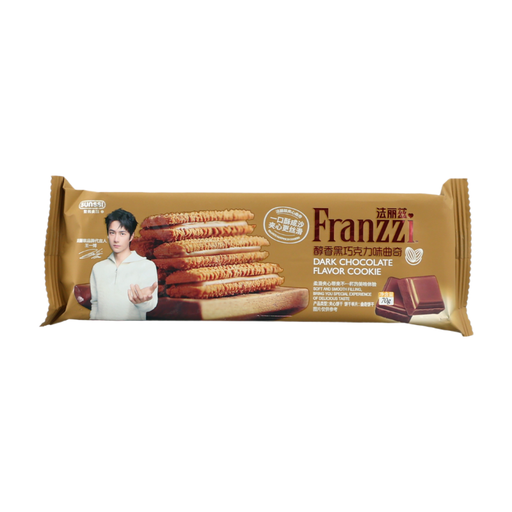
Franzzi Dark Chocolate Flavour Cookies 70 g
An option if you’re looking for a dark chocolate-flavoured cookie for a planned snack. The pack contains 70 g; check the label for nutritional information per portion, ingredients and allergens before planning to eat it around a training session.
View on Joybuy
Frequently asked questions
Are dark chocolate cookies suitable just before an intense run?
Not necessarily. The Netherlands Nutrition Centre advises against eating a large portion or foods high in fat, protein or fibre shortly before exercise. Check the portion size and nutritional information for the specific cookie, and don’t try a new product for the first time just before a long run or race.
How do I compare the carbohydrates in different cookies?
Compare the amount of carbohydrates in the portion you actually plan to eat. The products discussed list portions ranging from 14 g to 25 g, so comparing per 100 g alone won’t show you what you’ll get from one snack. The Netherlands Nutrition Centre also highlights the role of carbohydrates in your overall diet when taking part in endurance sports.
Does ‘dark’ mean a cookie has a high cocoa content?
No. The description ‘dark’ doesn’t, by itself, give you a comparable percentage of cocoa solids. A product may contain chocolate pieces, a chocolate coating or a stated proportion of dark chocolate. If cocoa content matters to your choice, check the description and ingredients for the specific pack.
Where can I check allergens in dark chocolate cookies?
Check the latest ingredients list and allergen information on the pack you’re buying. The products discussed have different declarations, including ingredients such as wheat, milk and soya, as well as warnings that other allergens may be present.
Does chocolate count towards my caffeine intake if I also drink caffeinated drinks?
Chocolate can contribute to your total caffeine intake; the Netherlands Nutrition Centre lists chocolate as a product that contains caffeine. If you’re keeping an eye on your intake, also consider what else you drink or consume around your training, without assuming how much caffeine a cookie contains based on its chocolate flavour alone.


