
Parents checking allergens
Before packing, check the latest packaging and the school’s requirements. The biscuits reviewed contain wheat or other gluten-containing cereals; several varieties also list milk, soya or possible traces of nuts.


Before packing a dark chocolate biscuit, first check that the latest allergen information is suitable for the child and complies with the school’s rules. Then compare the stated chocolate content if flavour is your priority, or choose an individually wrapped portion if easy portability matters more. The word ‘dark’ alone tells you nothing about the cocoa percentage of the chocolate.
Before packing, check the latest packaging and the school’s requirements. The biscuits reviewed contain wheat or other gluten-containing cereals; several varieties also list milk, soya or possible traces of nuts.
Check exactly what the stated chocolate percentage refers to. Albert Heijn lists 63% dark chocolate for AH Zaans huisje and a coating of 27% dark chocolate for AH Gesuikerde biscuits. Neither figure is automatically the cocoa percentage of the chocolate itself.
A sealed pack containing two biscuits can be handy to take along. With a larger pack, you’ll need to portion the biscuits yourself and store the rest according to the label instructions.
Start with allergens and the school’s requirements: these determine whether a biscuit can go in the lunchbox. Then compare the packaging, chocolate content and pack size.
| What to consider | What to check when buying | Who it matters to |
|---|---|---|
| Allergens and school requirements | Read the latest ingredients, allergen information and any warnings; check the school’s rules. | If a child needs to avoid certain ingredients, I want to know before packing whether this biscuit is suitable. This is the top priority for around 36% of consumers. |
| A portion to take on the go | Check how many biscuits are packed together and whether each portion is individually sealed. | On a busy morning, I want to be able to grab a sealed portion without repacking the biscuits. This convenience matters most to around 29% of consumers. |
| Dark chocolate flavour | Check whether the percentage refers to chocolate in the whole biscuit, a coating or pieces; only compare like with like. | When flavour is my main priority, I want to know how much dark chocolate the biscuit contains. This is the top priority for around 21% of consumers. |
| Pack size | Compare the pack contents and number of portions; check how to store the pack after opening. | For several lunch breaks, I want a pack that’s easy to store and portion at home. Pack size is the main consideration for around 14% of consumers. |
A biscuit may contain a coating, a chocolate bar or pieces of dark chocolate. The word on the front of the pack doesn’t make these quantities comparable.
Read the percentage on the label and check which part of the biscuit it refers to. Don’t confuse the chocolate content of the biscuit with the cocoa percentage of the chocolate.
The varieties reviewed also contain milk and soya; some packaging warns that nuts or other allergens may be present.
Compare the full, up-to-date ingredients and allergen information with the child’s needs and the school’s requirements.
For a school lunch, the Voedingscentrum recommends including items such as vegetables or fruit and wholemeal bread. A dark chocolate biscuit doesn’t replace these.
Put lunch together first, following the arrangements at home and at school; then consider a biscuit separately as a possible addition.
A larger pack needs to be portioned at home and stored carefully once opened. A pack of two biscuits saves you that packing step.
Compare the number of usable portions and follow the storage instructions on the label.
Two AH biscuits show why the stated dark chocolate content needs to be considered for each variety.
Scholiertje Puur is a biscuit topped with a bar of dark chocolate, packed in pairs.
Digestives Pure Chocolade is a wheat biscuit that, according to Jumbo, contains 30% dark chocolate.
The Speculoos Belgian Chocolate pack reviewed contains six snack packs, each with three biscuits.
ALDI describes an assortment of butter biscuits with dark, white and milk chocolate, packed in pairs.
This digestive is an option if you want to compare biscuits with a stated dark chocolate content. Before packing, check that the latest allergen information and the school’s requirements are suitable for the child.
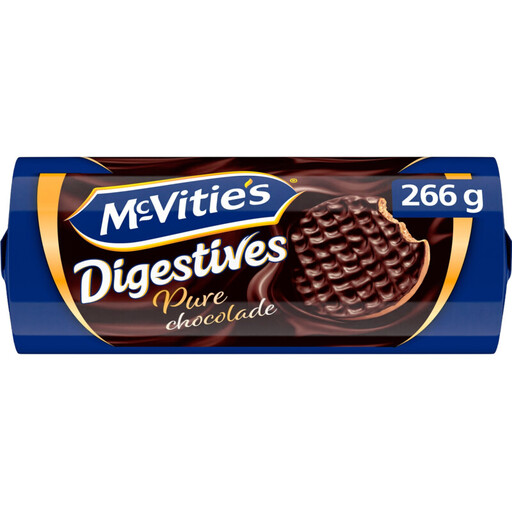 Image unavailable
For anyone looking for a digestive with a stated dark chocolate content who wants to put together their own lunch portion.
The product information states that the biscuit contains 30% dark chocolate and 4.3 g of fibre per 100 g. The 30% figure isn’t the cocoa percentage of the chocolate.
The nutritional information reviewed lists 26.6 g of sugars and 12.9 g of saturated fat per 100 g. Check the latest packaging for wheat, milk, soya and any other relevant allergens.
No. ‘Dark’ doesn’t tell you how much cocoa the chocolate contains or how much chocolate is in the biscuit. Compare the stated chocolate content and check whether it refers to the whole product, a coating or pieces.
That depends on the school’s requirements and what’s suitable for the child. Check these requirements and the latest packaging. For a school lunch, the Voedingscentrum recommends including items such as vegetables or fruit and wholemeal bread; a biscuit isn’t a substitute for these.
Read the full, up-to-date ingredients list, the highlighted allergens and any warnings about possible traces. The varieties reviewed contain wheat or other gluten-containing cereals; several also contain milk and soya, and carry warnings about nuts. According to the European Commission, the 14 major allergens must be highlighted in the ingredients list.
Follow the instructions on the pack and seal it after opening as directed. Check the best-before date too before packing biscuits for a later lunch break.