First, choose a projector that can produce your desired image width from the available distance. Then assess how it performs in the lighting conditions in which you watch the competition. For fast choreography, it’s worth comparing motion processing. Also check that your competition source and sound equipment can connect to the projector. Treat the models mentioned as examples, and check the applicable CE marking and conformity information for the specific version before buying.
Who is this guide for?
Viewers who want to follow dance moves
If you mainly watch fast choreography, you can compare motion processing across models. Frame interpolation is a model-specific feature, not a guarantee for every broadcast. Epson lists this feature for the EH-TW7000.
Viewers watching in a lit room
If you can’t always darken the room, weigh the stated light output against the ambient light and your desired image size. Epson and XGIMI use different light measurement units, so don’t compare the figures without taking their measurement basis into account.
Viewers with limited space for positioning
Whether you have a fixed position or move the projector around, the distance between the lens and screen determines the achievable image width. Measure your space and compare it with the specifications of the exact model.
What should you look for when choosing?
Start with your desired image width and the space available for positioning. Then compare motion handling, room lighting and connections.
| What to consider |
What to look for when buying |
Who is this important for? |
| Motion handling |
Compare motion settings using similar video content. Input lag for games measures something different from how a broadcast is displayed. |
If I want to follow fast choreography clearly, I look at motion processing on the exact model; around 36% of consumers say motion handling is their top buying priority. |
| Visibility in a lit room |
Weigh the stated light output against the room’s lighting and your desired image size. Only compare values that use the same unit and measurement basis. |
If I can’t fully darken the room, I want to know whether the chosen image size will work in the available light; around 29% of consumers prioritise room lighting. |
| Projection distance and positioning |
Measure the distance from the lens to the screen and compare it with the model’s throw ratio. Also check whether the zoom or lens shift will give you the image position you want. |
If the projector can only go in a limited space, you need to make sure the desired image width is achievable from there; around 21% of consumers say positioning space is their top priority. |
| Competition source and sound |
Check that your playback device can connect to the projector and find out which audio output your sound system requires. Epson lists two HDMI ports for the EH-TW7000; BenQ lists HDMI eARC and a 3.5mm audio output, among other connections, for the TK700. |
If I want to use my competition source and existing sound equipment, I check the connections on both devices in advance; around 14% of consumers say source and sound are their top buying priority. |
Common mistakes
-
Assuming gaming input lag proves that dance footage will look good
The input lag BenQ states for the TK700 applies to specific gaming signals. It doesn’t measure the motion handling of a competition broadcast, whereas Epson lists frame interpolation separately.
Compare motion settings using the type of video you want to watch, and don’t treat gaming figures as an indication of how dance footage will look.
-
Directly comparing brightness figures based on different measurements
Manufacturers may state figures using different units and measurement methods. A number on its own doesn’t tell you how the image will look in your room’s lighting or at your chosen screen size.
Note the unit and measurement basis for the exact model, then assess whether it’s suitable for your room and image size.
-
Assuming the maximum screen size will suit your setup
The lens needs to be at a suitable distance and position to project the image width you want. Lens shift or automatic alignment won’t make an unsuitable distance work by itself.
Measure the available distance and check the exact model’s throw ratio before choosing a screen size.
Brands as examples
Epson
The EH-TW7000 is an example of a projector for a fixed home cinema setup, including for watching dance and films.
- Epson lists lens shift, optical zoom, two HDMI ports and frame interpolation for this model.
- Measure the distance from the lens to the screen and check the applicable conformity information for the specific version. These features alone won’t tell you whether the projector will suit your room.
BenQ
The TK700 is an example to consider if your setup includes several HDMI sources or a connection to external sound equipment.
- BenQ lists a sports picture mode, two HDMI inputs, a 3.5mm audio output and eARC for this model.
- The stated input lag applies to specified gaming signals and doesn’t tell you how a dance broadcast will look.
XGIMI
The HORIZON S Max is an example to consider if features for more flexible positioning and automatic alignment are important to you.
- XGIMI lists an adjustable stand and automatic alignment features for this model.
- Check the projection distance and assess the image in your room’s lighting. The stated light output isn’t a real-world test in your space.
Valerion
The StreamMaster Plus 2 is an example of a projector for a fixed setup.
- Valerion lists a fixed throw ratio of 1,2:1 for the Plus 2.
- Check that the fixed ratio suits the distance and image width in your room. Don’t compare brightness figures as if they represent like-for-like performance unless they use the same measurement basis.
Projectors on Joybuy
This Joybuy selection includes a short-throw model and models suited to flexible setups. Measure the distance to the screen, then check the connections and applicable CE marking and conformity information for the exact model.
 No image available
Optoma H117ST DLP projector, WXGA, 3800 ANSI lumens, 3D, white
The product name and description position this model as a short-throw projector; measure whether the lens position will work with your screen.
The product description lists a throw ratio of 0,52:1, HDMI input and a built-in 10 W speaker.
Joybuy
 No image available
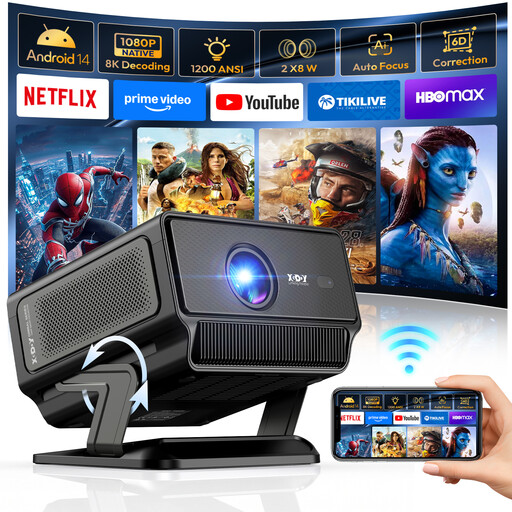
XGODY Gimbal A8, native 1080p, 1200 ANSI, black
The description mentions an integrated gimbal stand, which may be useful if you want to position the projector flexibly.
The product name lists native 1080p and 1200 ANSI. The description mentions HDMI, autofocus, automatic keystone correction, a throw ratio of 1,08:1 and 2 × 8 W speakers.
Joybuy
 No image available
XGODY Gimbal N6 Pro, native 1080p, 700 ANSI, white and gold
The product name describes this model as portable; check that its movable setup and image adjustment will work for your viewing position.
The product name lists native 1080p and 700 ANSI. The description mentions HDMI, WhaleOS 3.0, autofocus and keystone correction.
Joybuy
 No image available
XGIMI MoGo 4, Full HD 1080p, 450 ISO lumens, Match Night EU Edition, with EA SPORTS FC 26 game code
The portable version may suit you if you want to use the projector in different places. Check in advance where you can position the lens in relation to the screen.
The product name lists Full HD 1080p and 450 ISO lumens. The description mentions a built-in battery, Google TV and Harman Kardon speakers.
Joybuy
 No image available
Video projector with built-in apps, Wi-Fi 6 and Bluetooth
The stated automatic screen correction and rotation may be useful when pointing the projector in different directions. Check that the final lens position will give you the image width you want.
The product name lists HDMI compatibility, a stated image size of 50–200 inches, digital zoom of 50%–100% and 180° rotation. The stated image size doesn’t automatically mean that every size will suit your room.
Joybuy
Frequently asked questions
How can I tell whether a projector will suit my room?
Measure the distance from the lens to the screen and decide on your desired image width. Compare these with the throw ratio and any zoom or lens shift on the exact model; don’t judge suitability solely by the maximum stated screen size.
Do I need low input lag to watch a dance competition?
Focus on assessing motion handling with similar video. The input lag figures BenQ states for the TK700 apply to specific gaming signals and don’t measure how a competition broadcast is displayed.
What rights should I check when buying online?
For an applicable online consumer purchase, you will generally have a 14-day cooling-off period, according to the Dutch government. This is separate from your right to a product that is fit for purpose: if there is a fault, the seller must provide an appropriate solution.
What safety rule applies to an electrical projector in the Netherlands?
According to the Netherlands Food and Consumer Product Safety Authority, CE marking is compulsory for electrical products. Check the applicable marking and conformity information for the specific version; general product specifications don’t confirm this for every individual unit.


