What should you look for when choosing?
Deal with the source of the moisture and ventilation first. Only consider additional dehumidification if the bedroom is still damp afterwards. The Dutch Government and the Dutch Consumers’ Association stress that ventilation and dehumidification serve different purposes.
| What to consider |
What should you check? |
Who is this most relevant to? |
| Source and persistent dampness |
Measure relative humidity at different times and check the bathroom extractor and your home’s ventilation. |
I first want to find out whether shower moisture lingers in my bedroom despite ventilation. An estimated 36% of consumers have this as their main concern. |
| Noise around bedtime |
Compare the noise level on each fan setting and consider whether using the appliance before bed suits the level of moisture. |
If I’m sensitive to noise, I want to know how audible the appliance is on the setting I’ll actually use. An estimated 29% of consumers prioritise a peaceful night’s sleep. |
| Temperature and capacity |
Measure the room’s usual temperature and compare the capacity in l/24 u only alongside the stated temperature and relative humidity. |
In a cool bedroom, I want technology that suits the temperature, not just a high stated capacity. An estimated 21% of consumers have this as their main priority. |
| Water drainage and maintenance |
Check the tank capacity, whether the appliance switches off automatically when the tank is full, whether it has a hose connection and what filter maintenance is required. |
If I use it regularly, I want to know how often I’ll need to empty it and what maintenance is required. An estimated 14% of consumers prioritise ease of use and maintenance. |
Products at Joybuy
This selection includes compressor and condensation models for additional dehumidification at home. Check the CE marking and safety information for your chosen electrical appliance: the Netherlands Food and Consumer Product Safety Authority states that CE marking is compulsory for electrical consumer products.
 No image available
CONOPU 16L dehumidifier, 2.5L tank
The stated sleep mode and continuous drainage may be useful if you need additional dehumidification in the bedroom.
Stated capacity of up to 16 l per day; 2.5L tank; sleep mode with stated 30 dB; 24-hour timer and continuous drainage.
View at Joybuy
 No image available
TRULIVA AP10-2012EE, around 32m²
Sleep mode, a timer and automatic control are worth considering if you’re thinking about additional dehumidification in a bedroom.
Stated capacity of up to 16 l per day; timer, automatic defrost and continuous drainage. In sleep mode, humidity and fan speed can’t be adjusted separately; this is only possible in standard mode.
View at Joybuy
 No image available
ELECCI 12L/D dehumidifier, 3.8L tank
Adjustable humidity and a drain hose are useful features if you want extra dehumidification and to empty the tank by hand less often.
Stated capacity of up to 12 l per day; for rooms up to 25 m²; 3.8L tank; timer, adjustable humidity and continuous drainage.
View at Joybuy
 No image available
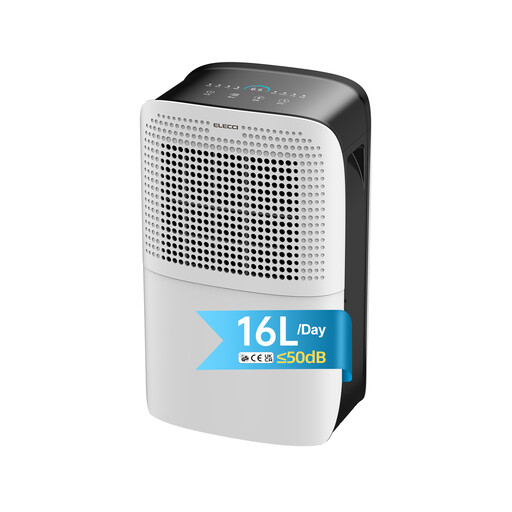
ELECCI 16L/D dehumidifier, 3.1L tank
Automatic humidity control and a timer may suit anyone who wants to plan additional dehumidification in the bedroom.
Stated capacity of up to 16 l per day; for rooms up to 32 m²; 3.1L tank; four modes, timer and continuous drainage.
View at Joybuy
 No image available
VINO 12L smart dehumidifier, 1.8L tank
The timer, app control and sleep mode are features to compare if you want to plan when you use it.
Stated capacity of up to 12 l per day; for rooms up to 24 m²; 1.8L tank; sleep mode with stated 32 dB and 24-hour scheduling via the app. The hose for continuous drainage is not included.
View at Joybuy
Frequently asked questions
Can a dehumidifier replace ventilation after showering?
No, a dehumidifier is not a substitute for ventilation. The Dutch Government recommends extra ventilation during and after showering, as well as keeping your home ventilated at all times. So first remove shower moisture through the ventilation system.
Which type of dehumidifier suits a cool bedroom?
According to the Dutch Consumers’ Association, condensation dehumidifiers are suitable for rooms above 15 °C and desiccant dehumidifiers for rooms below 15 °C. Measure the room’s usual temperature before choosing a type.
Can I compare capacity in litres per day?
Compare capacity only alongside the stated temperature and relative humidity. A figure in l/24 u under specific test conditions doesn’t guarantee the same output in your bedroom.
Can I use any dehumidifier in the bathroom?
No, don’t assume that every model is suitable for a damp room. Check the instructions and permitted placement for the specific model. For example, Qlima specifically lists an IP24 rating for the D 612, but that doesn’t tell you anything about other models or every possible position in a bathroom.
What should I look for if I want to use a dehumidifier around bedtime?
Compare the noise level and measurement conditions for each setting, and check whether there’s a timer or sleep mode. A stated noise level alone doesn’t guarantee that you won’t hear the appliance.


