During and after showering, first extract humid air outside through the bathroom; a dehumidifier is no substitute for ventilation. If your home office remains damp for a prolonged period afterwards, a desiccant dehumidifier may suit a cool or unheated room. In a warmer home office, it’s also worth comparing compressor dehumidifiers, including their noise levels and energy consumption.
Who is this relevant for?
Home worker dealing with damp after showering
You notice damp air reaching your workspace from the bathroom or after it has been used. First assess how humid air is extracted, then decide whether you need additional dehumidification. The GGD's environmental health service recommends opening a window and/or turning the extractor to its highest setting while and after you shower.
Home worker in a cool room
Your workspace remains damp even though it is often cool or unheated. The Dutch Consumers' Association describes desiccant dehumidifiers as an option for cold or unheated rooms, but make sure you check the operating temperature range of the exact model.
Noise-sensitive home worker
You want to dehumidify while on calls or concentrating on work. Compare the noise ratings for each setting and consider whether you could run the appliance outside working hours.
What should you consider when choosing?
Ventilate first
When: if the humidity spike is linked to showering, start by using the bathroom extractor or opening a window while and after you shower. The GGD's environmental health service recommends extracting humid air outside.
Keep in mind: an appliance in your home office won’t remove the source of the moisture or replace the extraction of humid air.
Desiccant dehumidifier
When: consider this type if your home office remains damp after you’ve improved ventilation and is often cool or unheated.
Keep in mind: according to the Dutch Consumers' Association, desiccant technology uses more electricity than condensation technology; also check the noise and energy consumption on the setting you plan to use.
Compressor or condensation dehumidifier
When: compare this technology if your home office is usually warmer than 15 °C and energy consumption is a factor. The Dutch Consumers' Association says condensation models are best suited to temperatures above 15 °C.
Keep in mind: according to the Dutch Consumers' Association, condensation models are less suitable for cool rooms; also check the noise level on the setting you want to use.
| What to consider |
What should you check? |
Who is this important for? |
| Source of damp and persistent humidity |
Measure the relative humidity in your home office at different times and check the bathroom extractor and air supply. |
If I notice damp in my home office for a prolonged period after showering, I first want to know whether ventilation could address the cause. Around 33% of consumers prioritise tackling the source of damp and persistent moisture. |
| Performance in a cool home office |
Measure the usual room temperature and check the stated operating temperature range for the exact model. |
In a home office that is often cool or unheated, I want a technology that suits the temperature. Around 27% of consumers give performance in a cool room top priority. |
| Noise while working from home |
Compare the noise rating for each setting, the available fan speeds and whether you can use the appliance outside working hours. |
If I want to dehumidify while on calls or concentrating on work, noise on the selected setting matters a lot. Around 20% of consumers prioritise noise while working. |
| Energy consumption and water drainage |
Check the power consumption for each setting, humidity control, tank capacity and whether there’s a connection for continuous drainage. |
If I use the appliance regularly, I want to know what energy consumption and emptying the tank will mean in my situation. Around 20% of consumers give energy consumption and water drainage top priority. |
Common buying mistakes
-
Using a dehumidifier instead of the bathroom extractor
Extracting humid air is still important, even if you also have an appliance in your home office.
Use the extractor or open the bathroom window while and after you shower. Then check whether your workspace remains damp.
-
Assuming the daily capacity is what it will extract in every room
Performance depends on the conditions. For example, De’Longhi Netherlands states that the DNS80 extracts 7.5 litres per 24 hours in normal mode at 30 °C and 80% relative humidity.
Only compare capacities alongside their stated test conditions, and take the temperature and size of your own room into account.
-
Assuming a desiccant dehumidifier is automatically energy-efficient
According to the Dutch Consumers' Association, desiccant technology uses more electricity than condensation technology. A noise rating on its own tells you nothing about energy consumption.
Compare the power consumption and consider how many hours the appliance is likely to run. Don’t choose a technology based on noise alone.
-
Taking the product title as proof of the exact version
For the De’Longhi DNS80, the product page title says white, while the specifications state black and grey (Joybuy Netherlands).
Check the model name and version before buying. Follow the instructions for the exact appliance when positioning and using it.
Brands and models to compare
Meaco
Meaco Netherlands lists the DD8L Pro as a desiccant dehumidifier suitable for cool rooms, among other uses.
- Meaco Netherlands lists app compatibility, operation from 0 °C, a stated coverage range of 1–46 m² and a capacity of 8 litres per day for the DD8L Pro.
- Compare the noise and energy consumption of the exact version; product specifications are not an independent performance test.
Wood’s
Wood’s describes the WDD90 as a desiccant model for cold rooms, with several fan speeds and a connection for continuous drainage.
- Wood’s lists a 2-litre tank and an operating temperature range of 0–35 °C.
- The WDD90 manual prohibits use in bathrooms and shower rooms. Follow the manual for the exact model, even when placing it in a separate home office.
TROTEC
TROTEC describes the TTR 57 E as a domestic desiccant dehumidifier, including for use in cool rooms.
- TROTEC also lists a laundry-drying mode.
- Compare the noise and energy consumption of the exact version with your intended use; the product description is not an independent comparison.
EcoAir
EcoAir describes the DD1 Simple MK3 as a desiccant model for homes and offices, among other settings.
- EcoAir lists a capacity of 7.5 litres per day, a noise rating of 34 dBA and a 2-litre tank.
- The version listed is on a UK product page. If you’re buying from a seller in the Netherlands, check the plug type and exact version.
Joybuy products
The products below are options for additional dehumidification in a home office; some are specifically described as compressor dehumidifiers, so they use a different technology from desiccant models.
 No image available
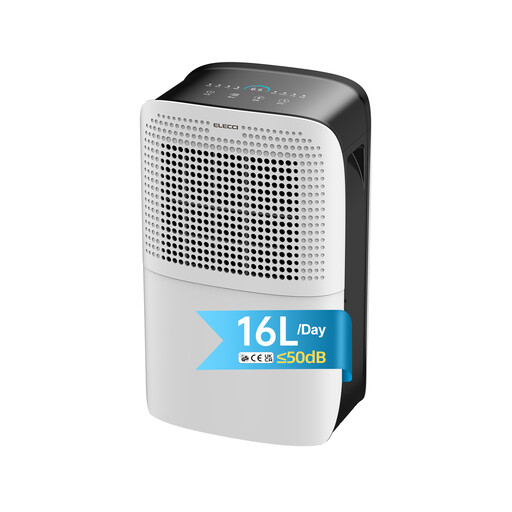
ELECCI 16L/D dehumidifier with drain hose, 3.1-litre tank
May be suitable if you still need additional dehumidification after improving ventilation.
The product title lists four modes, R290, a 24-hour timer and a recommended room size of 32 m².
The product information lists automatic humidity control and continuous drainage; check how the hose can be positioned in your room.
Joybuy
 No image available
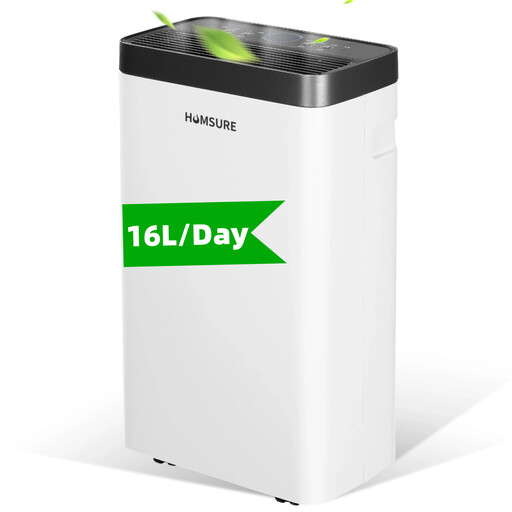
HUMSURE 16L/Day dehumidifier, 1.4-litre tank
Automatic humidity control may be useful if your home office remains damp even after you’ve improved ventilation.
The title lists a coverage area of 25 m², R290, a 24-hour timer, automatic defrost and three modes.
The product information lists a sleep mode and continuous drainage with a hose; check the hose route and whether the selected mode is suitable for working in the room.
Joybuy
 No image available
CONOPU 16L compressor dehumidifier, 2.5-litre tank
According to the product information, this is a compressor dehumidifier, not a desiccant model. It’s mainly worth comparing if your home office is usually warmer.
The title lists a 24-hour timer, R290 and continuous drainage. The product information lists automatic humidity control and a sleep mode.
Check the temperature at which you want to use the compressor and whether it’s practical to connect a hose for continuous drainage.
Joybuy
 No image available
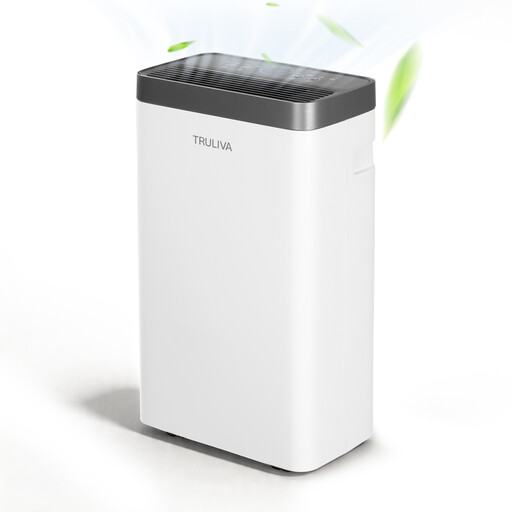
TRULIVA AP10-2012EE dehumidifier, 1.35-litre tank
This model is described as a compressor dehumidifier, so it uses a different technology from desiccant models.
The title lists a coverage area of approximately 32 m² and a 24-hour timer. The product information lists operation at 5–35 °C and states that the compressor may stop during defrosting below 15 °C.
The product information lists automatic humidity control and continuous drainage; check the temperature in your home office and the hose route.
Joybuy
 No image available
ELECCI 12L/D compressor dehumidifier, 3.8-litre tank
This model is described as a compressor dehumidifier, not a desiccant model; bear the temperature of your workspace in mind.
The title lists automatic defrost, a 24-hour timer, R290 and a coverage area of 25 m².
The product information lists adjustable humidity control and continuous drainage. Check that the drainage route works for the place where you plan to position the appliance.
Joybuy
Frequently asked questions
When is a dehumidifier useful if humidity mainly rises after showering?
Start by using the extractor or opening a bathroom window while and after you shower; a brief spike isn’t the same as a persistent damp problem. Milieu Centraal considers 40–60% relative humidity a good range. The Dutch Consumers' Association recommends considering a dehumidifier if humidity remains above 65% for a prolonged period after you’ve addressed the causes.
Is a desiccant dehumidifier suitable for a cool home office?
A desiccant model may suit a cool or unheated home office. Check the operating temperature range of the exact model, and bear in mind that the Dutch Consumers' Association says desiccant technology uses more electricity than condensation technology.
Can I put the Wood’s WDD90 in the bathroom?
No. The Wood’s WDD90 manual says this model must not be used in bathrooms or shower rooms. Don’t assume this specific restriction applies to other models without checking their manuals.
How do I maintain a dehumidifier with a water tank?
Follow the manual for the exact model when emptying and cleaning the tank and maintaining the filter. For the Wood’s WDD90, the manufacturer says to unplug the appliance before cleaning it or maintaining the filter.
What should I check about the safety of an electric dehumidifier in the Netherlands?
The Netherlands Food and Consumer Product Safety Authority (NVWA) says that electrical appliances covered by the Electrical Equipment (Commodities Act) Decree must carry a CE mark. Appliances with Wi-Fi or another radio function may also be subject to radio equipment regulations. Always follow the usage restrictions in the manual too; a marking does not automatically mean the appliance can be used in a shower room.


