Who might benefit from a DAC headphone amplifier at the office?

Listeners in an open-plan office

You don’t want to disturb your colleagues, and you shouldn’t need to keep turning up the volume to drown out background noise. Sonova Consumer Hearing describes closed-back headphones as designed to keep outside noise out and your music in. The World Health Organization emphasises that both listening volume and duration matter.

Listeners who move between workspaces

You take a laptop and wired headphones with you and want to keep your desk free of extra equipment. Check that your source’s USB connection and your headphone plug are compatible with the solution you’re considering.

Listeners with a fixed listening spot

You use several sources or want to adjust how your headphones are driven. Additional inputs and adjustable gain may be useful, provided they suit your equipment and how you use it.

What should you look for when choosing?

Use your existing output

A good fit if: your headphones work well with your current output and it supports the playback you want.

Bear in mind: this won’t automatically give you extra connections or a separate volume control.

A compact USB DAC

A good fit if: you often change workspaces or want a small wired solution.

Bear in mind: your source’s USB port and your headphone plug must be compatible. A 4,4mm output won’t make 3,5mm headphones balanced by itself.

A desktop DAC with an amplifier

A good fit if: you connect several sources at a fixed spot or need more amplification headroom after checking your setup.

Bear in mind: a desktop device may need an external power supply. The stated power output may apply only to a specific impedance and output.

What to consider What should you check? Who is this important for?
A calm office environment and manageable volume Check how well your headphones seal and fit, and set a comfortable volume. The World Health Organization highlights the importance of both listening volume and duration. In a shared office, I don’t want to disturb my colleagues and want to keep the volume at a manageable level; this is the top buying priority for around 36% of consumers seeking a quiet listening experience.
Lossless playback from your source Check your source, app, settings and existing output. Apple Support says that, for the iPhone and iPad setup described, an external DAC is needed for tracks above 48 kHz; according to Apple, certain compatible Macs have a built-in DAC supporting up to 96 kHz. If I want to play lossless music from my work computer, I first want to know what my existing connection supports; source compatibility is the top buying priority for around 29% of consumers.
Connections and headphone drive Compare your headphone plug, source port and headphone requirements. The FiiO K11’s stated 1400 mW applies at 32 Ω through the balanced output, not to every output or pair of headphones. I want the connections to suit my headphones and any extra amplification to meet my needs; connections or headphone drive are the top buying priority for around 21% of consumers.
Music and work calls Check that your headset microphone and work computer are compatible with the specific device’s features. Creative describes microphone muting and SmartComms features for Windows on the Sound Blaster PLAY! 4. If I want to use one wired setup for music and calls, I check my headset and computer together; work calls are the top buying priority for around 14% of consumers.

Common buying mistakes

  • Choosing a more powerful DAC to fix sound leakage

    A DAC amplifies the signal, but it doesn’t determine whether sound from your headphones leaks into the office.

    First, check how well your headphones seal and fit, and keep the volume at a manageable level.

  • Assuming a higher sample rate means noticeably better music

    Your source, playback settings and existing output all affect the playback available to you. Apple says that certain compatible Macs already have a built-in DAC supporting up to 96 kHz.

    Check your entire playback chain before choosing a DAC based on a higher specification.

  • Judging power output or a 4,4mm output without considering the conditions

    The FiiO K11 lists 1400 mW at 32 Ω through the balanced output. This figure doesn’t automatically apply to another output or pair of headphones.

    Compare the plug, output and impedance using the same specification basis.

  • Assuming every music DAC supports headset calls

    The term DAC alone doesn’t tell you whether a device has a microphone input or a microphone mute function.

    Check the microphone connection and headset support on your work computer. For example, Sound Blaster PLAY! 4 features may depend on a supported Windows setup.

Relevant brands to consider

FiiO

The KA11 is a compact DAC/amplifier; the K11 is designed for a fixed setup with several inputs.

  • FiiO lists a UAC1.0 mode for the KA11 and three gain settings for the K11.
  • FiiO’s stated 1400 mW for the K11 applies at 32 Ω through the balanced output, not to every use case.

iFi audio

The GO link Max is a compact USB DAC with 3,5mm and 4,4mm headphone outputs.

  • iFi lists PCM support up to 384 kHz for this model.
  • Check that the output suits your headphone plug and headphones. The stated specification alone doesn’t guarantee a noticeable difference.

MOONDROP

The DAWN PRO is a compact USB DAC/amplifier with 3,5mm and 4,4mm outputs.

  • MOONDROP lists a weight of 13 g and includes USB-C-to-USB-C and USB-A-to-USB-C adapters in the box.
  • On a managed work computer, check that the connection and use of the device are permitted and supported.

Creative

The Sound Blaster PLAY! 4 is designed for a wired office setup where calls matter too.

  • Creative lists a physical microphone mute button and SmartComms features for Windows.
  • Check compatibility with your computer and headset. Microphone features don’t mean that music stays inside your headphones.

AudioQuest

The DragonFly Black v1.5 is a USB DAC and headphone amplifier for a compact wired setup.

  • AudioQuest lists native decoding up to 24-bit/96 kHz.
  • AudioQuest recommends using a suitable adapter with mobile devices. A higher-resolution file doesn’t mean this model can decode it natively.

Joybuy pick for wired music and calls

This pick is a wired USB-C headset for music and calls. Check that your source has a USB-C connection.
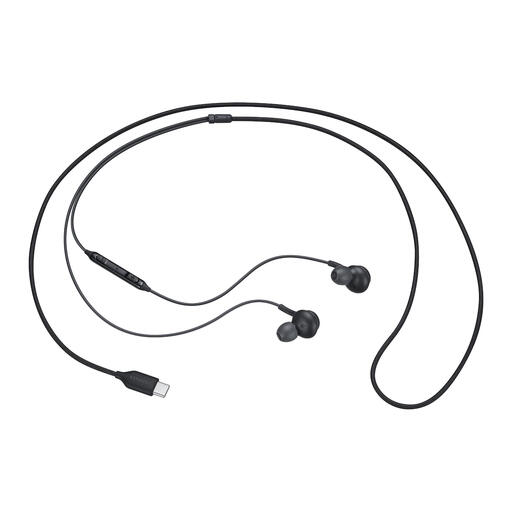
Samsung EO-IC100 wired in-ear headset, USB Type-C, black

Samsung EO-IC100 wired in-ear headset, USB Type-C, black

A wired headset for anyone who wants to use one connection for music and calls. Your source must support USB Type-C.

View at Joybuy

Frequently asked questions

Do I always need an external DAC for Apple Music Lossless?

No, you don’t always need an external DAC. Apple Support says that, for the iPhone and iPad setup described, an external DAC is needed for tracks above 48 kHz; according to Apple, certain compatible Macs already have a built-in DAC supporting up to 96 kHz.

What should I check after connecting a DAC?

Check that lossless playback is enabled in your playback app and that the correct audio output is selected. Apple explains how to enable the lossless setting in Music and recommends matching the headphone output’s sample rate to the source material on compatible Macs.

How can I stop myself from continually turning up the office volume?

First, check the fit and seal of your headphones and choose a manageable volume. The World Health Organization emphasises that both listening volume and duration matter for safe listening.

What are my rights when buying online in the Netherlands?

For a typical online consumer purchase, ACM ConsuWijzer says you generally have up to 14 days from delivery to change your mind, although exceptions may apply. Your statutory right to a product that meets expectations also depends on what you could reasonably expect under normal use, not just the manufacturer’s stated warranty period.

What should I look for in the product safety of an electronic DAC?

Check the applicable safety information and CE marking for the specific version. The Dutch government says that electronic products in the EU must carry a CE marking; the ‘hi-res’ product label alone doesn’t prove that the applicable requirements have been met.
