
Rush-hour commuter
Wants to quickly tune in to a familiar station with traffic updates before setting off. The ANWB lists NPO Radio 1 and BNR, with updates every half-hour and every 15 minutes during rush hour.


Start with a DAB+ radio that makes it easy to find a station with traffic updates. The ANWB recommends stations including NPO Radio 1 and BNR, which provide updates every half-hour and every 15 minutes during rush hour. Then choose between a compact radio for listening in one spot and a radio with extra reception options, if those features matter to you. Check reception and speech clarity where you plan to listen; nationwide coverage does not guarantee reception in every flat.
Wants to quickly tune in to a familiar station with traffic updates before setting off. The ANWB lists NPO Radio 1 and BNR, with updates every half-hour and every 15 minutes during rush hour.
Wants to follow spoken updates from their usual sitting or working spot. Which? assesses speech reproduction, controls and reception as separate aspects of a radio.
Needs to consider where to place the radio or wants an alternative way to receive broadcasts. Digital Radio NL points out that indoor reception depends on the buildings and structures at the location.
A good fit if: you mainly listen to spoken updates from one work or sitting spot and want to find stations easily.
The trade-off: a compact radio does not guarantee clear speech throughout an open-plan space, so consider how far away you’ll be listening.
A good fit if: you’re placing the radio in one spot and want internet reception as well as DAB+.
The trade-off: internet radio needs a working internet connection, and extra features are unnecessary if you won’t use them.
A good fit if: several people listen from different spots and you also want stereo for other audio.
The trade-off: according to Pure, the ChargePAK for the Pure Evoke Play is sold separately. Stereo does not guarantee clearer traffic updates.
| What to consider | What should you check? | Who should pay particular attention? |
|---|---|---|
| Finding traffic updates quickly | Check for DAB+, station search and presets. See which station and broadcast times suit your departure time. | If I want to find a station with traffic updates quickly before setting off, easy station selection matters. Around 42% of consumers in this context put traffic updates first. |
| Hearing speech clearly from your listening spot | Assess the controls and speech reproduction at the distance and volume you actually listen at. | If you want to follow short updates from a work or sitting spot, pay attention to how the radio sounds there. Around 33% of consumers give speech clarity in an open-plan space top priority. |
| Indoor reception | Test your preferred station in the spot where you plan to use the radio. Consider whether FM or internet radio would be a useful alternative way to receive broadcasts. | If reception varies in your flat, what matters most is whether the radio works in your chosen spot or offers a suitable alternative reception option. Around 25% of consumers put indoor reception first. |
According to Digital Radio NL, indoor reception also depends on the buildings and structures at the location.
Try your preferred station in the spot where you plan to use the radio. If you have problems, move the radio and scan for stations again.
Power output and speaker configuration alone don’t tell you how clear a traffic update will sound from your listening spot.
Choose based on speech reproduction and controls where you’ll actually listen, not just wattage or stereo sound.
Check which battery, batteries and power supply are included with the exact model.
According to Pure, the ChargePAK for the Pure Evoke Play is sold separately.
The TAR5505/10 is a specific example of a compact DAB+ radio with Bluetooth and preset stations.
The Evoke Spot combines DAB+ with internet radio. According to Pure, the Evoke Play has a stereo configuration and supports DAB+, FM and internet radio.
The Revival Petite 2 is a compact DAB+/FM radio with Bluetooth and a rechargeable battery, designed for people who want to move their radio around.
These products list portable radio and audio features. For Dutch DAB+ traffic stations, check that the exact model supports DAB+; FM or AM/FM is not a substitute.
 No image available
Could suit you if you’re looking for a portable FM radio, but check that the exact model supports DAB+ if you want to listen to Dutch DAB+ stations.
The product information lists an external aerial, LCD screen and physical tuning and volume buttons. The title also mentions AUX, USB, TF card and MP3 playback.
 No image available
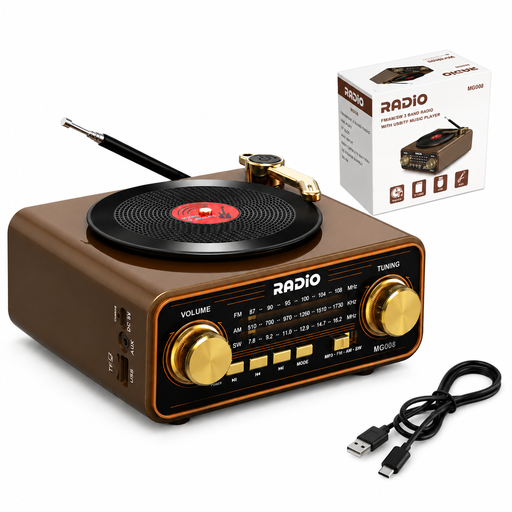
Could suit you if you’re looking for a portable radio with several listed reception bands; check that the exact model supports DAB+ for Dutch DAB+ traffic stations.
The title lists AM, FM and shortwave, Bluetooth 6.0 and a 2000 mAh battery. USB-C, TF card and AUX are also mentioned.
No. You need to tune in to a station that broadcasts traffic information and listen at the relevant times. The ANWB lists stations including NPO Radio 1 and BNR, with updates every half-hour and every 15 minutes during rush hour. A DAB+ tuner is not, on its own, a route-specific traffic service.
Move the radio and scan for stations again. Digital Radio NL says indoor reception depends on the building and recommends rescanning or briefly unplugging the radio if you have reception problems. Internet radio may be an alternative if you have an internet connection.
According to Digital Radio NL, listening via DAB+ over the air does not require a subscription. Any internet connection costs are separate if you use internet radio.
For a standard online purchase from a business, you have a cooling-off period. ACM ConsuWijzer states that it ends 14 days after delivery, although exceptions may apply. This is separate from your statutory guarantee: if a product doesn’t meet reasonable expectations under normal use, the seller must offer an appropriate solution free of charge.