
Anyone cleaning narrow gaps beside a wardrobe
You want to reach dust beside or behind your wardrobe. The width and depth of the gap determine whether a standard or a longer, flexible crevice tool will fit.


First, measure the gap beside your wardrobe and the space available for the complete vacuum cleaner. Then choose a model with a crevice tool that can reach into the gap. A bag keeps the dust contained when you dispose of it, while a bagless model doesn’t need replacement bags but does have a dust container you’ll need to empty. Dimensions and accessories vary by model, so check the details of the one you’re considering.
You want to reach dust beside or behind your wardrobe. The width and depth of the gap determine whether a standard or a longer, flexible crevice tool will fit.
You’re looking for a cylinder vacuum cleaner with room for its hose, tube and attachments too. So look beyond the dimensions of the main unit.
You’re weighing up how you’d prefer to dispose of the dust you’ve vacuumed up: in a bag that you replace or from a dust container that you empty.
Measure the gap and storage space before comparing models. Then consider how important dust disposal and reach from the socket are for the way you’ll use it.
| What to consider | What to look for | Who should prioritise this? |
|---|---|---|
| Reaching dust in the gap | Measure the width and depth of the gap. Check which crevice tool is included and whether the hose and handle can reach comfortably. | If I want to reach dust deep beside the wardrobe, I’ll focus on the shape and length of the tool. Around 36% of consumers prioritise reach into gaps. |
| Storing the complete set | Measure the space available and compare it with the main unit, parking position and storage requirements for the hose, tube and separate attachments. | I want to be able to store the hose, tube and accessories too, especially if floor or cupboard space is limited. Storage space is the top priority for around 29% of consumers. |
| Minimising contact with dust | Compare replacing compatible dust bags with emptying a dust container and maintaining the filters. | If I’d rather dispose of dust in a bag, I’ll weigh that up against the need to replace it regularly. Around 21% of consumers prioritise dust disposal. |
| Cleaning reach around the wardrobe | Measure the route from the socket and compare it with the stated operating radius. This doesn’t tell you how wide the tool is. | I want to reach the wardrobe without having to change sockets frequently. Cleaning reach is the top priority for around 14% of consumers. |
The main unit might fit in a cupboard, but you may not have space for the hose, tube or separate accessories.
Measure the space available for the complete set and check how the parts are stored on or alongside the model you’ve chosen.
A standard tool and an extra-long, flexible brush are different. Neither is guaranteed to fit your gap.
Measure the gap and how far you need to reach, then check which attachment comes with the exact model you’re considering.
A bagless model means you won’t need to buy replacement bags, but you’ll still have to empty the dust container and maintain the filters. As the Dutch Consumers’ Association (Consumentenbond) explains, it’s harder to avoid contact with dust when emptying a container than when replacing a dust bag.
Choose the disposal method you’re happy to maintain, and follow the model’s instructions for the dust container and filters.
A higher power rating alone doesn’t prove that a vacuum cleaner cleans better. The European Commission makes the same distinction in its information about vacuum cleaners.
Compare the tool supplied with the exact model and, where available, independent results for cleaning in gaps.
The Serie 2 BGBS2LB1 is a bagged vacuum cleaner worth comparing if you’re interested in its dimensions and the included crevice tool.
The Compact Power RO3923 is a bagged model supplied with a 2-in-1 crevice tool.
The Guard S1 Parquet Flex in Brilliant White is a bagged model with an extra-long, flexible crevice brush.
The bagless 1000 Series XB1142/10 is worth considering if you don’t want replacement bags and are looking for a compact main unit.
The products below are bagged cylinder vacuum cleaners. Compare the crevice tool, the dimensions of the complete set and how you replace the dust bags.
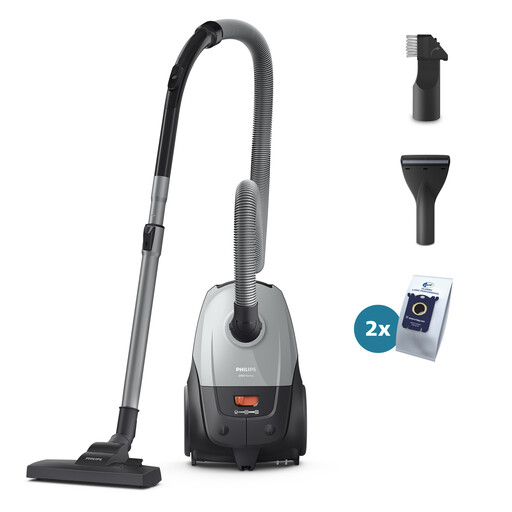 No image available
A bagged model with an integrated 2-in-1 crevice tool for gaps that the tool can reach.
The stated operating radius is 9 m; the dimensions are 41,1 × 26,9 × 24,1 cm. This model uses S-Bags.
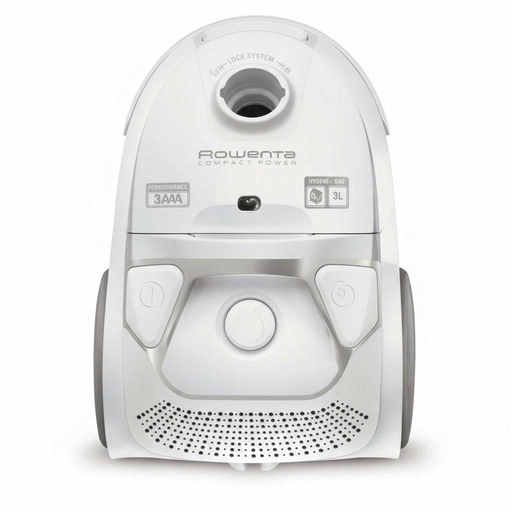 No image available
A bagged model supplied with a crevice tool. Check that it fits the width and depth of your gap.
The stated operating radius is 8,80 m and the dimensions are 28,1 × 23,3 × 41,4 cm. The dust bag has a capacity of 3 litres and the tube is telescopic.
 No image available
The product information lists a flexible XL crevice tool for deep gaps. Measure your gap to check that it will fit.
The stated operating radius is 10 m, the dust bag capacity is 3,5 litres and the weight is 5,7 kg. The stated dimensions are 30 × 42,5 × 23 cm. This model uses HyClean Pure TU dust bags.
Measure the available width and how far into the gap you want to reach. Compare these measurements with the tool supplied with the exact model, and allow enough room to move the hose and handle. ‘Compact’ doesn’t necessarily mean the tool will fit.
Replace a full dust bag or empty the dust container, and clean or replace the filters as instructed in your model’s manual. A full bag or dust container, and clogged filters, can reduce performance.
A bagged vacuum cleaner needs compatible replacement bags from time to time; a bagless model needs its dust container emptied. You don’t need an extended warranty to have statutory rights: compare its additional terms with the protection you already have.
According to the European Commission, the former energy labelling scheme for vacuum cleaners is no longer in force. A higher wattage alone also doesn’t prove that a vacuum cleaner will clean better.
No. The Dutch government says there’s no fixed statutory warranty period in the Netherlands. What you can expect depends, among other things, on the product and normal use. If a product is faulty, the seller is responsible for providing an appropriate solution.