
For anyone cleaning narrow stair treads
You want to remove dry dirt from the treads, edges and corners. Choose a tool that suits hard or carpeted treads; the Dutch Consumers’ Association explains which tools are designed for different jobs.


First, choose a tool that suits the finish of your stair treads and the narrow edges. Then compare the weight when carrying it, the space needed to store all its parts and the working radius from the socket. A bagged vacuum cleaner limits contact with dust when you change the bag, while a bagless model doesn’t need replacement dust bags but may expose you to more dust when you empty it.
You want to remove dry dirt from the treads, edges and corners. Choose a tool that suits hard or carpeted treads; the Dutch Consumers’ Association explains which tools are designed for different jobs.
You need to carry the vacuum cleaner to the stairs, then find space for the hose, tube and separate tools after use. The Dutch Consumers’ Association advises looking beyond the main body when considering portability and storage.
You share the appliance or storage space and want to minimise contact with collected dust when emptying it. According to the Dutch Consumers’ Association, changing a dust bag involves less direct contact with dust than emptying a dust container.
| What to consider | What should you check? | Who is this important for? |
|---|---|---|
| Tool for treads and edges | Check whether a crevice tool is included and whether the floor tool is suitable for hard or carpeted treads. | If you also want to clean narrow edges and corners, having the right tool matters; around 33% of consumers put stair cleaning first. |
| Carrying and storage | Compare the available cupboard space with the space needed to store all the parts. Also check whether the stated weight refers to the main body only. | If you carry the appliance between floors and need to store everything in a shared cupboard, weight and space are key considerations; around 27% of consumers put these first. |
| Contact with dust when emptying | Check whether the model has a dust bag or dust container, which bags fit and how the collected dirt is emptied. | If you want to reduce contact with collected dust when emptying, a dust bag may be a good option; around 20% of consumers put this first. |
| Working radius and maintenance | Measure the route from the socket to the tool and compare it with the stated working radius. Also check which filters and dust collection materials need maintaining. | If you want to reach the furthest tread without repeatedly changing sockets, the working radius matters; around 20% of consumers prioritise reach and maintenance. |
The shared cupboard also needs to fit the hose, tube and separate tools. What’s more, manufacturers sometimes state the weight without accessories, so the figures aren’t always based on the same things.
Measure the cupboard and check how the complete vacuum cleaner and its accessories can be stored. When checking the weight, find out exactly what has been included.
Power consumption alone doesn’t predict cleaning performance. The choice of tool and how it works on the surface also play a part.
Choose a tool that suits the finish of your treads. Compare cleaning results only when they have been measured for the exact models under similar conditions.
A bagged vacuum cleaner needs compatible replacement bags. With a bagless model, you’ll need to empty and clean the dust container.
If you share the appliance, agree on who empties it and maintains the filters.
Emptying and cleaning a dust container and its filters takes time; with a bagged model, compatible replacement bags are an ongoing expense.
The included tools and specifications can vary between versions. A similar-sounding model name won’t necessarily tell you what’s in the box.
Before choosing a version, compare the full model code, the accessories included and the specifications that matter to you.
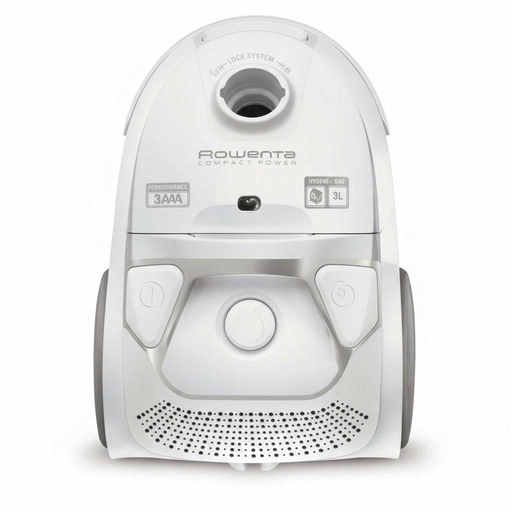
The Dutch Compact Power versions mentioned here include both bagged models and a bagless option. The accessories and dust collection system vary by model.
The Dutch Serie 2 BGDS2BAL mentioned here is a bagged cylinder vacuum cleaner with separate crevice, upholstery and universal tools listed.
The Dutch 2000 Series XD2142/12 mentioned here is a compact bagged cylinder vacuum cleaner with adjustable suction power.
This selection from Joybuy is for anyone looking to remove dry dirt from stair treads with a bagged cylinder vacuum cleaner.
 No image available
The included crevice tool and two-position standard brush are suitable for cleaning edges and different tread finishes.
The product information lists a 3 l dust bag, a working radius of 8,80 m and a product weight of 3,85 kg. It doesn’t say whether accessories are included in the stated weight.
According to the product information, the main body measures 28,10 × 23,30 × 41,40 cm. Measure the available cupboard space for the complete set-up, including the hose, tube and tools. The model has a metal telescopic tube and automatic cord rewind. Replacement bags are an ongoing expense.
Use a convertible standard floor tool with the brush setting that suits the tread finish. According to the Dutch Consumers’ Association, the brushes should be off for hard floors and retracted for carpet. A crevice tool is suitable for narrow edges; for carpeted areas, check whether your version includes a suitable upholstery tool.
First, check whether the dust bag or container is full and whether the tool, tube or hose is blocked. Bosch recommends cleaning or replacing filters as instructed in the manual for the specific model.
With a bagged model, compatible replacement bags are an ongoing cost. According to the Dutch Government, you’re entitled to a product that works as it should in the Netherlands, but there’s no fixed statutory warranty period of two years. If there’s a fault, contact the retailer. Normal wear and tear and damage caused by incorrect use aren’t automatically covered.
No. According to the European Commission, vacuum cleaners no longer have an energy label, following the annulment of the previous labelling rules. This is separate from the ecodesign requirements for mains-powered vacuum cleaners.
According to Milieu Centraal, you can hand in an old, similar appliance free of charge when you buy a new one, including when buying online. You can also take it to your local council’s recycling centre.