Brands to compare
These brands and versions each have different features to consider; a brand name alone doesn’t tell you whether a nozzle will suit your radiator.
Miele
The Guard S1 Parquet Flex is a bagged vacuum cleaner for anyone looking for a flexible crevice tool included with the machine.
- Miele lists a 10 m operating radius and the SFD 20 among the equipment supplied with this version.
- The SHB 30 radiator brush is a separate accessory. Check the connection and measure the space around your radiator.
Bosch
The Serie 4 BGL41GR3H is a bagged vacuum cleaner with an integrated crevice nozzle.
- Bosch lists an 11 m operating radius and a HEPA hygiene filter for this model.
- The operating radius doesn’t tell you whether the crevice nozzle will fit into the gap in your radiator; measure it first.
AEG
The Clean 6000 ÖKO AB61C2OKO is a bagged vacuum cleaner with a 3-in-1 accessory that includes a crevice nozzle.
- AEG lists a 12 m operating radius and a 3,5-litre dust bag for this version.
- A 3-in-1 accessory isn’t necessarily an extra-long, flexible radiator tool; check its shape and dimensions.
Rowenta
The Silence Force RO7740EA is a bagged vacuum cleaner supplied with a crevice nozzle.
- Rowenta lists a noise level of 67 dB(A) at full power and a 4,5-litre bag capacity for this version.
- These are manufacturer specifications, not an independent comparison. The noise level is measured at full power.
Philips
The PowerPro Expert FC9745/09 is a bagless version for anyone who doesn’t want to replace dust bags.
- The Dutch product page confirms that this model is bagless.
- Check separately which radiator attachment comes with this version and whether its connection suits your needs.
Joybuy products
This selection from Joybuy includes a bagged vacuum cleaner and a bagless vacuum cleaner; check whether the nozzle on each model will fit the gap in your radiator.
 Image unavailable
Miele Guard S1 Parquet Flex bagged vacuum cleaner
The flexible XL crevice tool supplied is designed for deep, narrow spaces; measure the radiator gap to check whether it will fit.
Stated power: 890 W; dust bag: 3,5 l; operating radius: 10 m. The dust bag needs replacing when full.
Joybuy
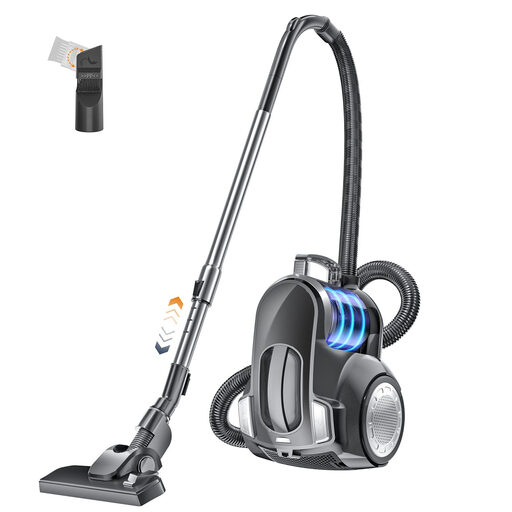 Image unavailable
Bagless vacuum cleaner, 1200 W, 2,5-litre container
A bagless model for anyone who doesn’t want to use replacement dust bags; check separately whether the nozzle supplied is suitable for the gap in your radiator.
Stated power: 1200 W; dust container: 2,5 l; cable: 5,5 m.
Joybuy
Frequently asked questions
Which attachment should you use behind a radiator and between its fins?
A suitable long or flexible crevice tool can help you reach deep, narrow spaces; for accessible fins, Miele describes a separate radiator brush. Measure the gap and check the connection. If possible, switch off the radiator and let it cool before cleaning, as radiator manufacturer Vasco advises.
How can you keep your vacuum working well after removing a lot of built-up dust?
Replace a full dust bag or empty the container promptly, and follow the model’s manual for filter care. A full bag or container and clogged filters can reduce suction. Don’t use a standard household vacuum cleaner for construction dust, rubble or liquids.
Do you need to buy an extra warranty if the vacuum cleaner breaks?
Not necessarily. According to the Dutch government, the seller is responsible for resolving the issue if a product doesn’t meet expectations; there is no fixed statutory two-year warranty period. A paid extended warranty is only worthwhile if its terms offer more than the cover you already have.
Which safety or energy label applies when buying in the Netherlands?
Electrical appliances sold in the Netherlands must meet the applicable European safety requirements and carry the CE marking, according to Ondernemersplein, the Dutch government’s business information portal. This doesn’t prove that a specific model complies; check the marking and product information for the version you’re considering. The European Commission says the former EU rules on energy labels for vacuum cleaners have been annulled, so this category no longer has a current EU energy label.


