
Pet owners with rugs
If you mainly want to remove pet hair from a rug, look for tests on hair pickup from carpet and check which floorhead is included. The Consumers’ Association identifies removing hair from carpet as a challenging cleaning task.


When choosing a cylinder vacuum cleaner for pet hair on rugs, first look for model-specific information on how well it picks up hair and check which floorhead comes with the model. The Consumers’ Association tests pet hair pickup on carpet; a turbo brush is not proven to outperform the standard floorhead on every model. Then consider how much storage space you have and whether you prefer a bag or a dust container: a bag limits contact with dust when you throw it away, while a bagless model means you won’t need to buy replacement bags.
If you mainly want to remove pet hair from a rug, look for tests on hair pickup from carpet and check which floorhead is included. The Consumers’ Association identifies removing hair from carpet as a challenging cleaning task.
If you want to store a cylinder vacuum cleaner in a small home, it’s worth comparing the dimensions of the exact model with the space you have available.
If you want to avoid direct contact with dust when emptying the vacuum, consider a model with a dust bag. The Consumers’ Association points out that contact with dust cannot be avoided when emptying a dust container.
First compare how well the vacuum picks up hair from carpet and check which floorhead is suitable. Then weigh up storage space, how you empty the dust, ongoing purchases and maintenance.
| What to consider | What to look for | Who should consider this? |
|---|---|---|
| Pet hair on carpet | Where available, compare model-specific results for hair pickup and suction resistance on carpet; check which floorhead is included. | If I mainly want to remove embedded hair from my rug, I look for results for that specific task. Around 36% of consumers say hair pickup is their top priority when buying. |
| Storage in a small home | Compare the vacuum’s dimensions with the space available and check that the tube and floorhead will fit too. | When storage space is limited, I want to know in advance whether the vacuum and its accessories will fit. Around 29% of consumers prioritise compact storage. |
| Contact with dust when emptying | Weigh up a dust bag against a dust container. If you have a dust allergy, also consider dust emissions and how you empty the vacuum. | If I want to minimise contact with the dust that’s been picked up, the main thing to consider is how I dispose of it. Around 21% of consumers give minimising contact with dust top priority. |
| Bags and maintenance | Check which replacement bags fit the model and what maintenance is needed for the dust container, filters and brush. | If you want to limit ongoing purchases, check whether a bagless model suits the way you want to empty and maintain the dust container. Around 14% of consumers focus mainly on running costs. |
A mini turbo brush and a turbo floorhead for carpet are not the same accessory. For example, AEG lists different additional floorheads for the AL51A3LDB and the AL61A4UG.
Check the accessories supplied with the exact model and what each floorhead is designed for.
A power rating or model name alone doesn’t tell you how well the vacuum will pick up hair from your rug, or how difficult the floorhead will be to push over carpet.
Where available, compare tests for pet hair pickup on carpet and ease of use on that surface, such as the task assessed by the Consumers’ Association.
You come into contact with the dirt that’s been picked up when you empty a dust container. Bagless vacuums also need maintenance, including cleaning the dust container, filters and brush.
Weigh the saving on dust bags against how the vacuum is emptied, and follow the maintenance instructions for your chosen model.
Hair can collect around the brush roller, so it needs to be checked and cleaned.
A product page with conflicting model codes or information about dust collection doesn’t make it clear which version is being offered.
Before buying, check the model code, packaging and product specifications. Don’t treat conflicting product information as proof that it’s a particular version.
The bagless PowerPro Compact FC9334/09 is a compact option that Philips lists with a large rotating turbo brush.
The bagless Boost CX1 Cat & Dog PowerLine and the Complete C3 Cat & Dog are different options: the first is bagless, while the second uses a dust bag.
According to AEG, the bagless AL61A4UG comes with a standard floorhead for hard floors and carpet, as well as a separate turbo floorhead for carpet.
The BGB8PET0L ProAnimal is a bagged model with an AirTurbo Pro floorhead.
A bagless vacuum cleaner for anyone considering carpet and pet hair when choosing. Check the details of the model and weigh up how it’s emptied against your preferred way of collecting dust.
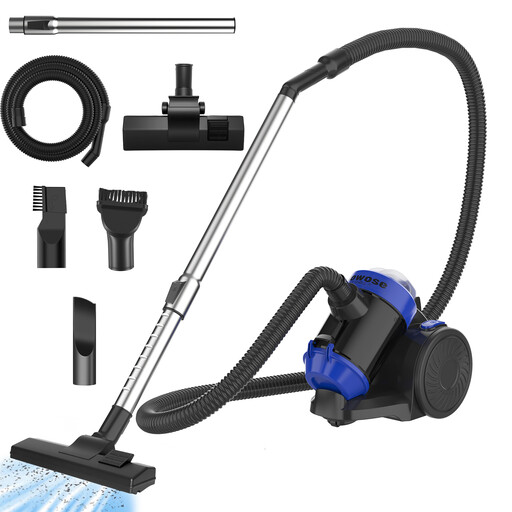 No image available
Its listed uses include carpet and pet hair; compare its performance on your type of rug before choosing.
Power: 1200 W. Cord: 4 m. Dust container: 1.5 litres. Bagless.
No, it varies by model and floorhead. The Consumers’ Association tests pet hair pickup on carpet and says that a turbo brush doesn’t always work better than the standard floorhead. Where possible, also compare how difficult the floorhead is to push over carpet.
Don’t assume so: check the connection and compatibility with the exact vacuum and floorhead. For example, AEG asks for the vacuum’s product number to check whether its separate turbo brush is compatible.
Switch off the vacuum and check your model’s manual before opening the brush. For the brushes covered on its maintenance page, Philips advises unplugging the vacuum first and removing any tangled hair from the brush roller once it’s taken out. Don’t follow those disassembly steps on other models without checking first.
No, your statutory guarantee applies even if you haven’t bought extra cover. ACM ConsuWijzer explains that the seller is responsible for providing a suitable solution free of charge if, under normal use, the product doesn’t do what you could reasonably expect it to. The assessment depends on the product and the circumstances.
For online consumer purchases, you generally have a statutory cooling-off period of up to 14 days after delivery, according to ACM ConsuWijzer. Check the rules on trying out and returning the product; some exceptions to the right to cancel apply.