
Removing crumbs from under a low sofa
You mainly want to reach the floor under the sofa and along its back edge. The shape and height of the floorhead, and the clearance under the sofa, are therefore important things to consider.


Start by checking the clearance under your sofa. Choose a floorhead that will actually fit underneath, or a suitable crevice tool for narrow gaps. Then consider how you’ll store the vacuum cleaner and choose between a dust bag, which you throw away with the dirt, and a bagless dust container that you empty yourself. Motor power alone doesn’t tell you how well it will pick up crumbs.
You mainly want to reach the floor under the sofa and along its back edge. The shape and height of the floorhead, and the clearance under the sofa, are therefore important things to consider.
After a quick clean, you want to be able to fit the appliance, hose, tube and nozzles into a limited space.
You’re weighing up a dust bag against a bagless dust container, and considering what happens when you dispose of the collected dirt. The Dutch Consumers’ Association explains that a dust bag is thrown away with its contents.
First, measure the clearance under your sofa. Then check whether the vacuum cleaner, hose, tube and nozzles will fit in your storage space.
| Factor to consider | What should you check? | Who is this important to? |
|---|---|---|
| Reach under the sofa | Measure the clearance and compare it with the floorhead in its working position. Also check whether the hose and tube can reach the back edge. | If I want to reach crumbs under and behind the sofa, I’ll focus on the clearance and the shape of the floorhead. Around 36% of consumers prioritise reach under the sofa. |
| Storage in a small home | Compare the appliance’s dimensions with the space available and check how the hose, tube and accessories are stored. | I want to be able to fit the vacuum cleaner and its parts in a small cupboard after use. Around 29% of consumers make compact storage their top priority. |
| Less contact with dust when disposing of it | Check which type of dust bag the model uses and whether suitable replacement bags are available. | When disposing of the collected dust, I want as little direct contact with it as possible. Around 21% of consumers prioritise less direct contact with dust. |
| Avoiding dust bags | Find out how to empty the dust container and check the filter care instructions for the model. | I don’t want to buy replacement bags, and I’m happy to empty and maintain a dust container myself. Around 14% of consumers prefer to avoid dust bags. |
Power consumption alone doesn’t predict how well a vacuum cleaner will clean. To pick up crumbs under a sofa, the floorhead also needs to reach the right spot.
Measure the clearance under the sofa and check the floorhead and its reach. Where available, compare test results for the type of flooring in your home too. The European Commission distinguishes between electrical power and cleaning performance.
The appliance’s dimensions don’t tell you how high the wide floorhead is when you slide it under the sofa.
Measure the gap under your sofa and check the dimensions of the floorhead supplied separately.
A bagless model needs its dust container emptied and its filters maintained. A full dust container or a blocked filter can reduce performance, according to the European Commission.
Compare the steps for emptying the container and maintaining the filters with those for replacing dust bags. Bear in mind that emptying and maintenance can take extra time.
The 1000 Series XD1101/10 is a bagged cylinder vacuum cleaner that Philips describes as compact.
The Serie 2 BGC05AAA2 is a bagless cylinder vacuum cleaner with stated appliance dimensions and a hose storage system.
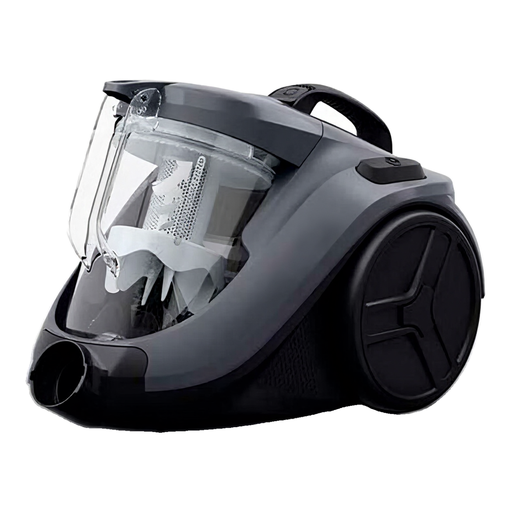
The Swift Power Cyclonic RO2913 is a bagless cylinder vacuum cleaner. Rowenta says it comes with a 2-in-1 crevice tool.
The Compact C2 Flex is a bagged vacuum cleaner with a storage system and, according to Miele, accessories for furniture and crevices.
These models offer a choice between a bagged vacuum cleaner and a bagless model, with accessories for hard floors or narrow gaps. Check for yourself whether the floorhead will fit under your sofa.
 No image available
A bagged model is worth considering if you want less direct contact with collected dust when disposing of it. The Dutch Consumers’ Association explains the difference between a dust bag and a dust container.
The product information lists 890 W, a 3,5 l dust bag and a 10 m operating radius. It also mentions a Parquet Twister floorhead and an extra-long flexible crevice nozzle. Check the height of the floorhead before using it under your sofa.
 No image available
This bagless model is an option if you don’t want to use replacement dust bags and are happy to empty the container yourself.
The product information lists 800 W, a dust container, a telescopic tube and a 2-in-1 narrow nozzle. The dust container needs to be emptied when it’s full. Check whether the floorhead will fit under your sofa in its working position.
Measure the clearance where you want to vacuum and compare it with the height of the floorhead in its working position. For narrow gaps, also check whether a suitable crevice tool is included. The dimensions of the appliance body alone won’t tell you whether it will fit.
No. Wattage alone doesn’t predict how well a vacuum cleaner will clean. The European Commission distinguishes between electrical power and cleaning performance. For this job, also check whether the floorhead can reach under the sofa.
A bagged vacuum cleaner could suit you if you want to throw away the collected dirt with the bag and have less direct contact with dust. A bagless model means you don’t need replacement bags, but you’ll need to empty the container and maintain the filters according to the model’s instructions.
Follow the manual’s instructions for the floorhead, replace a full dust bag or empty the dust container, and clean or replace the filters as directed. According to the European Commission, a full dust container or a blocked filter can reduce performance.
For many online purchases from a business in the Netherlands, consumers have a 14-day cooling-off period, according to the Government of the Netherlands. Check the terms that apply to your purchase. A purchase from a private seller isn’t covered by the same distance-selling rules.