Choose a floorhead that stays in contact with the floor when you hold the tube low, and check whether a crevice tool can reach along the edges. Match the floorhead to the flooring in your living room. A bagged model can limit your contact with dust when you dispose of it, while a bagless model doesn’t need replacement bags but does need emptying. Measure the clearance and depth under your shelves at home: a vacuum’s specifications won’t tell you whether the entire tube and floorhead will fit underneath.
Who is this choice relevant to?
Cleaning under low shelves
After guests have been round, you want to reach dust and crumbs under low shelves. Check whether the floorhead stays on the floor when you hold the tube low, and whether you can get along the edges with a suitable crevice tool. The Consumentenbond explains why it matters for the floorhead to make good contact with the floor.
Homes with different floor types
After cleaning under furniture, you also want to tackle hard floors and carpets. Check that the supplied floorhead is suitable for the surfaces in your home.
If you want to limit contact with dust when emptying
If you’d prefer less contact with the dust you’ve vacuumed up, compare a bagged model with one that has a dust container to empty. The Consumentenbond explains that you come into less contact with dust when removing a full bag than when emptying a dust container.
What should you look for when choosing?
The Consumentenbond points out that a floorhead can lift away from the floor when you hold the tube low. So assess the complete tube-and-floorhead combination, and measure the space under your own shelves.
| What to consider |
What to look for |
Who is this more relevant to? |
| Reach under shelves |
Check that the floorhead stays on the floor with the tube held low; measure the clearance and depth. |
If I want to remove dust under low shelves and along the edges after guests have been round, the whole combination needs to move underneath. Around 36% of consumers put reach under shelves first. |
| Different floor types |
Check that the supplied floorhead is suitable for both hard floors and carpets. |
After cleaning under the shelves, I also want to clean the surrounding floor without using an unsuitable floorhead. Around 29% of consumers prioritise suitability for multiple floor types. |
| Contact with dust when emptying |
Compare a dust bag with a dust container, and check the dust emissions for the specific model. |
If I want as little contact as possible with collected dust after vacuuming, how the vacuum is emptied matters a lot. Around 21% of consumers make this their main consideration. |
| Avoiding replacement bags |
For a bagless model, check the capacity of the dust container and which filters it uses. |
I don’t want to buy replacement bags and am happy to empty the dust container. Around 14% of consumers prioritise avoiding dust bags. |
Common mistakes
-
Looking only at the wattage
A higher power rating doesn’t automatically mean a vacuum will clean better. For cleaning under low shelves, it also matters whether the floorhead stays in contact with the floor when you hold the tube low.
Compare the floorhead and its suitability for your floors, and measure the available space under the shelves. The European Commission also makes clear that a higher power rating doesn’t always mean better cleaning.
-
Mistaking a furniture brush for a low-profile floorhead
A furniture brush and a floorhead for cleaning under low shelves aren’t necessarily interchangeable. Miele sells its SBD 380-3 floorhead, described as particularly flat, separately.
Check exactly what’s included and whether the floorhead fits the model you’ve chosen before relying on it.
You may need to buy a compatible floorhead or crevice tool separately.
-
Assuming bagless means maintenance-free
With a bagless model, you’ll need to empty the dust container and maintain the filters. You may come into contact with dust when emptying it.
Weigh up avoiding dust bags against emptying the container, and follow the manual for your chosen model when maintaining the filters.
Brands to consider
Miele
A bagged cylinder vacuum could be a good choice if you value low-dust disposal and reach under low furniture.
- Miele lists a dust bag and a 10 m operating radius for the Guard S1 Obsidian Black.
- Miele describes its separately sold SBD 380-3 floorhead as particularly flat and suitable for low furniture. According to Miele, it fits its vacuum cleaners, except upright models.
- Check whether the floorhead is included with the model you’ve chosen; the separate accessory listing doesn’t confirm this.
Bosch
Bosch’s bagless cylinder vacuums include compact options, but you’ll need to check separately how high the floorhead sits under your shelves.
- Bosch lists a 1.5 l dust container, a 9 m operating radius, a universal floorhead, a parquet brush and a 2-in-1 tool as included with the BGC05AAA2.
- These specifications don’t confirm how low the floorhead will reach under your shelves.
Rowenta
The Compact Power XXL range is bagless, so it may be worth considering if you want a larger dust container and would rather not use dust bags.
- Rowenta lists a 2.5 l dust container, an 8.80 m operating radius, a parquet brush and a 2-in-1 crevice tool for the RO4B30EA.
- These are the manufacturer’s specifications for this model. You may come into contact with dust when emptying a bagless vacuum.
AEG
AEG offers bagged cylinder vacuums in its 5000, 6000, 7000 and 8000 series, among others.
- AEG lists a 3.5 l dust bag and a stated noise level of 73 dB(A) for the AB61C1OG.
- These figures don’t tell you whether the model will fit under low shelves; check the floorhead and accessories for the exact model.
Joybuy products
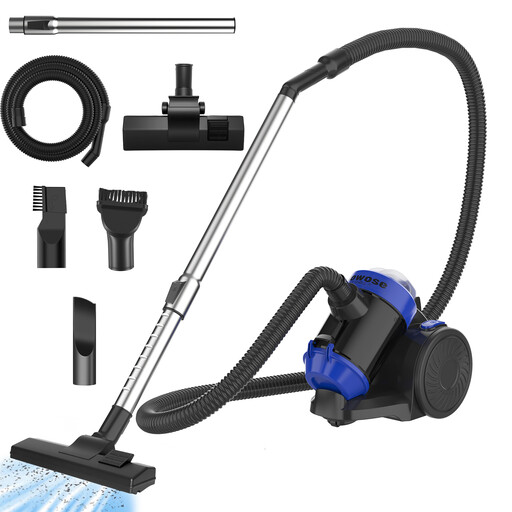
This product selection focuses on a bagless cylinder vacuum for cleaning floors and edges around low shelves.
 No image available
1200 W bagless vacuum cleaner with 4 m cord
The product listing mentions hard floors, carpets and a crevice tool for hard-to-reach areas. Check that the complete floorhead will fit under your shelves.
Listed features: 1200 W, 4 m cord and multi-stage filtration.
View at Joybuy
Frequently asked questions
How can you check whether you can vacuum under your shelves?
Measure the clearance and depth under the shelves, and check that the floorhead stays on the floor when you hold the tube low. A suitable crevice tool can help with narrow edges. A floorhead described as low-profile won’t necessarily fit in your space.
Can you vacuum up a spilt drink with a regular cylinder vacuum?
No. Use a regular vacuum cleaner for dry household dust and dirt, not liquids, building dust or rubble. The Consumentenbond lists these limitations; you’ll need a suitable wet and dry vacuum for liquids.
What should you check if suction power drops?
Check the dust bag or container, filters and floorheads, following the manual. Follow the instructions for your specific model when emptying, cleaning or replacing parts.
What are your rights when buying online in the Netherlands?
For online purchases from a business, you generally have 14 days to change your mind, as the Dutch government explains. A product must also meet the expectations you could reasonably have when using it normally. According to ACM ConsuWijzer, the seller is responsible for providing a solution if the product doesn’t meet those expectations; your statutory rights aren’t automatically limited to two years.
Does a new cylinder vacuum need an EU energy label?
No. According to the European Commission, there are currently no energy-labelling rules for vacuum cleaners; the previous labelling scheme has been withdrawn. EU ecodesign requirements still apply to mains-powered vacuum cleaners. So don’t use an old energy label as a current buying requirement.


