
People cleaning under low beds
You want to know whether the floorhead and tube will fit under your bed and reach right to the back. A compact vacuum cleaner alone is no guarantee; check the clearance and the floorhead.


Start by measuring the space under your bed: the floorhead and tube need to fit underneath and reach far enough. Then choose what matters most for your work breaks: compact storage, a lower stated noise level or a dust bag. Check which attachments are included with the exact model and which bags it needs.
You want to know whether the floorhead and tube will fit under your bed and reach right to the back. A compact vacuum cleaner alone is no guarantee; check the clearance and the floorhead.
You want to be able to get started quickly and put the vacuum cleaner away easily afterwards. Its stated noise level may also matter if others are at home or your workspace is nearby.
You want to avoid as much contact with dust as possible when disposing of collected fluff, and factor in the ongoing cost of suitable dust bags. The Consumers' Association (Consumentenbond) notes that changing a dust bag involves less contact with dust than emptying a dust container.
First measure the clearance under your bed, then decide which combination of reach, ease of use and dust collection best suits your cleaning routine.
| What to consider | What should you check? | Who might prioritise this? |
|---|---|---|
| Reach under the bed | Measure the clearance and depth; check the height, manoeuvrability and reach of the floorhead supplied. | If I want to clean right to the back under a low bed, the floorhead has to physically fit underneath. Around 36% of consumers prioritise reach. |
| Quick, quiet cleaning | Compare the stated noise level, ease of storage, cord and operating radius; check which setting the noise level applies to. | If I want to vacuum between work sessions, being able to get the cleaner out quickly and keeping noise to a minimum both matter. Around 29% of consumers prioritise quick, quiet cleaning during a break. |
| Less contact with dust | Check whether the model uses a dust bag, which bag fits and which filter is included. | If I want to dispose of collected fluff with as little direct contact with dust as possible, a dust bag may be a priority. Around 21% of consumers say this is their main need. |
| Running costs and maintenance | Find the right bag and filter type, and check the maintenance instructions for the exact model. | If I want to factor in ongoing costs and maintenance, I compare the consumables required and how the dust container is emptied. Around 14% of consumers prioritise running costs. |
Higher power consumption doesn’t guarantee that the vacuum will reach dust under a low bed. The shape of the floorhead and the space it needs to move are important too.
Measure the bed clearance and check the floorhead supplied. Then compare performance on your type of flooring.
According to Miele, the Parquet Twister XL supplied with the Miele Guard S1 Parquet XL is 41 cm wide. That doesn’t tell you whether the floorhead will fit through the clearance under your bed or move easily around the legs.
Compare the available space with the dimensions of the exact floorhead. For narrow gaps, also check whether a suitable crevice tool is included.
With a bagged vacuum cleaner, suitable replacement bags are an ongoing cost. A bagless model avoids that expense, but you still need to empty and clean the dust container.
Weigh the cost of suitable bags against how you prefer to empty the dust container. The Consumers' Association (Consumentenbond) includes the cost of vacuum cleaner bags in its testing methodology.
The Philips XD2142/12 from the 2000 Series is a compact bagged cylinder vacuum cleaner worth comparing if quick access and easy storage are important to you.
The RO7457 from the Silence Force range is worth considering if a low stated noise level and a flexible crevice tool matter to you.
The BGB6SIL0L is a bagged cylinder vacuum cleaner whose stated noise level, operating radius and included parquet brush can be compared side by side.
The Guard S1 Parquet XL is worth considering if you’re looking at a parquet floorhead for a larger hard-floor area.
The bagged 6000 series is an option to compare if floor-setting controls and changing dust bags matter to you.
This selection features bagged cylinder vacuum cleaners for quick cleaning sessions and hard floors, with a focus on easy storage and tools for furniture and crevices.
 No image available
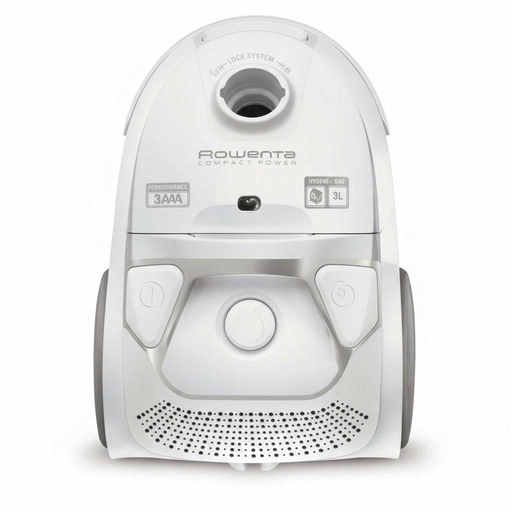
The dust bag may suit you if you want less direct contact with dust when emptying the cleaner. Its compact design and automatic cord rewind also make it easy to put away quickly.
750 W motor; 3 L dust bag; metal telescopic tube; crevice tool; automatic cord rewind; 8.8 m operating radius.
 No image available
The dust bag may suit you if you want less direct contact with dust when emptying the cleaner. The flexible XL crevice tool is designed for narrow gaps.
890 W; 3.5 L dust bag; Parquet Twister floorhead; telescopic tube; 10 m operating radius.
No. Measure the clearance beneath the bed frame and check the height and manoeuvrability of the floorhead and tube combination for the exact model. The stated operating radius alone won’t tell you whether the floorhead will fit under the bed.
Replace a full dust bag or empty the dust container, and clean or replace the filters as instructed in the manual. The European Commission notes that a full container or blocked filter can reduce performance.
With a bagged model, suitable replacement bags are an ongoing cost. A bagless model avoids that expense, but you’ll still need to empty the dust container. In the Netherlands, statutory warranty also applies if a product used normally doesn’t meet the expectations you could reasonably have had. According to ACM ConsuWijzer, your statutory warranty doesn’t expire just because you don’t buy additional cover.
The specific EU energy labelling regulation for vacuum cleaners has not been in force since 19 January 2019. Ecodesign requirements still apply to mains-powered vacuum cleaners within the scope of the rules. Higher power consumption doesn’t automatically mean better cleaning.