
Quickly cleaning the hallway
You want to pick up grit around the rack legs and skirting boards just before visitors arrive, then put the vacuum away easily.


Start by checking how you’ll reach the grit: make sure the version you choose comes with a suitable crevice tool and that the hose and cord can reach the space beside the rack. Then compare how the model performs on your floor and whether you’d rather replace a dust bag or empty a dust container. Wattage alone won’t predict cleaning performance.
You want to pick up grit around the rack legs and skirting boards just before visitors arrive, then put the vacuum away easily.
Your hallway has laminate or parquet flooring, for example. You’re looking for a suitable tool and want to know how well the model picks up dirt from the floor and out of crevices.
When disposing of collected dirt, you’d rather avoid contact with dust from an open container. Filters and replacement bags may also be worth considering.
First, check that the tool and reach are suitable for the space beside the rack. Then consider floor care and how you’ll dispose of the dust.
| What to consider | What to look for | Who is this important for? |
|---|---|---|
| Reach beside the rack | Check whether a crevice tool is included with the version you’re considering and whether the hose can reach the area. | If you want to remove grit around the rack legs and skirting boards without manoeuvring the full-size floorhead, access to tight spaces is especially important. Around 36% of consumers give reach top priority. |
| Easy to get out and put away | Compare the size, storage position and operating reach with your hallway and the space available in your cupboard. | If you only use the vacuum briefly before visitors arrive, being able to move it quickly and put it away again could be decisive. Around 29% of consumers prioritise ease of handling. |
| Suitability for your floor | Check whether the included tool is suitable for parquet or laminate, and look for separate information about cleaning floors and crevices. | If your hallway has a hard or scratch-prone floor, you’ll want to match the tool to the surface rather than assume that a floor test also says something about cleaning crevices. Around 21% of consumers give their own floor top priority. |
| Dust disposal | Compare emptying a dust container with replacing a bag, and check what filter maintenance is required. | If you’d prefer less direct contact with collected dust when tidying up, a bagged model may suit you. If you want to avoid bags, you’ll need to empty a container. Around 14% of consumers prioritise dust disposal and maintenance. |
Wattage alone doesn’t predict how well a vacuum cleaner will clean. The European Commission warns that higher power consumption does not automatically mean better cleaning.
Where available, compare separate results for hard floors and crevices, and check whether the right tool is included.
A tool described as a compatible accessory is not necessarily included with every version.
Check the contents for the exact model before choosing it to pick up grit beside the rack.
If the tool you need isn’t included, you may have to buy it separately.
A dust container needs emptying and filters need maintaining. The European Commission says that a full container or a clogged filter can reduce performance; a dust bag, on the other hand, needs replacing when it’s full.
Check the manufacturer’s instructions for emptying and filter maintenance, then choose the approach that suits you.
The XD1101/10 is a compact bagged model for anyone short on storage space.
According to Miele, the Compact C2 Flex is a bagged model that can be stored away to save space.
The Serie 4 BGLS4POW2 is a bagged model supplied with several attachments.
The bagless Compact Power XXL RO4B50 and Swift Power Cyclonic RO2917 are two models with different specifications.
The bagless CLEAN 6000 AL61C2CR is listed with a standard floorhead and a separate parquet nozzle.
These product choices are suited to dry dirt, crevices and hard floors. The versions differ in dust collection, attachments and cord reach.
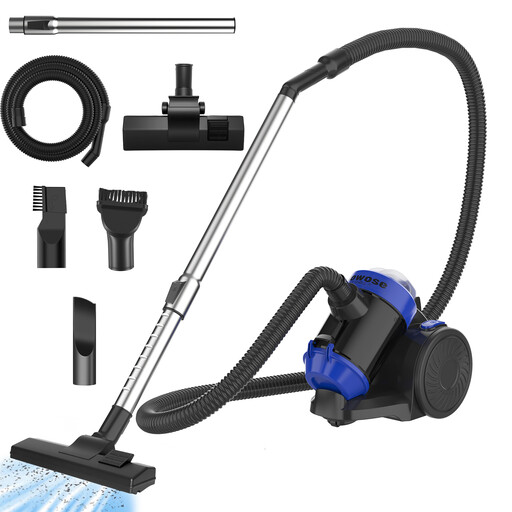 Image unavailable
The description lists a crevice tool for hard-to-reach areas.
The dust container has a capacity of 1,5 l and the mains cord is 4 m long. The title mentions multi-layer filtration and use on hard floors and carpets.
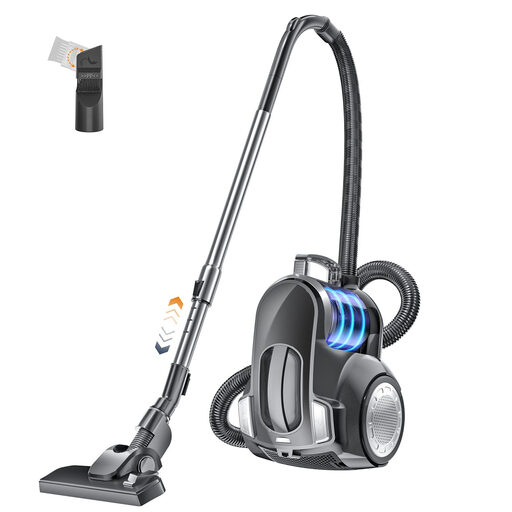 Image unavailable
The description lists an integrated 2-in-1 crevice tool for hard-to-reach areas.
The dust container has a capacity of 2,5 l. The cord is 5,5 m long and the stated operating radius is 14 m; the description also mentions a 360° swivel hose.
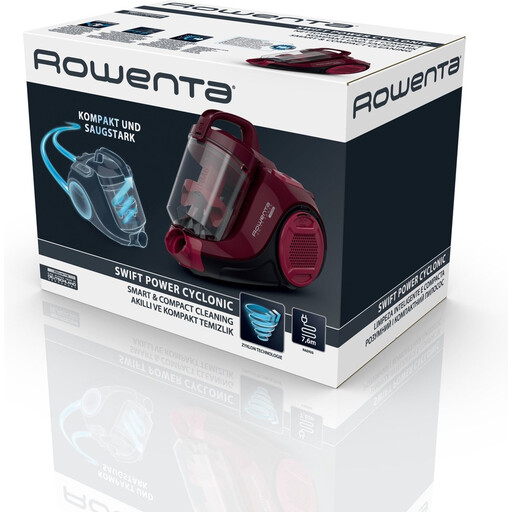 Image unavailable
The product description lists a crevice tool for narrow gaps and a parquet brush for hard floors.
The stated operating radius is 7,6 m and the dust container has a capacity of 1,2 l. This is a bagless model, so the dust container needs emptying.
 Image unavailable
The description lists a crevice tool and a flexible XL crevice nozzle for areas beside or behind a shoe rack.
This model has a 3,5 l dust bag, a stated operating radius of 10 m and a Parquet Twister floorhead. Its stated power is 890 W; the dust bag needs replacing when it’s full.
Not necessarily: the Dutch Consumers’ Association says that a regularly cleaned standard floorhead often won’t scratch the floor and can sometimes clean more comfortably or effectively than a special parquet tool. Assess the exact floorhead and your flooring separately.
Empty a full dust container or replace a full dust bag, and maintain the filters according to the manufacturer’s instructions. The European Commission warns that an overfull container or a clogged filter can reduce performance.
If you’ve used the product normally and it doesn’t meet what you could reasonably expect, the retailer is responsible under the statutory guarantee. A free repair or replacement, and sometimes a refund, may be available; a shorter manufacturer’s guarantee does not take away this right. Online consumer purchases also generally come with a 14-day cooling-off period from delivery, subject to legal exceptions.
No. Wattage alone doesn’t predict cleaning performance. According to the European Commission, higher power consumption does not automatically mean better cleaning; where available, compare results for hard floors and crevices.
Check the safety information and make sure the exact version is suitable for use in the Netherlands. The European Low Voltage Directive applies to electrical equipment within the relevant voltage range; products must carry a CE mark where required by applicable EU harmonisation rules.