
If you mainly clean hard floors
You want to remove loose grit from tiles, laminate or another hard floor. Check how the floorhead moves across your floor and look for information about its floor-cleaning performance.


Choose a cylinder vacuum that suits your flooring and has a suitable crevice tool to reach alongside or behind the shoe rack. A bagged model can reduce contact with collected dust when you dispose of it; a bagless model means you don’t need dust bags, but you will have to empty the dust container. Wattage, or simply having a parquet floorhead, doesn’t prove how well a model will pick up grit from your floor.
You want to remove loose grit from tiles, laminate or another hard floor. Check how the floorhead moves across your floor and look for information about its floor-cleaning performance.
You also want to vacuum behind shoes or in narrow gaps. Check which crevice tool comes with the specific model and version you’re considering.
How you empty the bag or dust container may influence your choice. The Consumers’ Association explains that a dust bag can reduce contact with collected dirt when you dispose of it.
Start by considering how well it cleans your floor and whether it can reach the space beside the rack. Then weigh up which dust collection and emptying method suits you. The percentages in each row are an uncertain indication of how many consumers in this situation would make that need their top priority.
| What to consider | What should you check? | Who is this important to? |
|---|---|---|
| Grit on hard floors | Compare information about floor-cleaning performance and check that the floorhead moves easily across your floor. | If I mainly want to clear loose grit from the hallway floor after a weekend away, floor cleaning comes first; around 36% of consumers make this their top priority. |
| Reaching narrow spaces | Check whether a crevice tool is included with the model and whether you can use it alongside or behind the rack. | If I need to vacuum between rack legs or behind shoes, I want to reach the area with a narrow tool; around 29% of consumers prioritise reaching tight spaces. |
| Disposing of collected dust | Check whether the model has a bag or dust container. If emissions are a concern, look for an assessment of the complete appliance. | If I want as little contact as possible with collected dust when emptying, the collection method matters a lot; around 21% of consumers put low-dust emptying first. |
| Maintenance and storage | Check the dimensions, operating reach, maintenance instructions and availability of suitable consumables. | If I want the appliance to be easy to store and maintain between cleans, these practical details are decisive; around 14% of consumers make this their top priority. |
The Consumers’ Association notes that a parquet floorhead isn’t necessarily needed for hard floors. So look at information about floor-cleaning performance and the right floorhead, rather than relying on the name of the attachment alone.
A specialised floorhead isn’t automatically more effective or easier to use than a clean standard one. The Consumers’ Association advises checking the floor-cleaning performance.
Compare information about hard floors and check the floorhead for trapped grit.
The Consumers’ Association points out that a filter specification alone doesn’t tell you how much dust the complete appliance emits; air can leak around a filter.
If dust emissions matter to you, look for an assessment of the complete model.
According to the Consumers’ Association, a full dust bag or container, or a blocked filter, can reduce performance.
Check the maintenance instructions for the exact model, including which parts need cleaning or replacing.
The Guard M1 Flex is an example of a bagged model with a flexible crevice brush for hard-to-reach areas.
The Serie 4 BGB38RD2 is an example of a bagged cylinder vacuum supplied with a crevice nozzle.
The XD2142/12 from the 2000 Series is an example of a compact bagged model with adjustable suction and a convertible floorhead.
The Compact Power Cyclonic RO3731EA is an example of a bagless option.
This selection includes bagged and bagless vacuum cleaners whose product information mentions hard floors and reaching into crevices. Check which floorheads are included with each version and whether its dust collection method suits you.
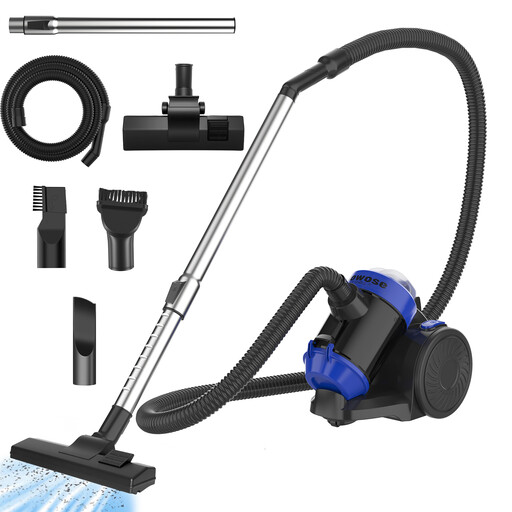 No image available
The product information lists a floorhead and crevice tool for hard floors; check that the tool suits the space beside your rack.
The title specifies a 4 m cord and a bagless design. You’ll come into contact with the collected dirt when emptying the dust container.
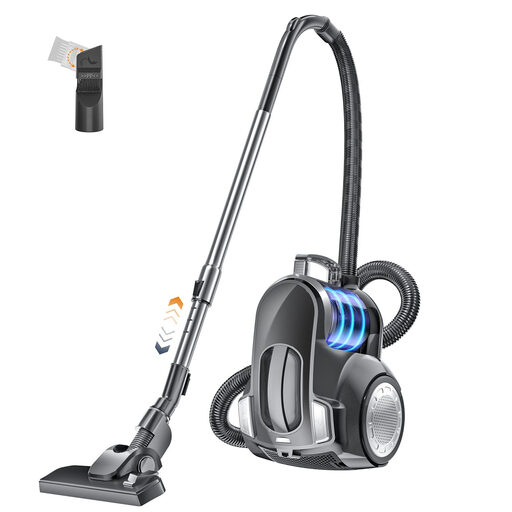 No image available
The product information lists an automatic floorhead for hard floors and carpets, plus an integrated 2-in-1 crevice tool.
The title specifies a 2,5 l dust container and a 5,5 m cord. The dust container needs to be emptied.
 No image available
The product information lists an adjustable floorhead for hard floors and an integrated crevice tool.
Philips lists 800 W, a 9 m operating radius, a HEPA filter and S-bags. The filter specification alone doesn’t prove that the complete appliance has low dust emissions; also check which compatible bag you’ll need for your use.
 No image available
The product information lists a floorhead for hard floors and a crevice tool; check what’s included with the version you choose.
The title specifies a 750 W motor, a 3 l dust bag, a metal telescopic tube and automatic cord rewind. A Hygiene+ dust bag is listed for this model.
 No image available
The product information lists a Parquet Twister floorhead for hard floors and a flexible XL crevice nozzle.
The title specifies 890 W, a 3,5 l dust bag and a 10 m operating radius. According to the product information, a compatible HyClean Pure TU dust bag is required.
No, a parquet floorhead isn’t essential. The Consumers’ Association notes that a clean standard floorhead may also work; compare information about floor-cleaning performance and keep the floorhead clear of trapped grit.
Following the maintenance instructions, check the dust bag or container, filters, floorhead and any blockages in the hose or tube. Follow your model’s manual when cleaning or replacing filters, and only put a cleaned filter back once it’s completely dry.
No, a HEPA filter alone doesn’t guarantee low dust emissions from the complete appliance. The Consumers’ Association points out that air can leak around a filter; if emissions matter to you, look for an assessment of the whole model.
According to ACM ConsuWijzer, there is generally a statutory cooling-off period of up to 14 days after delivery, subject to applicable exceptions. This is separate from your rights if a product is faulty, damaged or inaccurately described; check which rules apply to your purchase.
According to the European Commission, the old EU energy labelling regulation for vacuum cleaners was annulled with effect from 19 January 2019. EU ecodesign requirements do apply to mains-powered vacuum cleaners within scope. A higher power rating alone doesn’t prove that a vacuum cleaner cleans better.