
Cleaning narrow gaps
Want to reach sand between the shoe rack, the wall and the skirting board? Check that the crevice tool and hose will fit in the space. The Consumentenbond recommends a crevice tool for narrow spaces.


Start with the crevice tool: it needs to fit between the shoe rack and the skirting board. Then check that the floor head is suitable for your flooring. The Consumentenbond reports that bagged vacuum cleaners perform better on average in tests on hard floors, but that doesn’t tell you how well any one model picks up dry sand next to a rack. A bag does, however, reduce direct contact with dust when you dispose of it, whereas you have to empty a dust container.
Want to reach sand between the shoe rack, the wall and the skirting board? Check that the crevice tool and hose will fit in the space. The Consumentenbond recommends a crevice tool for narrow spaces.
If you’re cleaning up sand from flooring such as parquet or laminate, check that the model comes with a suitable floor head.
Would you rather dispose of collected dust in a bag, or do you find an emptyable dust container more practical? The Consumentenbond describes this as a difference between bagged and bagless vacuum cleaners.
| What to consider | What to look for when buying | Who is this important for? |
|---|---|---|
| Reaching narrow spaces | Check whether the crevice tool is included with the exact model, and whether the hose and tube will fit alongside the rack. | If I want to remove sand from the narrow gap between the rack and skirting board, reach is my top priority; around 36% of consumers say reaching narrow spaces is their main buying priority. |
| A suitable floor head | Identify your type of flooring and check which floor head is included. | For parquet or laminate, I want a floor head that’s suitable for my flooring; around 29% of consumers give suitable floor cleaning top priority. |
| Dust disposal and maintenance | Compare a dust bag with an emptyable dust container, and check the model’s maintenance instructions. | I want to know in advance how to dispose of the sand I’ve vacuumed up and how much maintenance is involved; around 21% of consumers put this first. |
| Practicality | Compare the stated operating range with the distance to the socket, and check the dimensions and stated noise level. | When moving between rooms, I want the appliance to be easy to use and store; around 14% of consumers say practicality is their top buying priority. |
A higher input power doesn’t prove that a vacuum cleaner cleans better. For sand next to a rack, the floor head and access to the gap matter too. The European Commission makes the same distinction between input power and cleaning performance.
Check which tools are included with the exact model and, if available, look at model-specific results for hard floors and crevices.
A full dust container or dirty filter can affect performance. You may also come into contact with collected dust when emptying it; according to the Consumentenbond, a bagged vacuum cleaner reduces this contact when you dispose of the dust.
Decide in advance how you want to dispose of the sand, and follow the model’s maintenance instructions.
Emptying a dust container and maintaining the filters takes time, even if you don’t use replacement dust bags.
A floor head for delicate flooring and a crevice tool serve different purposes. Having one doesn’t automatically mean you can reach the narrow gap alongside the rack.
Check that both tools are included with the exact model, and consider whether the hose will fit alongside the rack.
The Serie 4 BGL41GR3H is a bagged cylinder vacuum cleaner with an integrated crevice tool.
The Silence Force RO7457 is a bagged model; Rowenta lists a flexible crevice tool and an XXL crevice tool.
According to Philips, the PowerPro Compact FC9332/09 is a bagless cylinder vacuum cleaner with a dust container and TriActive floor head.
The bagless 6000 AL61C2OG is described as coming with a crevice tool and separate floor heads for different floor types.
When looking at Miele cylinder vacuum cleaners, check the accessories included with the exact model, even when the product name refers to a Complete C3 model.
This selection is for anyone looking for a bagless vacuum cleaner with a crevice tool for a narrow space, who would rather not use replacement dust bags.
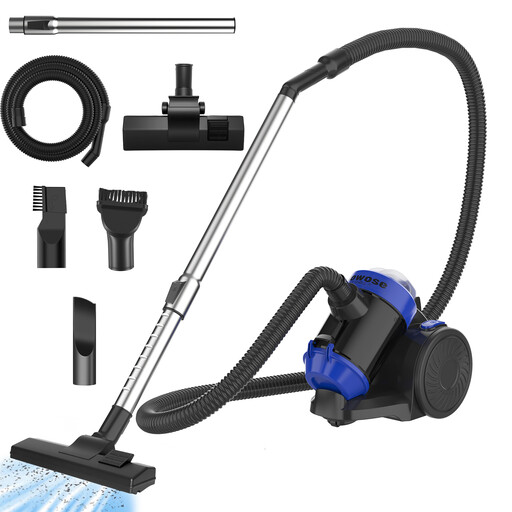 Image unavailable
The product description lists a crevice tool for hard-to-reach places, making it suitable for the narrow space next to a shoe rack.
The dust container has a capacity of 1.5 l and the cord is 4 m long. The description lists carpets and hard floors as suitable surfaces.
Use a suitable crevice tool along the skirting board and a floor head that’s suitable for the open floor. Check beforehand that the hose and tool will actually fit alongside the rack.
Follow the manual to check the dust bag or dust container, filters, floor head and hose for anything full or blocked. Only wash a filter if the manufacturer says you can, and let it dry completely before putting it back.
This guide only covers dry, everyday sand. The Consumentenbond advises against using standard household vacuum cleaners for liquids, construction dust or coarse rubble. For these other jobs, choose an appliance designed for the task.
Online consumer purchases generally come with a statutory cooling-off period of up to 14 days after delivery, although exceptions apply. ACM ConsuWijzer also explains that the statutory guarantee is separate from any manufacturer’s guarantee offered. If a product doesn’t meet what you could reasonably expect, contact the seller.
No. The European Commission states that the former EU regulation on energy labelling for vacuum cleaners has been annulled. Higher input power alone doesn’t prove better cleaning performance.