
Anyone cleaning narrow door tracks
You want to reach dry dirt with a suitable crevice tool, rather than relying on a wide floor head. The Consumentenbond describes crevice tools as accessories for tight spaces.


For dry household dirt in narrow door tracks, a cylinder vacuum cleaner with a crevice tool is a sensible choice, provided the tool actually fits your track. Then consider how you’ll use and store the appliance between stays, where the plug sockets are and whether you’d rather replace dust bags or empty a dust container. Don’t use a standard household vacuum cleaner for liquids, building dust or large debris; the Consumentenbond advises against it.
You want to reach dry dirt with a suitable crevice tool, rather than relying on a wide floor head. The Consumentenbond describes crevice tools as accessories for tight spaces.
You clean the property repeatedly and consider reach, accessory availability and maintenance. A full dust bag or dust container can reduce suction, according to the Consumentenbond.
You’re weighing up whether less direct contact with collected dust when emptying matters more than the convenience of not having to buy replacement dust bags. The Consumentenbond describes this difference between bagged and bagless models.
First check that the accessory fits your door track. Then weigh up reach, dust collection and storage in light of how often the vacuum will be used and who will use it.
| Consideration | What to look for when buying | Who is this important for? |
|---|---|---|
| Reaching into narrow tracks | Check that the supplied crevice tool fits into the track and that you can reach the opening properly. | I want to remove dry dirt from a narrow track without relying on a wide floor head; around 36% of consumers put reach into tracks at the top of their list when buying. |
| Cleaning between stays | Compare the stated operating radius with the distance to plug sockets, and check whether the accessory can be stored with the appliance. | If you need to clean quickly or several people use the appliance, reach and an easy-to-find accessory matter; around 29% of consumers prioritise cleaning speed. |
| Emptying and maintenance | Compare a dust bag with a bagless dust container, and check how the filters, hose and tool should be maintained according to the manual. | If you want to choose how collected dust is disposed of, you’ll also want to know what maintenance is involved; around 21% of consumers prioritise dust collection and maintenance. |
| Storage and supplies | Check the appliance’s dimensions and which type of replacement dust bag is required for that version. | If cupboard space is limited or the appliance is used regularly, I may want to factor in storage and the availability of compatible bags; around 14% of consumers prioritise these points. |
There are separate crevice tools for tight spaces. Even a supplied accessory won’t necessarily fit every door track.
Before buying, check the tool’s shape and dimensions against the track.
The Consumentenbond advises against using a standard household vacuum cleaner to pick up liquids, building dust or large debris.
First identify what’s in the track. For dirt the vacuum isn’t designed to handle, use an appliance intended for the job.
A full dust bag or container and clogged filters can reduce suction. A dust bag needs replacing; a bagless container needs emptying regularly.
Choose the dust collection system that suits your preferences and follow the maintenance schedule for your chosen model.
With a bagged model, you’ll need to keep buying compatible replacement bags; a bagless model needs to be emptied regularly.
The Rowenta RO3950 and RO3953 are different models. The Bosch BGC41PET and BGB41HYG1H are different models too.
Check the full model number and version before assuming that accessories or specifications are compatible.
The Compact Power RO3953 is a compact bagged model. Rowenta lists a 2-in-1 crevice tool and an operating radius of 8.80 m.
According to Miele, the Guard L1 AllFloor Flex has a dust bag, a floor head and an extra-long flexible crevice brush.
The Serie 4 BGB41HYG1H is a bagged model. Bosch lists an integrated crevice and upholstery tool, a dust bag capacity of 4.0 l and an operating radius of 11 m.
According to AEG, the CLEAN 6000 ÖKO AB61C2OKO has a 3-in-1 accessory with a crevice tool, a 3.5 l dust bag and an operating radius of 12 m.
These models combine a crevice tool or flexible crevice nozzle with features that may be worth considering for storage, reach and dust collection. Before buying, check that the accessory fits your door track.
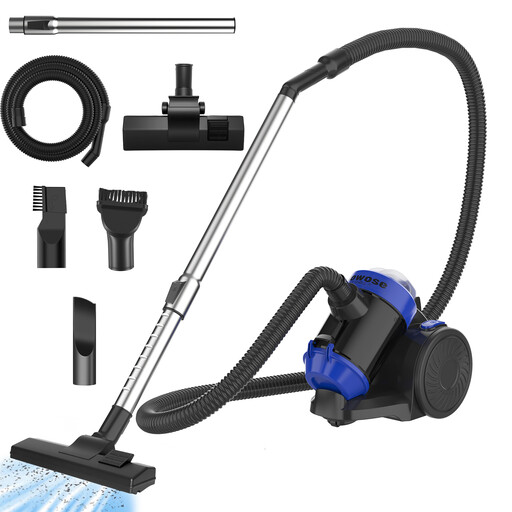 No image available
The product information lists a crevice tool for hard-to-reach places.
Bagless design; 4 m cord and 1.5 l dust container.
Don’t use a standard household vacuum cleaner for liquids, building dust or large debris.
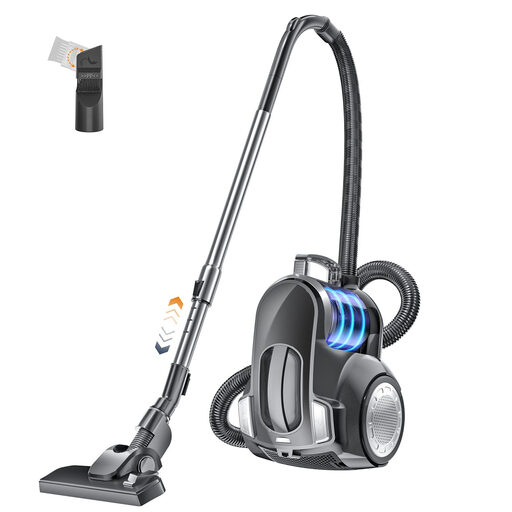 No image available
The product information lists a 2-in-1 crevice tool for hard-to-reach places.
2.5 l dust container, 5.5 m cord and a stated operating radius of 14 m.
Don’t use a standard household vacuum cleaner for liquids, building dust or large debris.
 No image available
The product information lists an integrated 2-in-1 crevice tool for tight spaces.
Bagged vacuum cleaner; 800 W, stated reach of 9 m and dust bag capacity of 3 l. Two dust bags are included.
Don’t use a standard household vacuum cleaner for liquids, building dust or large debris.
 No image available
The product information lists a supplied crevice tool for tight spaces.
Bagged vacuum cleaner with a 3 l dust bag, 750 W and a stated operating radius of 8.80 m.
The product information advises against using it for liquids, damp floors or plasterboard dust. Don’t use a standard household vacuum cleaner for large debris either.
 No image available
The product information lists a flexible XL crevice tool for deep crevices and tight spaces.
Bagged vacuum cleaner with a 3.5 l dust bag, 890 W and a stated operating radius of 10 m.
The product information advises against using it for liquids, hot ash or fine dust such as plaster or cement dust. Don’t use a standard household vacuum cleaner for large debris either.
Start with a crevice tool that you’ve checked will fit your track. A standard floor head isn’t designed specifically for such tight spaces; a flexible version may help if you can’t approach the opening straight on.
No, don’t use a standard household vacuum cleaner for that. The Consumentenbond advises against using one to pick up liquids, building dust or large debris. Choose an appliance designed for that type of dirt, and check the manual for the model you’ve chosen.
Following the manual, check whether the dust bag or container is full and whether the filter, tool, tube or hose is blocked. Only clean a filter in the way specified in the manual, and let a filter cleaned with water dry completely before putting it back.
No. The Dutch government states that there is no fixed statutory guarantee period for consumer purchases in the Netherlands; what you can expect depends, among other things, on the product, its price and the information provided by the seller. If something is faulty, contact the seller. This information about consumer purchases doesn’t necessarily apply to a business purchase for running holiday accommodation; in that case, check the contract and guarantee terms.