
Cleaning tight spaces
You want to reach fluff behind chair legs and along edges. The shape of the tool and the room you have to manoeuvre are important. The Consumers’ Association recommends crevice tools for tight spaces.


First, check whether a suitable crevice tool, hose and tube can reach behind your chairs. Then compare the vacuum cleaner’s dimensions with your storage space. A bagged model keeps dirt contained in the bag when you dispose of it, but you’ll need replacement bags. A bagless model avoids that expense, but you’ll need to empty and maintain the dust container.
You want to reach fluff behind chair legs and along edges. The shape of the tool and the room you have to manoeuvre are important. The Consumers’ Association recommends crevice tools for tight spaces.
You want to put the cylinder vacuum cleaner, hose and tube away after use without them taking up room in your walkway. Bosch Netherlands and Philips Netherlands describe the storage features of the models they’ve assessed.
You prefer to use a dust bag when disposing of dirt and are happy to factor in the cost of replacement bags. The Consumers’ Association explains the trade-off between bagged and bagless models.
Start by checking whether the tool can reach behind your chair. Then compare the storage space available and decide how you want to dispose of the dirt you vacuum up.
| What to consider | What to look for | Who should prioritise this? |
|---|---|---|
| Reach behind chairs | Check which crevice tool is included, how it connects to the hose and whether the combination can reach the area. | I want to reach fluff behind chair legs without moving the chair, so the tool, hose and tube need to fit together. Around 36% of consumers prioritise being able to reach behind chairs. |
| Storage and manoeuvrability | Compare the dimensions and weight of the exact model. Also check whether you have room for the hose and tube. | If my cupboard or alcove is small, I want to be able to store the cylinder, hose and tube out of the way after use. Around 29% of consumers put storage and manoeuvrability first. |
| Dust disposal and maintenance | Weigh up replacing dust bags against emptying the dust container and maintaining the filters. | I want as little direct contact as possible with the dust I’ve vacuumed up when disposing of it, even if that means replacing dust bags. Around 21% of consumers prioritise disposal and ongoing maintenance. |
| Noise while in use | Compare the stated dB(A) rating for the exact model and check separately whether the tools you need are included. | If I vacuum while other people are at home, the stated noise level matters, but I don’t want to lose sight of reach. Around 14% of consumers put noise first. |
The dimensions of the body don’t tell you whether the tool and hose can reach behind your chair.
Check which attachments are included and consider the layout of your own furniture when making your choice.
You won’t need dust bags, but you will need to empty the dust container and maintain the filters. The Consumers’ Association points out that filter maintenance is important for maintaining suction power.
Follow the instructions for emptying the dust container and cleaning or replacing the filters. Bear in mind how much time this will take.
An extended warranty is not the same as your statutory rights if there’s a problem with a product. The Dutch government advises contacting the seller to resolve any issues.
Check what additional rights the warranty offers before paying for it.
The Dutch Series 2 models assessed include a bagged model, BGLS2BA3H, and a bagless model, BGS05X240. This makes it possible to compare their dimensions and how they handle dirt disposal.
The Philips XD1101/10 from the 1000 Series is a bagged model that Philips describes as compact and easy to store.
The bagged Classic C1 Flex is a useful example of a model that comes with an extra-long flexible crevice tool.
The VX6-2-IW-5 is a bagged cylinder vacuum cleaner, with AEG highlighting how easy it is to manoeuvre around objects.
This product selection is for anyone looking to avoid dust bags. Before cleaning behind chairs, check that the tools you need are included and suit your furniture layout.
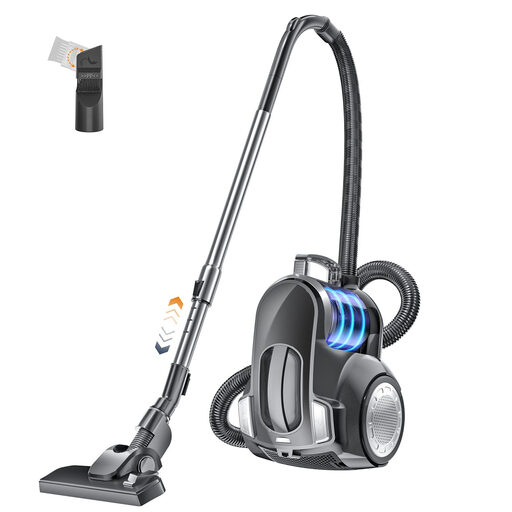 No image available
This model is suited to shoppers looking to avoid dust bags. Check separately whether the included tools can reach behind your chairs.
The product name lists 1200 W, a 2,5 l dust container and a 5,5 m cord. It’s described as suitable for hard floors and carpets. The name also describes the model as quiet; only compare noise levels when they’re stated for the exact models.
A crevice tool is designed for tight spaces. Before buying, check that it’s included with the exact model and can reach behind your chair when attached to the hose.
You don’t need a permanent installation for ordinary vacuuming. Follow the instructions for attaching the tools and maintaining the dust bag, dust container and filters. The Consumers’ Association recommends cleaning or replacing filters in good time to maintain suction power. Don’t use an ordinary household vacuum cleaner to pick up liquids or building dust.
No. With a bagged model, you’ll need to replace the bags with the right type. Filters also need maintenance or replacing in line with the model’s instructions. A bagless model avoids the cost of dust bags, but you’ll still need to empty and maintain the appliance.
For online purchases, you’ll usually have 14 days from delivery to change your mind, according to the Dutch government. You also have statutory rights if there’s a problem with a product, and the seller is your point of contact. An extended commercial warranty doesn’t replace those statutory rights.
When you buy a new, similar appliance, the shop must take back your old one under the Dutch old-for-new scheme, according to the Dutch government.