
If you mainly want to reach corners
You want to tackle cobwebs around skirting boards and in low corners. The included crevice tool and how easy the hose and tube are to handle are important considerations.


To remove cobwebs from low corners, start with a suitable crevice tool. A soft brush can also help with delicate skirting boards. According to the Consumentenbond, a dust bag limits contact with collected dust when you empty the vacuum, while a bagless dust container needs to be emptied and maintained. Also check that the floor head and operating radius suit the rest of your home.
You want to tackle cobwebs around skirting boards and in low corners. The included crevice tool and how easy the hose and tube are to handle are important considerations.
You want to have as little contact as possible with dust when emptying the vacuum after cleaning. So pay attention to the dust collection system and how the filters need to be maintained.
You remove cobwebs and then clean the floors too. The operating radius, floor head and ongoing maintenance all matter when choosing a vacuum cleaner.
Start with the tool for corners, then weigh up the dust collection system, and finally check that the floor head and operating radius suit your everyday cleaning.
| What to consider | What should you look for? | Who is this important for? |
|---|---|---|
| Narrow, low corners | Check whether a crevice tool is included and whether the tube and hose can reach the corner you have in mind. | I want to remove cobwebs around skirting boards and in tight corners; around 42% of consumers put corner reach first. |
| Contact with dust when emptying | Compare emptying a dust container with throwing away a dust bag, and check the filter maintenance requirements too. | If I want to limit contact with dust when emptying the vacuum, the dust collection system is a key consideration; around 25% of consumers rank this as their top priority when choosing. |
| Cleaning floors too | Check that the floor head suits your floor type and look at the stated operating radius for the exact model. | After cleaning corners, I also want to vacuum my floors; around 17% of consumers prioritise this all-round usefulness. |
| Replacing bags and maintenance | Check which dust bags or filters are compatible with the model and what the manual says about replacing or cleaning them. | I want to avoid having to buy dust bags regularly, and I’m happy to take emptying and maintaining a dust container into account; around 16% of consumers put this first. |
A floor head designed for larger areas won’t necessarily reach narrow corners. AEG specifically describes a crevice tool for tight gaps.
Check what’s included with the exact version and whether a separate attachment will fit the tube or hose.
If the right attachment isn’t included, you may need to buy one separately.
According to the Consumentenbond, it’s harder to avoid contact with dust when emptying a bagless container than when throwing away a dust bag.
If avoiding contact with dust is important to you, take the emptying process into account.
Higher electrical power doesn’t prove how well filters trap dust. The Consumentenbond also highlights the quality and fit of the filters.
Check the information on filter maintenance and dust emissions for the exact model; don’t rely on wattage or the name of a filter alone.
The Serie 4 BGB41HYG1H is a bagged cylinder vacuum cleaner with an integrated crevice tool and upholstery nozzle.
The Guard S1 Obsidian Black is a compact model with a dust bag, crevice brush and adjustable tube.
The PowerPro Compact FC9330/09 is a bagless model with an integrated brush for furniture and flat surfaces.
The 6000 AB61C1OKO is a bagged cylinder vacuum cleaner that AEG lists with a crevice tool and upholstery nozzle.
The Compact Power Cyclonic RO3731EA is a bagless option.
This selection includes bagless cylinder vacuum cleaners with a crevice tool, as well as a bagged cylinder vacuum cleaner for low corners and everyday floor cleaning.
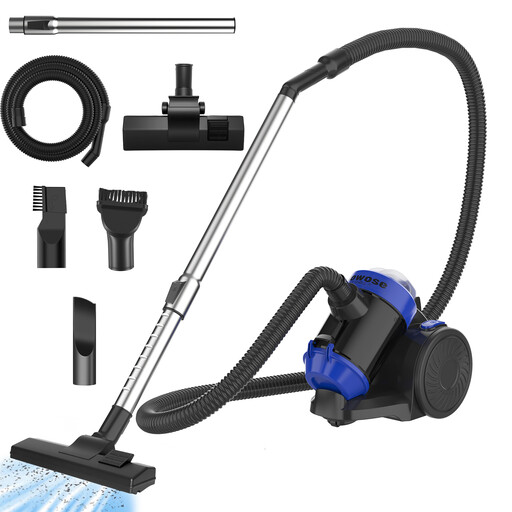 Image unavailable
The product description mentions an integrated 2-in-1 crevice tool for hard-to-reach places, as well as use on hard floors and carpets.
The product information lists a power rating of 1200 W and a 2,5 l dust container.
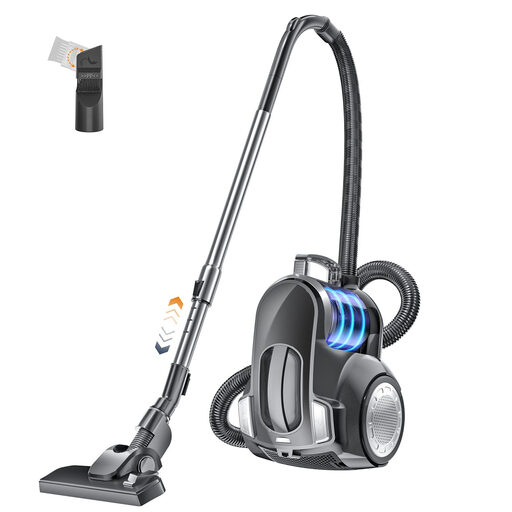 Image unavailable
The product description mentions an integrated crevice tool for corners and under furniture, as well as use on hard floors and carpets.
The product information lists a 2,5 l dust container and a 5,5 m cord.
 Image unavailable
This bagged cylinder vacuum cleaner is described as having a flexible XL crevice tool for tight spaces. The dust bag may be a good choice if you want to limit contact with dust when emptying the vacuum.
The product information lists a 3,5 l dust bag capacity, a 10 m operating radius, an adjustable telescopic tube and a Parquet Twister floor head.
For a narrow corner, start with a crevice tool. A soft dusting brush may be more suitable for dust on a delicate skirting board; check whether your chosen version includes both attachments.
A bagged vacuum cleaner is a good choice if you want little contact with collected dust when emptying it; a bagless model means you won’t need to buy dust bags. According to the Consumentenbond, it’s harder to avoid contact with dust when emptying a bagless container, while dust bags need to be replaced regularly.
You need to empty the dust container and maintain the filters according to the manual for the exact model. Before use, also check that the chosen tool fits the tube or hose.
No. Power consumption alone doesn’t prove how well a vacuum cleaner cleans. If dust emissions are important to you, also check the filter information and maintenance guidance for the exact version.
No. The European Commission states that the energy labelling rules for vacuum cleaners under Delegated Regulation (EU) 665/2013 have been annulled, and these products no longer carry an energy label.