
Cleaning beneath low furniture
You want to reach dust beneath a low shelf after being away. The shape of the floor head and tube, and the room they have to move, are key.


Start by checking the clearance beneath the shelf: the floor head, tube and hose need to move underneath at the right angle. Then choose a brush that suits your floor and decide whether you’d rather empty a dust container or replace a bag. A higher wattage doesn’t, by itself, mean better cleaning, and you can’t tell whether a particular model will fit without measuring your shelf.
You want to reach dust beneath a low shelf after being away. The shape of the floor head and tube, and the room they have to move, are key.
You want to remove dust beneath furniture with a floor head that suits your hard floor, without letting reach dictate your choice of floor head.
You’re thinking about how dust is collected and how to maintain the bag or container and filters. Check filter claims for each model.
| What to consider | What should you check? | Who should pay particular attention? |
|---|---|---|
| Reach beneath the shelf | Measure the clearance and depth, then check the dimensions, range of movement and accessories supplied with the exact model. | If I want to clear dust beneath a low shelf after a weekend away, the floor head and tube need to reach it at the right angle. Around 40% of consumers say reach beneath shelves is their top priority. |
| Floor head for your flooring | Check your floor type and which brush comes with the model. | For delicate hard floors, I want to choose a suitable brush, even if another floor head offers greater reach. Around 30% of consumers put choosing the right floor brush first. |
| Dust collection and maintenance | Compare how you empty the dust container or replace the bag, and check what filter maintenance the manual recommends. | If I’d rather collect dust in a bag or empty a container, that’s something I’ll factor into my choice. Around 20% of consumers prioritise how dust is collected and the maintenance involved. |
| Ongoing costs | Check which bags, filters or other consumables fit the exact model, and compare costs on a like-for-like basis. | If I want to factor in recurring costs, I’ll check which parts I might need later. Around 10% of consumers make running costs their top priority. |
A higher power consumption doesn’t automatically mean a vacuum cleaner will clean better. The European Commission makes the same distinction in its guidance on vacuum cleaners.
Compare the floor head, reach and relevant cleaning reviews rather than looking only at motor power.
A parquet brush tells you which type of flooring the floor head is designed for, but not how much clearance it needs.
Measure the gap beneath the shelf and check whether the exact model also comes with a suitable narrow attachment.
A dust container still needs emptying, and the filters need to be maintained as set out in the manual.
Compare emptying and filter maintenance with replacing bags, and check which parts fit the model.
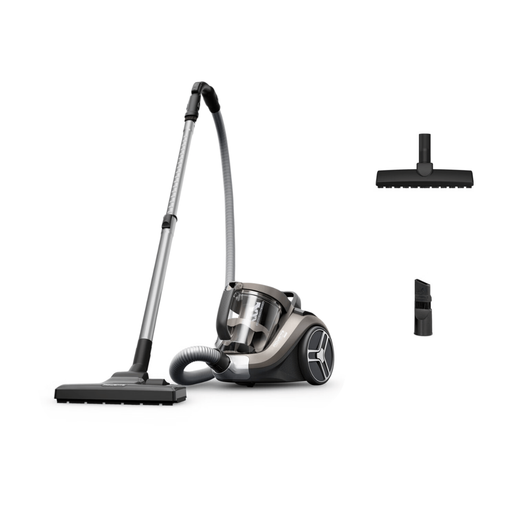
The Compact Power XXL RO4B30 is an example of a bagless model with a dust container, parquet brush and 2-in-1 crevice tool.
The PowerPro Compact FC9332/09 is an example of a bagless cylinder vacuum cleaner with a TriActive nozzle.
The BGB7X420 is an example of a bagged vacuum cleaner whose operating radius and model-specific filter information you can compare.
The Complete C3 Parquet Flex is an example of a bagged vacuum cleaner that comes with a parquet brush.
These cylinder vacuum cleaners have floor heads or dust collection features that may be useful when cleaning beneath shelves. Measure the gap and check which attachments come with the exact model before choosing.
 No image available
The 2-in-1 crevice tool may be useful in narrow spaces; check whether the nozzle and tube fit beneath your shelf.
The product information lists a 9-metre operating radius, a multi-purpose nozzle with settings for hard floors and carpets, a furniture nozzle and S-Bags. The bag needs replacing when it’s full.
 No image available
The crevice tool may come in handy for narrow gaps, while the parquet brush is designed for hard floors; check that it fits beneath your shelf.
Rowenta lists a 2.5-litre dust container, an 8.80-metre operating radius, a parquet brush and a 2-in-1 crevice tool for this model. The dust container needs to be emptied.
 No image available
The crevice tool is designed for tight spaces; measure the gap and check whether the floor head can move beneath your shelf.
The product title lists a 750 W motor, a 3-litre dust bag and a metal telescopic tube. The product information also mentions a crevice tool and a standard brush with two settings. The bag needs replacing when it’s full.
 No image available
The flexible crevice tool may be useful for deep, narrow gaps; check the dimensions and movement beneath your shelf.
The product information lists a 10-metre operating radius, four suction power settings, a flexible XL crevice tool and a Parquet Twister floorhead. The dust bag has a capacity of 3.5 litres and needs replacing when it’s full.
That depends on the clearance and depth, the floor head and the angle of the tube. Measure the gap and compare it with the exact attachment; a crevice tool can reach edges that are too narrow for a wide floor head.
Empty the dust container or replace the bag, and clean or replace the filters when the manual recommends it. According to the European Commission, a dust container or bag that’s too full can reduce a vacuum cleaner’s performance.
The European Commission says that Regulation (EU) No 665/2013 on energy labelling for vacuum cleaners was annulled by the General Court of the European Union. Ecodesign requirements still apply to mains-powered vacuum cleaners within scope; since 2017, these include a maximum of 900 W, among other requirements. According to the Commission, higher power consumption doesn’t automatically mean better cleaning.
For many eligible distance purchases from a business, you have 14 days to change your mind. You’re also entitled to a product that’s fit for purpose; if the appliance is faulty, the seller must provide a remedy. Exactly how these rights apply depends on the specific purchase.