
Cleaning around chair legs
You want to clean around chair legs, skirting boards and narrow gaps without having to move lots of furniture. Check which tools are included and whether the tube and hose are easy to handle.


Choose a cylinder vacuum cleaner with a floorhead suited to your flooring and a narrow crevice tool for cleaning around chair legs; check that the accessory is included with the exact version you’re considering. Then compare the space needed for the complete set and the dust capacity: a compact machine may have a smaller dust bag, while a bagless model won’t need replacement bags but may expose you to more dust when you empty it.
You want to clean around chair legs, skirting boards and narrow gaps without having to move lots of furniture. Check which tools are included and whether the tube and hose are easy to handle.
You only have a small cupboard or corner for the machine, hose and tools. Compare the dimensions of the complete set and how it stores away.
You’re thinking about dust exposure when emptying the vacuum, as well as how well the complete machine contains dust—not just the name of its filter.
Start with the floorhead for your flooring, then check whether a crevice tool is included. Next, measure the space available for the complete set and decide whether you’d rather replace a dust bag or empty a dust container.
The percentages refer to consumers choosing a cylinder vacuum cleaner for this situation; each row shows their main buying concern.
| Buying concern | What to look for | Who is this most relevant to? |
|---|---|---|
| Reach around chair legs | Check that the exact version includes a narrow crevice tool, and that the tube and hose are comfortable to use in your dining area. | If you want to clean between chair legs and along edges without moving furniture, reach is a priority. Around 31% of consumers in this situation consider it their most important factor. |
| Storage | Measure the space available for the complete set and compare its dimensions and storage position; check the dust capacity separately. | If you only have a small cupboard or limited corner space, you’ll need to allow room for the machine, hose and tools. Around 25% of consumers in this situation put storage first. |
| Dust and emptying | Compare how the dust container is emptied, and assess the filters and dust emissions of the complete machine. The Consumentenbond notes that how well filters fit is important too. | If you want to limit dust exposure when emptying the vacuum and are concerned about dust escaping from the machine, dust containment is key. Around 19% of consumers in this situation choose it as their main consideration. |
| Noise | Only compare stated noise levels when they’re measured on the same basis; also consider the tools and how easy the vacuum is to handle. | If you’re mindful of other people in a compact home, the stated noise level may be a factor, although it doesn’t tell you anything about cleaning performance. Around 13% of consumers in this situation prioritise noise. |
| Maintenance | Check which dust bags, filters and replacement parts fit the exact model. Bagless doesn’t mean maintenance-free: you still need to empty the dust container. | If you want to factor in ongoing purchases and maintenance, consider both replacement bags and the work involved in emptying and maintaining a dust container. Around 12% of consumers in this situation put this first. |
The hose, tube and tools also take up storage space. A small body also doesn’t tell you how much dust the bag or container can hold.
Measure the space available for the complete set and compare the stated dust capacity of each model.
The narrow tools supplied can vary between versions, even within the same product range.
Check what’s in the box for the exact model before you buy.
The name of a filter alone doesn’t tell you how well it fits in the machine or how much dust the complete vacuum emits.
Assess how well the filter fits and the dust emissions of the complete vacuum, and consider dust exposure when emptying it too.
An additional package is not the same as the statutory protection you have if a product is faulty. The Dutch government states that there is no fixed statutory warranty period in the Netherlands, and that the retailer is your point of contact if there’s a problem with a product.
Check what an additional package covers and keep the retailer’s details.
The ST154RZA is an example of a compact bagged cylinder vacuum cleaner with accessories.
The Serie 2 BGBS2LB1 shows how the stated dimensions of the vacuum body and the bag capacity can be compared separately.
The PowerPro Compact FC9330/09 is a bagless model with a TriActive floorhead.
Miele says the Compact C2 Flex is designed for space-saving storage and uses a dust bag.
The 5000 AB51C1DB is a bagged vacuum cleaner with integrated tools.
These product picks are suited to cleaning around chair legs and weighing up dust capacity, tools and available storage space. Check which tools are included with each version and whether the set will fit where you plan to store it.
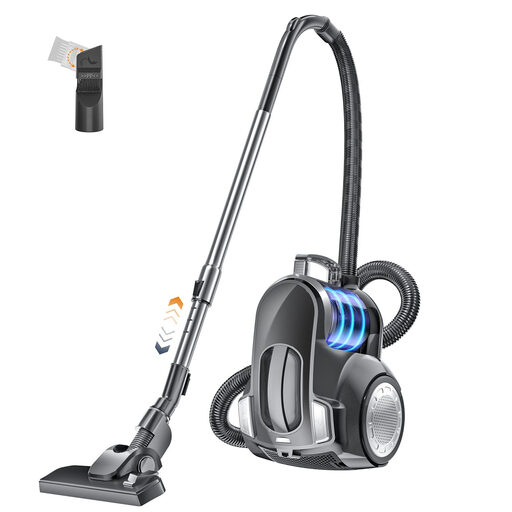 No image available
The product name mentions hard floors and carpet; check that the supplied floorhead and any crevice tool are suitable for your flooring and the space around chair legs.
The product name lists a 2.5-litre dust container and a 5.5-metre cable.
 No image available
The product information lists an XL crevice tool for narrow spaces and a Parquet Twister floorhead for hard floors; check that these tools suit your cleaning needs.
The product information lists a 3.5-litre dust bag, a 10-metre operating radius, a telescopic tube and 890 W of power. This model uses dust bags.
Use the floorhead where it fits and a suitable crevice tool for narrow spaces. Before buying, check whether it’s included with your version; Miele specifically lists one for the Classic C1 Flex and AEG for the AB51C1DB.
No. A filter name alone doesn’t tell you everything about the dust emissions of the complete vacuum cleaner. The Consumentenbond says that how well the filters fit in the machine also matters; replacing a dust bag may also expose you to less dust than emptying a dust container.
Use a dust bag that fits the model and follow the instructions for maintenance and filter replacement. Inventum warns in the ST154RZA manual that fine powders can reduce performance, even when the bag isn’t full.
No. The Dutch government says there is no fixed statutory warranty period in the Netherlands; what you can expect depends, among other things, on the product, its price and the information provided at the time of sale. If a product is faulty, the retailer is your point of contact.