
Cleaning in tight spaces
If you mainly clean around chair legs and along narrow edges, the shape of the floorhead and a suitable crevice tool are important considerations.


Start with the floorhead: it needs to fit between your chair legs, and a suitable crevice tool can help with narrow edges. Then compare the vacuum’s dimensions and weight with your storage space. Choose a bagged model if you want less direct contact with dust when disposing of it, or a bagless model if you’d rather not buy dust bags and don’t mind emptying the canister. Check which accessories are actually included with the version you’re considering.
If you mainly clean around chair legs and along narrow edges, the shape of the floorhead and a suitable crevice tool are important considerations.
The Consumers’ Association notes that a compact vacuum cleaner is easier to store and move around. Compare the dimensions of the model you’re considering with the cupboard or corner where you plan to keep it.
According to the Consumers’ Association, you come into less contact with dust when disposing of a full dust bag than when emptying a canister.
Start by checking the space around your chair legs, then make sure the vacuum is easy to store. Finally, decide whether a dust bag or a canister is right for you.
| What to consider | What should you check? | Who is this important for? |
|---|---|---|
| Space around chair legs | Compare the width and manoeuvrability of the included floorhead with the available space. Also check whether a crevice tool is included. | If the floorhead doesn’t fit between my chair legs, a compact body only helps so much; around 36% of consumers prioritise reaching around chair legs and along narrow edges. |
| Storage and manoeuvrability | Measure your storage space and compare it with the dimensions and weight of the exact model. | I want to put the vacuum away in a small cupboard after use and move it around easily; around 29% of consumers prioritise storage and manoeuvrability. |
| Disposing of dust | Choose between a dust bag and a canister. If you’re considering a bagged model, check which type of bag it takes. | I want less direct contact with dust when emptying the vacuum, or I’d rather not buy replacement dust bags; around 21% of consumers consider dust collection their main priority. |
| Noise | Compare the stated noise level of each exact model with its dimensions and included floorheads and accessories. | If I vacuum while other people are at home, the stated noise level matters, but I don’t want to lose sight of storage space; around 14% of consumers prioritise noise. |
A vacuum cleaner may be easy to store, but its floorhead could still be awkward to use between chair legs.
Check the body, floorhead and included crevice tool separately.
A canister needs to be emptied regularly. According to the Consumers’ Association, you come into less contact with dust when disposing of a dust bag; with a bagless model, dust may escape when you empty it.
Choose the emptying method that suits you, and take the Consumers’ Association’s advice into account if you have a dust allergy.
With a bagged model, you’ll need to replace the dust bags with the correct type. A bagless model needs regular attention when it comes to emptying the canister.
The European Commission states that the former EU energy-labelling scheme for vacuum cleaners no longer applies. The ecodesign power limit is not a ranking of cleaning performance.
Compare the floorheads and relevant test results for the type of flooring you want to clean. Don’t judge cleaning results on power alone.
Miele describes the Guard S1 Parquet Flex as a compact, bagged cylinder vacuum cleaner for hard floors.
The AEG VX6-2-IW-5 is a bagged model which, according to the manufacturer, features 360° Motion wheels.
The PowerPro Compact FC9332/09 is a bagless cylinder vacuum cleaner for anyone who’d rather not replace dust bags.
The Silence Force RO7457 is a bagged model for anyone who prioritises low noise over the smallest possible body.
The Serie 4 BGL41POW2H is a bagged model with accessories for narrow spaces and furniture.
This selection includes bagged cylinder vacuum cleaners described as compact, including models with nozzles for narrow edges. Check the CE marking on the product itself; according to the Government of the Netherlands, electrical appliances sold on the EU market must meet the applicable CE requirements. For vacuum cleaners covered by ecodesign rules, the European Commission has set a maximum rated input power of 900 W since 2017. Check whether those rules apply to the exact model.
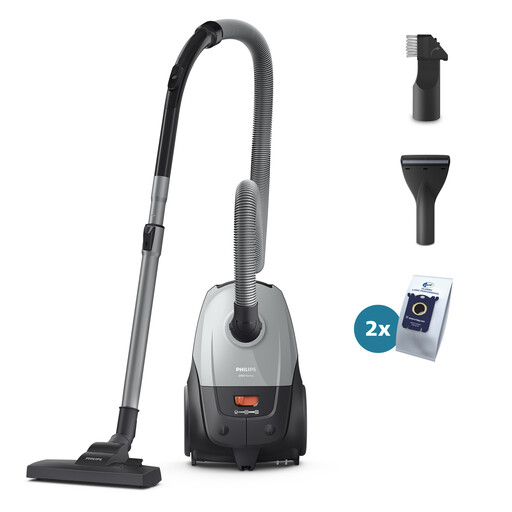 No image available
This compact, lightweight bagged model could suit you if you want to clean around chair legs and have less direct contact with dust when disposing of it.
The product information lists an integrated 2-in-1 crevice tool, a multi-purpose nozzle, 800 W and a 9 m operating radius. Check that the included nozzles suit your flooring and fit between your chair legs.
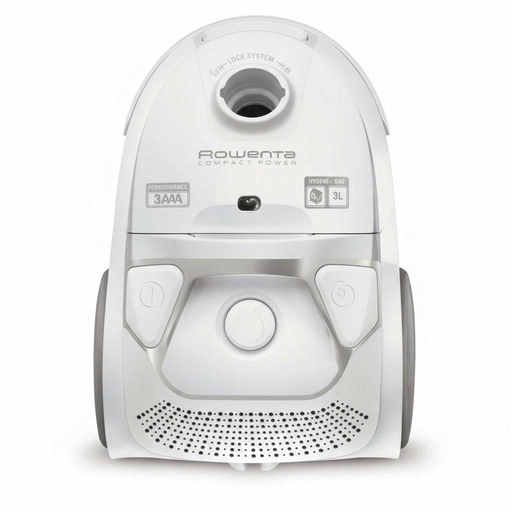 No image available
This compact, bagged cylinder vacuum cleaner could suit you if you want to use a crevice tool along narrow edges and would rather replace a dust bag than empty a canister.
The product information lists a crevice tool, a 3 L dust bag, 750 W of power and a telescopic metal tube. Check the package contents of the model you choose.
 No image available
This bagged model could suit you if you want to clean hard floors and narrow edges without having to empty a canister when disposing of dust.
The product information lists a Parquet Twister brush, a flexible XL crevice tool, a 3,5 L dust bag, 890 W and a 10 m operating radius. Check that the floor brush suits your flooring and fits into the space between your chair legs.
Use the floorhead if it can move freely, and a suitable crevice tool for narrow edges. Check in advance that the tool is included with the exact model and that the floorhead fits between your chair legs.
With a bagged model, you dispose of the full bag with its contents and replace it with the correct type. With a bagless model, you don’t need to buy dust bags, but you do need to empty the canister regularly; according to the Consumers’ Association, this is an important consideration if you have a dust allergy.
According to ACM ConsuWijzer, online purchases generally come with a statutory cooling-off period of up to 14 days after delivery. This is separate from your statutory guarantee: if the product breaks sooner than you could reasonably expect under normal use, the seller must offer an appropriate solution at no cost.
No. According to the European Commission, the former EU energy-labelling scheme for vacuum cleaners no longer applies. Since 2017, vacuum cleaners covered by ecodesign rules have been subject to a maximum rated input power of 900 W; first check whether those rules apply to the exact model. The Government of the Netherlands also states that electrical appliances sold on the EU market must meet the applicable CE requirements.