First, measure the distance from the projector lens to the wall and the available width for the image. If you only have room for a unit close to the wall, compare ultra-short-throw models; if there’s space further back, a short-throw model could also work. For daytime races, you’ll also need to consider ambient light, your screen and a working live source: a brightness rating or built-in app alone won’t guarantee a suitable picture.
Who is this setup for?
Viewer with limited projection space
Don’t want a projector between your seats and the wall? Measure the lens position, available furniture space and desired image size before comparing ultra-short-throw and short-throw models. BenQ Netherlands explains how projection distance and image size are linked.
Viewer who watches during the day
If you can’t always darken the living room while the race is on, assess the ambient light, projector and screen as one complete setup. Epson Netherlands explains how screens can help block ambient light.
Viewer who wants to stream live
If you want to watch the race through an app, check that it’s available on the exact device and in your region. BenQ Netherlands notes that app availability can vary by region and settings.
What should you look for when buying?
Choosing a projector for this setup starts with where it will go. Then assess the daylight and the source you’ll use to watch your race.
| What to consider |
What should you check? |
Who should pay extra attention? |
| Projection distance and placement |
Measure the distance from the lens to the wall and the available image width. Compare these with the distance and image size specified for the exact model. |
If there’s no room for a projector in the middle of my narrow room, it needs to fit close to the wall; around 36% of consumers make this their first requirement. |
| Daytime visibility |
Assess how much light falls on the projection surface. Only compare brightness ratings when they use the same measurement basis, and check that the screen suits your setup. |
If I can’t darken the room properly during the race, I want to match the projector and screen to the ambient light; around 29% of consumers prioritise this choice for daylight viewing. |
| Live source and race picture |
Check that the specific race and app are available on the device, or see whether you can use an HDMI source. Also assess the image size from your seat. |
If I want to watch the race live, the broadcast needs to play properly and the picture needs to be clear from my seat; around 21% of consumers start with this combination. |
| Sound and complete setup |
Check which speakers, connections and image sources are included, and what else you’ll need for your intended use. |
If you’d rather connect fewer separate devices, weigh up the built-in sound and the source you need together; around 14% of consumers prioritise a simple, complete setup. |
Common pitfalls
-
Focusing only on the maximum image size
A stated maximum screen diagonal doesn’t tell you whether the required distance and image width will work in your living room.
Measure where you plan to position the lens and furniture, then check the distance required for your preferred image size on the exact model.
-
Comparing brightness ratings based on different measurements
Optoma lists both 650 lumens of image brightness and 1,200 ‘Brightness (HK)’ for the Photon Go. Don’t treat these different figures as if they were directly comparable measurements.
Only compare brightness ratings when they use the same measurement basis, and factor in daylight and your chosen screen too.
-
Assuming a TV platform will show every live race
App availability can vary by region and device settings.
Check that the race and app are available on the exact device. If necessary, see whether you can use an external source via HDMI.
-
Choosing a portable projector without planning for power
Optoma quotes a battery life of up to 1.5 hours for the Photon Go; ‘up to’ doesn’t guarantee that the battery will last for your entire broadcast.
Check whether mains power is available where you plan to watch, and don’t base your decision on the maximum battery life alone.
Brands to consider for this setup
Epson
The EH-LS670W is an example of a fixed ultra-short-throw setup with Google TV and built-in sound.
- Epson quotes 3,600 lumens and an image size of up to 120 inches for this model.
- The setup and daytime picture depend on the room and projection surface; manufacturer specifications alone can’t predict the result.
BenQ
The TK710STi is an example of a short-throw model for a room with enough space for the required distance.
- BenQ quotes 3,200 lm, HDMI inputs and an included Android TV dongle.
- Check the distance needed for your preferred image size and whether your live-streaming app is available. The quoted low input lag applies to gaming signals.
Optoma
The Photon Go is a portable ultra-short-throw model with Google TV; the product specifications quoted are for the European version.
- Optoma quotes a 0.18:1 projection ratio, Full HD and a battery life of up to 1.5 hours.
- The specifications distinguish between 650 lumens of image brightness and 1,200 ‘Brightness (HK)’. These figures aren’t like-for-like; the European specification doesn’t confirm every version available in the Netherlands.
Samsung
The Premiere 7 SP-LPU7DSAXXXE is an example of an ultra-short-throw model with Tizen OS and built-in sound.
- Samsung quotes 30 W 2.2-channel speakers for this specific model.
- Check that the built-in features and connections suit your live source and viewing setup.
Joybuy products
These Joybuy products include portable ultra-short-throw and short-throw options to consider for a narrow living room; check the required distance and live source for each model.
 No image available
Optoma Photon Go
Ultra-short-throw projection and an HDMI input make this model worth considering if space is limited and you want to connect an external live source.
Full HD 1920 × 1080; native aspect ratio 16:9; 650 lumens of image brightness; HDMI 2.0; projection ratio 0.18:1 and quoted projection distance of 0.26–0.4 m.
The specifications also list 1,200 ‘Brightness (HK)’; don’t compare this directly with the 650 lumens of image brightness.
Joybuy
 No image available
BenQ MW809STH
This short-throw projector is worth considering if your room has space for the distance required to achieve your preferred image size.
3,600 ANSI lumens; DLP; XGA 1024 × 768; aspect ratio 4:3; HDMI input; projection ratio 0.49.
The quoted XGA resolution is 1024 × 768 with a 4:3 aspect ratio; check that it suits the picture you want for the broadcast.
Joybuy
 No image available
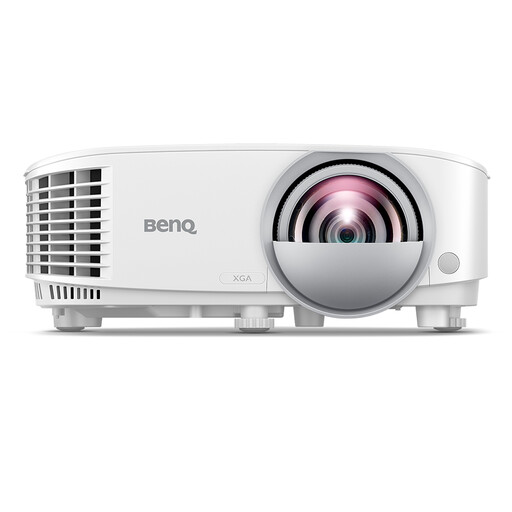
BenQ MX825STH
This short-throw model is worth considering if you can leave enough room for the distance required to achieve your preferred image size.
3,500 ANSI lumens; DLP; XGA 1024 × 768; aspect ratio 4:3; projection ratio 0.61; two HDMI ports; 10 W built-in speaker.
The quoted XGA resolution is 1024 × 768 with a 4:3 aspect ratio; consider how this specification suits the way you want to watch the race.
Joybuy
 No image available
Epson EB-1780W
This short-throw option is worth considering if you can make space for the projector and the required distance.
3,000 ANSI lumens; 3LCD; WXGA 1280 × 800; HDMI port; automatic vertical and horizontal keystone correction; carry case included.
Joybuy
Frequently asked questions
How do I know if the image will fit on my wall?
Measure the available image width and the distance between the planned lens position and the wall. Then check the distance required for your preferred image size on the exact model; don’t rely on the term ‘short-throw’ alone.
Do I always need a special screen to watch a race during the day?
Not necessarily: start by assessing how much light falls on the wall or screen. Epson says a suitable screen that blocks ambient light can improve contrast in a bright room; check that it works with your projection setup.
Can any projector with Google TV show my cycling race live?
No. First check that the specific broadcast and app are available on the device. BenQ says app availability can vary by region and settings; an external HDMI source may be an alternative if the model has the connection you need.
What can I do if the projector doesn’t fit in my room or breaks down early?
For online purchases in the Netherlands, you’ll usually have a 14-day cooling-off period under ACM ConsuWijzer rules. You’re also covered by the statutory guarantee: a product must work properly under normal use for as long as you could reasonably expect. The retailer is your point of contact for a claim under this guarantee.
What product regulations apply to projectors in the Netherlands?
Applicable European rules apply to electrical and electronic equipment placed on the market in the Netherlands. The manufacturer must affix the required CE marking and draw up an EU declaration of conformity; equipment with Wi-Fi or Bluetooth may also be subject to radio equipment regulations. Check the documentation for the specific unit.


